
Silence and semi-darkness inside the market hall. Only the moon strolls among the empty stands, with a shopping basket on its arm.
Faint lights on the counters and their retractable shutters. Loose apples and cabbages hiding under them.
The building is somber, surrounded by dark houses. The windows—illuminated squares.
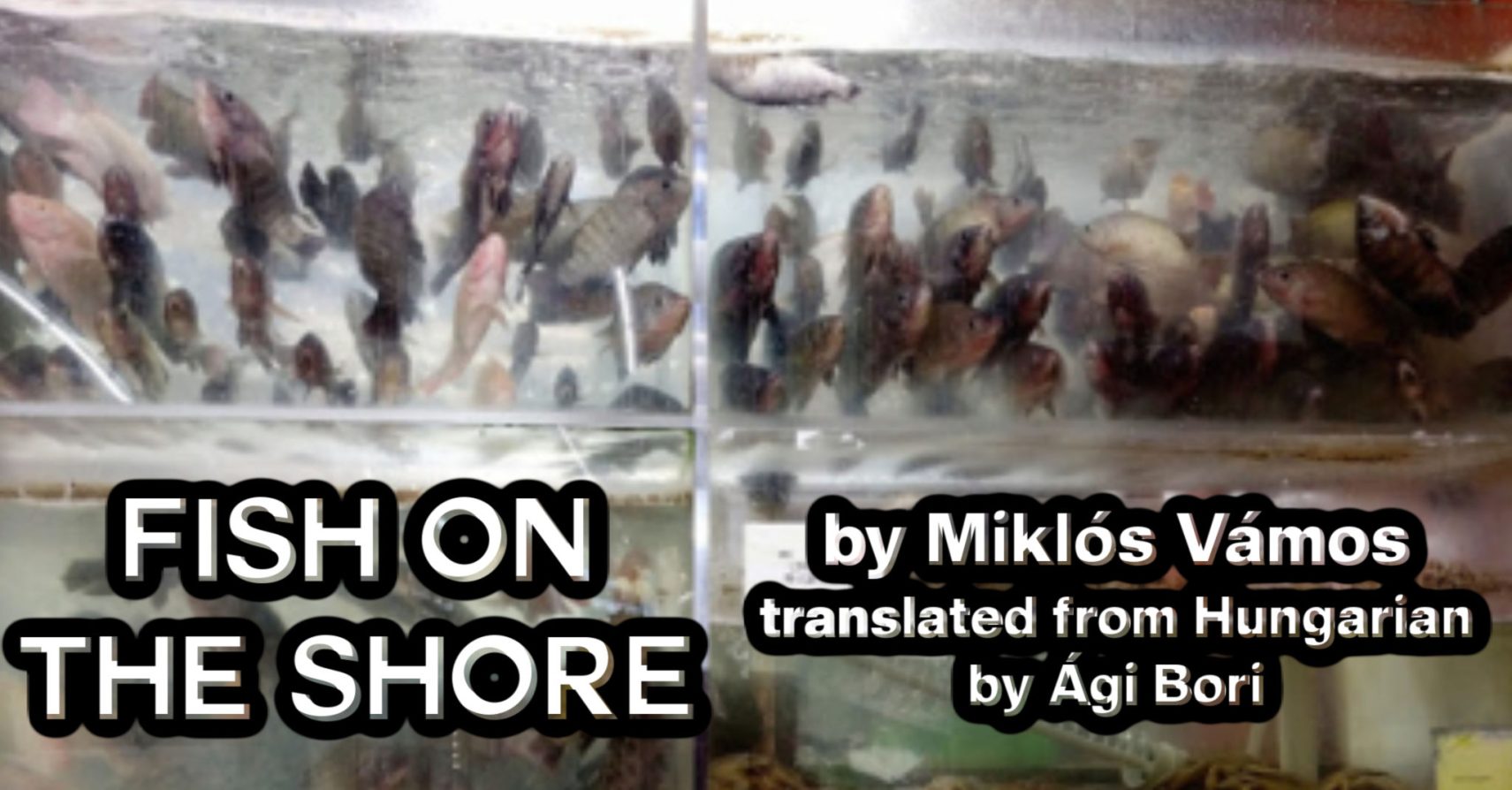
There is not a single soul around at the market at this time but the fish in the aquarium. This is their time. Tubes carry whirring air under the water along the sidewalls.
There is a lot of jostling for room. The stronger ones swim up to the edge of the aquarium, battling for their already hard-fought positions. Those at the bottom struggle to rise, sometimes singing soft, plaintive songs.
Who would have thought that fish could talk? If someone were to put their ears to the aquarium walls now, they could catch them in the act. But who comes here in the dead of night?
Space is scarce. Only the older carps reach the water surface, at the cost of pushing and shoving.
“We’re going to have a warm night!” announced the old carp with a tuft of tentacle-like appendages on his head. He steered himself with his pectoral fins. Others occasionally shoved him, knocking him off balance. He didn’t care; he was used to it. He turned toward the direction of the tube blowing the air bubbles.
“Move over!” An argument down below. “You’re always on top of me!”
“Someone’s pushing me, too!”
“Be quiet!”
Undulating gills.
“You can’t fall asleep either?” the spot-backed carp asked the old carp with a tuft of tentacle-like appendages on his head.
He waved a flat no.
“Get this,” the spot-backed carp moved his mouth, “did you know that this afternoon Potya got out, too?”
“Potya? The one with yellow eyes?”
“Yup. The two-legged fish put the net in and moved it around until they managed to get Potya out.”
The old carp with a tuft of tentacle-like appendages on his head said nothing in reply. A little later:
“Lucky devil.”
“Supposedly,” a younger carp said, “they’ll take everyone out tomorrow.”
“Supposedly,” nodded the old carp with a tuft of tentacle-like appendages on his head.
A middle-aged, slightly graying fish swam closer:
“Do you know something?”
The old carp with a tuft of tentacle-like appendages shook his head:
“I only know that there’s not enough space. Or oxygen. And we’ll have less every day.
“It won’t be long!” the younger carp said.
“What do you mean?”
“We’ll get out!”
“Right!” The old carp with a tuft of tentacle-like appendages on his head seemed angry. “I’ve been here for two weeks, and who knows how much longer I’ll stay. I know what’s going on here. Those who are lucky, or at least have good connections, get taken out. The rest stay.”
It became quiet.
“Dear Lord!” the middle-aged carp said. “If only I could get out!”
“Don’t hold your breath!” The old carp with a tuft of tentacle-like appendages on his head kept nodding.
“Maybe tomorrow. Tomorrow I might be able to position myself near the net.”
“Not tomorrow.”
“Why not?”
“Because tomorrow is Sunday.”
“So what?”
“The two-legged fish don’t come on Sundays.”
“What makes you say that?” The middle-aged carp made a nervous gesture. “It’s been dark five times since I got here, and so far, they’ve come every day.”
The old carp waved dismissively.
“You’ll see.”
The spot-backed carp let out a sigh. He looked up dreamily.
“Dear Lord!” The middle-aged carp looked up, too. “What life must be like out there! Among the two-legged fish! Sunshine, oxygen-rich air, lots of space. No shoving and pushing, everyone can go where they want, when they want, without bumping into invisible walls, like here.
“That’s right!” the old carp with a tuft of tentacle-like appendages on his head said calmly.
“Maybe tomorrow!” The middle-aged carp hurried to the opening of the tube, but others pushed him aside.
“Or the day after tomorrow!” the younger carp said.
“Or not.” The old one with a tuft of tentacle-like appendages on his head retreated and carped: “I wish I could at least get some sleep!”
“Out there!” the spot-backed carp said, shaking his head. This sounded so sad that nobody replied.”
“I’ve been out there once already,” chimed in a small gray carp from down below.
“Oh, come on!” The middle-aged carp looked at him in disbelief.
“It’s true!”
All eyes were on the gray carp now.
“When?” they asked, as if they were interrogating him.
“Yesterday,” the gray carp said. “When Potya made it out, I also swam into the net.”
“Did they take you out?”
“They did.”
“Then why are you still here?”
A short silence.
“They threw me back.”
They all stared at him in disbelief.
“And what was it like?”
“Well…strange.”
“How so?” the younger carp nagged him impatiently. “Tell us more!”
“Well, when we rose above the water, Potya was lying on top of me, so I couldn’t see anything. Then they threw us down somewhere. I hit my back and lost consciousness. When I came to, three two-legged fish were leaning over me. Potya was lying next to me, gaping spasmodically with happiness. My heart was pounding so fast that I almost suffocated, too.
“And then? What happened next?”
“A two-legged fish grabbed me by my tail and threw me back. I crashed into the invisible wall from the momentum. A lot of my scales came off. Look!”
“They looked.”
“And?”
The gray carp shrugged.
The middle-aged carp seemed dissatisfied:
“Didn’t you feel some sort of grand liberation while you were out? Happiness beyond the water?”
The gray carp thought for a moment. He stared ahead hesitantly:
“Well…”
“Don’t duck the question! Tell us!”
“Fine… I was suffocating out there… I don’t know. I was clearly happy when I got back in the water. Believe me, this is strange for me, too—he went silent. Then he quickly added: “Perhaps because I really hit my lower back.”
They were silent. Then the spot-backed carp:
“I don’t believe it.”
“What?”
“That you were out there.”
Then the middle-aged carp, feeling emboldened:
“Of course not! I suspected right away! He’s full of hot air!”
“But please…” the gray carp opened his gills from the shock. “Why would I lie?”
“Only you know why. One thing is for sure. You’re not telling the truth. Who saw you out there? Name your witnesses!”
“Excuse me, but…”
“The witnesses, sir, the witnesses!”
“Name them!” demanded the middle-aged carp, too. “Who saw you? Now you’re quiet, aren’t you?”
“Oh, please, I had bigger fish to fry than watching who was looking my way,” the gray carp explained angrily. But nobody paid attention to him.
“Ha! Like he really was out there!”
“Come on,” said the spot-backed carp with a dismissive wave. “Everyone knows that there’s one hundredfold more air out there than down here. Enough oxygen for everyone, endless space, no pushing and shoving or disagreements. And he has the nerve to say that…”
“He hurt his lower back, right?!” the middle-aged carp said bitterly.
“If only they would lift me out!” The spot-backed carp’s tail fin shook from excitement. “If only I could get out of here!”
“Out there!” The younger carp shook his head sadly. They all had the same thought, which put them in a bad mood.
Down below another argument broke out:
“Get away from here! Give me some space!”
“Air!” someone said pleadingly.
On the water surface, the old carp with a tuft of tentacle-like appendages on his head yawned. He closed his eyes.
“Finally, it’s getting cooler,” the spot-backed carp said. Then it slowly became quiet. (Except for the monotonous, metallic noises of the oxygen tubes.)