
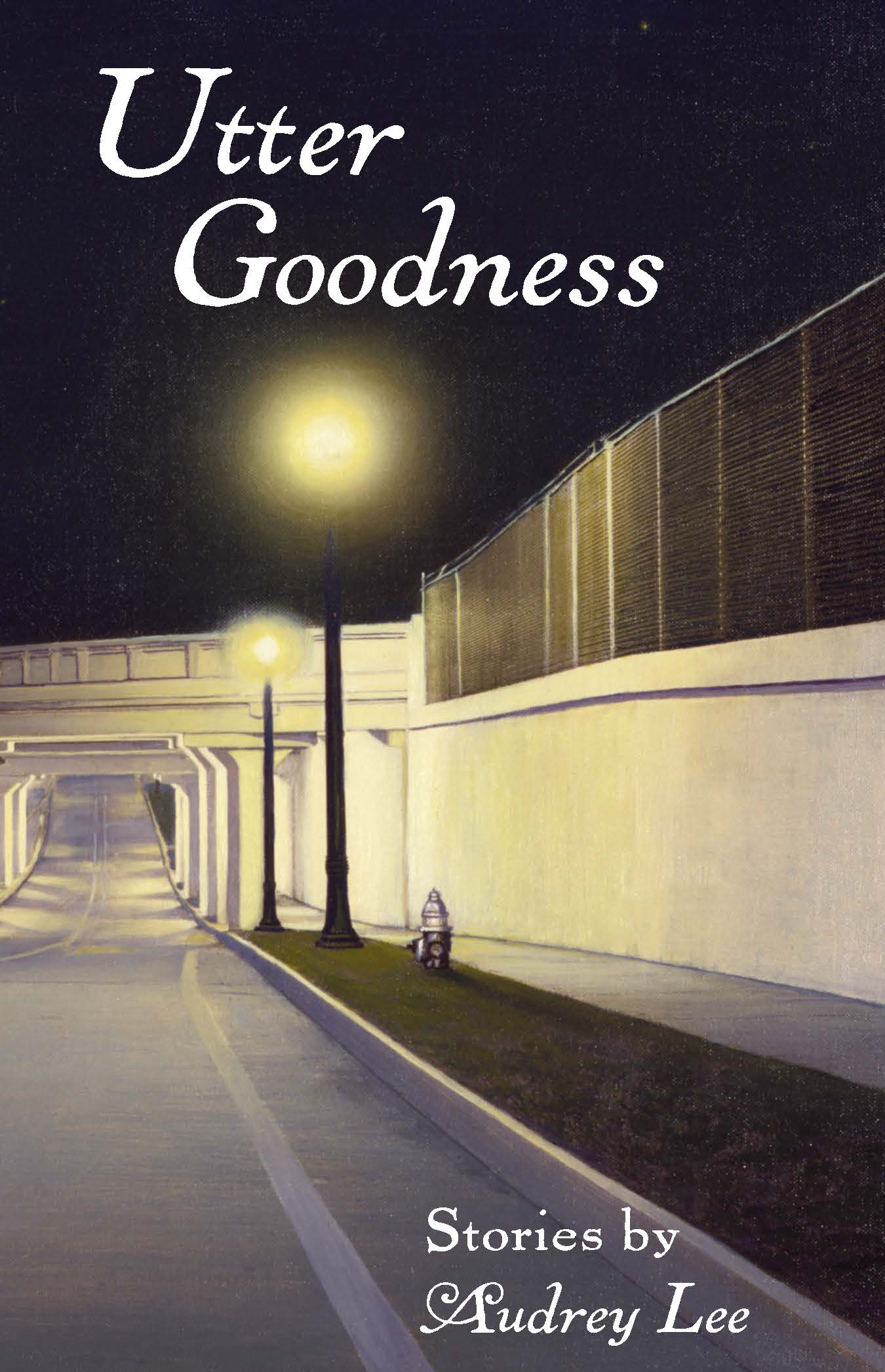
 Audrey Lee’s Utter Goodness (Farthest Heaven, 2026) is a collection of ambitious range. The stories traverse American landscapes from Malibu to small-town Idaho, ventriloquizing fearlessly across gender, class, and generation. Lee, who has previously published two poetry collections, has made a decisive turn toward fiction, trading the mirror of confessional poetry for what she calls the “larger container” of the short story. The result is a book concerned with judgment and redemption, with “spiritual holes” and the dubious ways Americans try to fill them. What follows is our conversation about genre, place, absurdity, faith, and inspiration.
Stephanie Yue Duhem: I’m intrigued by your move from poetry to fiction with Utter Goodness. Your previous collections are both poetry, but you’ve clearly been writing fiction for a while. Can you walk me through your timeline as a writer? When did you first start writing poetry versus fiction? Have you gone through phases where you focused on one over the other, or do you tend to work on both simultaneously?
Audrey Lee: I have always been “a writer.” I was a voracious reader as a kid and was always writing stories–mostly knockoffs of what I was reading, which was a lot of children’s and YA genre fiction. For some deep Audrey lore, I self-published a novel on Kindle-on-Demand when I was 11. (If you dig enough, you can still find it on Amazon. It contains very cancel-worthy material.)
I started publishing my work in high school after taking a poetry class. In short, I was always on a path to go to college for creative writing; this was mostly self-determined, but with the help of my teachers and approval of my parents. This was around the time that a consortium of teen writers was connecting online, mostly on Twitter, and starting magazines, applying to writing programs, and preparing portfolios for college. The “holy trinity” of being in the “teen writer scene” in 2016-2018 was to go to the Iowa Young Writers’ Studio, the Adroit Journal’s Summer Mentorship program, and YoungArts (I did one of these). Twitter is where I started making connections with other writers, finding publishers, and promoting my writing, and I’ve been on it ever since.
At the time, I was writing almost exclusively poetry. This continued early into my college career. I shifted into writing fiction (or, back into writing fiction–it’s all I wrote until about junior year of high school) by my sophomore year of college when I had to choose a genre track for my degree. I was getting frustrated with poetry. I found it to be incredibly internal, for the lack of a better word. I found my own confessional poetry to be self-flagellating, and I was uninspired by other subject matter (skill issue on my behalf). Writing poetry felt like staring at myself in a mirror for too long. This is a subjective assessment, but I think I am a better fiction writer than I am a poet! I am not a comparable poet to my better contemporaries, and I have always been a storyteller. I have many more stories in me than I do poems.
SYD: When writing stories as opposed to poems, do you find yourself drawn to different types of material, or thinking about voice and interiority in different ways? More broadly, what do you make of the popular poet-to-fiction-writer pipeline? Can you share any tips you’ve learned from moving between genres—any writerly gestures that don’t translate, habits you’ve had to switch up, or differences you see in the editing and publishing processes?
AL: I am generally in favor of the poet-to-fiction-writer pipeline. There isn’t a broad assessment that can be applied to it. The more cynical perspective would be that poets make bad fiction writers, which I don’t think is true at all. At the same time, fiction is as much of a practice as poetry is, so it takes practice to shift from poetry to fiction (and vice-versa).
I think I am less of a poet-to-fiction writer than I am a fiction writer-who-had-a-good-go-at-being-a-poet. Writing mostly poetry for several years, however, made me more acutely aware of sentence structure, concision, and revision in my fiction writing–very technical and careful skills that I think are much more emphasized in poetry than prose. Writing poetry has made me a better fiction writer on a granular level. Editors tend to have to rein in my wordiness; poetry has helped me improve at this.
Poetry, as I said, is a very “internal” genre to me. I am mostly fascinated with subject matter that is not myself, and fiction is the best way to explore this, especially given the “container” of fiction. A poem is a very small “container” to explore a subject within, while a short story is a larger “container,” and a novel might be the largest. I often want to write more than my “container” has space for.
SYD: The stories in Utter Goodness take place all over the map—from New York, Malibu, and Vegas to smaller towns in Idaho, Texas, Georgia, Utah, Iowa, and Indiana. As I read, I thought: Audrey has either moved around a lot or loves a good road trip. Can you speak to how you were able to write about these places so intimately? Also, you noted being an American Studies major on your website. Have your studies or research informed the way you think and write about place?
AL: I’ll start with the latter question. I am an American Studies major, and while my writing doesn’t directly pull from that major, I think it gave me a framework to approach “place”: why is this place the way it is? How has its economy, culture, faith, etc. shaped its way of life? Texas is not Texas without oil. Utah is not Utah without the Church of Jesus Christ of Latter Day Saints, or the ski bum transplants, and the cultural rift between these groups. None of these places exist in a vacuum, and none of the stories in Utter Goodness could either.
My life has been relatively stationary, actually! I grew up outside of Philadelphia, went to college an hour away in Lancaster, PA, and now live in South Philadelphia. I lived in Utah over the pandemic, in a very formative time of my life. I have traveled a lot, out of combinations of leisure, curiosity, and sheer necessity.
“Travel” evokes images of absconding from your home to “find yourself” Eat Pray Love-style, or Instagram posts from all-inclusive resorts in the tropics, neither of which describe my motivations for traveling, nor what I get out of travel. “Traveling” has limitations that make me hesitate at calling Utter Goodness a product of travel. Travel is an experience, not an accomplishment; its benefits are those of eating at a restaurant or going to a concert. I admittedly think I have a desperate desire to understand or “get to the bottom of” a place that I visit. This is always a desire unfulfilled, as there is no way to “understand” a place without living there, no matter how many local favorites you patronize and tourist traps you avoid. I try to avoid romanticizing travel, or projecting my own notions onto a place, because usually I am wrong. “Travel” is fun to tell stories about after you return home, but not necessarily a useful tool for “understanding” a place, people, or yourself.
This all being said: my travels have most influenced the stories in Utter Goodness, including the characters I encountered traveling. I would be lying if I further minimized the impact of driving across the country multiple times, taking trains coast-to-coast, and living here-and-there on my writing. Some places in Utter Goodness are based on real experience: the Kum ‘n’ Go gas station in Iowa City featured in “Goodbye, Burger City” really did exist on Columbia Drive, and I was not carded when I bought blue raspberry Four Lokos there when I was eighteen. It has since been bulldozed for a new apartment complex. “Yellowstone” features a gas station just across the Utah/Idaho border called CJ’s Chevron Closest Border. If I were to bleed out anywhere, it would be at that gas station as the sun barely began to rise over the foothills.
SYD: I’m interested in the moral universe of this collection. The title story follows one of these uniquely American hippie cults, where “utter goodness” refers to the practice of imitating God himself. Throughout the collection, there are also references to Protestant church marquees, assumed identities, and petty criminality…. You seem to have a clear-eyed view of American darkness, but also a belief in starting over, in redemption. Would you say that’s an accurate read? Did you yourself have a religious upbringing? Why did Utter Goodness feel like the right title for this book?
AL: This is a very accurate read. One of the major themes of Utter Goodness is judgement. It arrives in the form of tabloids, of gossipy peers, of prophets and congregations, and of uncertain friends, judging the morality of others. Many of the characters have skewed moral directions, or ideas of what is just, if any at all. I think of Daisy in the story “American Girlfriend,” who obtusely rationalizes shooting a Playboy spread by going to church the prior Sunday.
A central facet of any Protestant sect is that “faith alone” can establish one’s relationship with God and salvation is earned through faith, rather than faith and good works (a Catholic belief). Different sects have different beliefs to guide behavior, but in a very American way, there is more freedom to achieve salvation once one has sinned. Judgement and redemption is central to Utter Goodness in this way.
This is somewhat of a pull from the American Studies major, but I am fascinated by American Protestantism, how it has shaped American culture beyond the chapel. Not to get too Laschian with it, but “Protestant values” (such as hard work and economical prowess, intellectual freedom, modesty and humility, external action in one’s community) are not as emphasized as they used to be in American culture. At the same time, American Protestantism and its many denominations, schisms, and conflicting heresies is so intrinsic to daily life. The Branch Davidians being a schism of the Seventh Day Adventists is an extreme example of this, but any mainstream Protestant denomination has its offshoots (I say this as someone who dabbled in Anglo-Catholicism, which is considered a schism from the Episcopalian Church). Dare I mention megachurches, or mainstream non-Prot offshoots such as the LDS church or Jehovah’s Witnesses?
But I had the opposite of a religious upbringing! My family is basically non-denominational Christian. I attended an Episcopalian high school but avoided its spiritual opportunities and was militantly agnostic for the first 23 years of my life. I now recognize that, especially as a young adult, I had a “spiritual hole” in myself. I tried to fill this hole without recognizing it was even there: with politics, hobbies, music, substances. This is not something I blame on my upbringing, as I had plenty of opportunities to recognize this hole and that it could only be filled by faith in God. This is also a constant theme in Utter Goodness, as the characters strive to fill their own spiritual holes with money, fame, alcohol, false prophets, reckless romance, and other hedonistic behaviors; they want to reach for and achieve something that will not cure what ails them, no matter how much they want it to.
To finish up: I began going to church when I was 24. Out of sheer curiosity, I went to many different churches: Episcopalian, Presbyterian, Anglo-Catholic, Methodist, to learn about different denominations and their theology. I am now converting to Catholicism. I could not imagine telling you this five years ago, but my growing faith has had the largest impact on my adult life.
SYD: I was so impressed by the range of your characters and how richly you’ve depicted a pre-internet era. You write fluidly across gender, age, and class, which is relatively rare in the online literary circles where we met. Given that—and your recent essay critiquing confessionalism, which generated some heated responses—I couldn’t help but perceive your breadth as a bit of a flex. Was that intentional? How much is your style a reaction to the prevalence and popularity of autofiction, or of internet fiction?
AL: Thank you! My style is not a reaction to autofiction, but as I stated earlier, a reaction to an insecurity about writing about myself. “I don’t like writing about myself” is not a flex; it’s not out of humility or some weird kind of moral superiority. I just don’t like it. In the wise words of Jemima Kirke, I don’t like “thinking about [myself] too much” because I become hypercritical and overanalyze myself in ways that are not productive or healthy. I’ve been this way for most of my life, and it’s my biggest motivation for writing fiction over poetry.
I also think that my style is less of a reaction to internet fiction and more that writing about the internet and technology can often feel clunky, at best, and quickly dated at worst. Even writing text messages in “The Swans” was a difficult task: how do I write texts that sound realistic, but keep the reader in the story versus bringing them into a phone?
I also love absurdity. America is a larger-than-life country, filled with larger-than-life characters. And Americans love them! We watch Netflix documentaries about these larger-than-life characters, listen to podcasts about them, and follow them on Instagram. There are characters so much more insane and absurd and interesting than myself, and I want to write about them with the same gawking gaze that we consume documentaries and podcasts and biopics, like watching a rhinestone-studded trainwreck. Some of my characters are pulled from real people—the Baron in “Oysters By the Dozen” is based off of drug kingpin Rex Cauble—but most are inventions of my own creation or Frankensteined from people I have observed, then amped up on steroids.
When I wrote earlier about the collapse of “Protestant values,” one that stood out to me is modesty/humility, because America is such a shameless country. Freedom and liberty are at odds with modesty and piousness; the gaudiness and shamelessness of characters in Utter Goodness is a demonstration of how “faith alone” in Protestantism is interpreted. The European mind could never comprehend American lack of shame.
In that essay, “You Might Be Writing Too Much About Yourself,” I use Joan Didion’s essays as an example of writing narratives that de-center the narrator from the work. This is one of the reasons that I love Didion’s work: her writing aims at something much larger than herself, like praying to a higher power. Despite referencing her in my Twitter display name, I do not strive to mimic Didion in my writing practice or prose. However, her discerning, objective, outward narrative is similar to how I write fiction. Leave your preconceived notions of how you understand people at the door.
SYD: What are your favorite short story collections?
AL: Airships by Barry Hannah, Pigeon Feathers by John Updike, Bad Behavior by Mary Gaitskill. I always cite “A&P” by John Updike as the story that changed how I wrote and what I was interested in writing about. Maybe a controversial take, but I also really love Otessa Moshfegh’s Homesick for Another World as both a standalone book and in comparison to her other work. It captures the absurdity, cynicism, and knee-jerk irony of twenty-first century life without falling into despair.
SYD: So, Audrey, I also see you as a bit of a lifestyle influencer, what with your impeccable outfit photographs, elaborate homemade meals, and in/out lists on social media. How do you fit writing into this lifestyle? What does your practice look like? How do you manage your time? Influence me!
AL: My life is so structured it would make a Catholic school look lenient, but it’s the best way for me to live. I have a few things that I have to accomplish every day: 1. Get ready, 2. Work my day job, 3. Either go to the gym or run, 4. Eat, 5. Pray, and 6. Read or write. I do not structure these in time slots; rather, I treat them as a checklist I need to achieve before I go to sleep. I also don’t set minimums for how much or how long I have to read or write, because it puts undue pressure on the activity. Telling myself that I had to read 30 pages a day or write 200 words always discouraged me out of forming a regular habit. If I read one page or write a sentence of a Substack, so be it. Usually, I am motivated to do much more.
I find comfort in schedule and repetition, and prefer to find creativity and variety in what I eat, read, and write. Hence why I love cooking! I worked for a dairy in college and at a farmer’s market, which taught me a lot about food supply chains, sourcing locally, and eating well. It’s one of the best things you can do for yourself—and the inherent consumer in me loves to buy some beautiful farmer’s market produce.
SYD: What are you working on now? What’s next for Audrey Lee?
AL: The only time that I do not follow my rule of reading or writing a little bit every day is when I am working on a novel, which is what I always seem to be doing, but am especially doing now. I have to write novels similarly to how I write short stories, which is all at once; I cannot write a few snippets of a novel here-and-there over an extended period of time. Instead, I have to lock myself in a room and write 2,000 words a day for a month or two until I have a manuscript. It’s not a marathon, but it is the longest sprint ever. For better or for worse, it works. This novel is a tragicomedy about a wealthy family in Omaha, Nebraska, sent into splinters when an illegitimate daughter shows up.
I’m also always working on my Substack, Audrey’s America.