
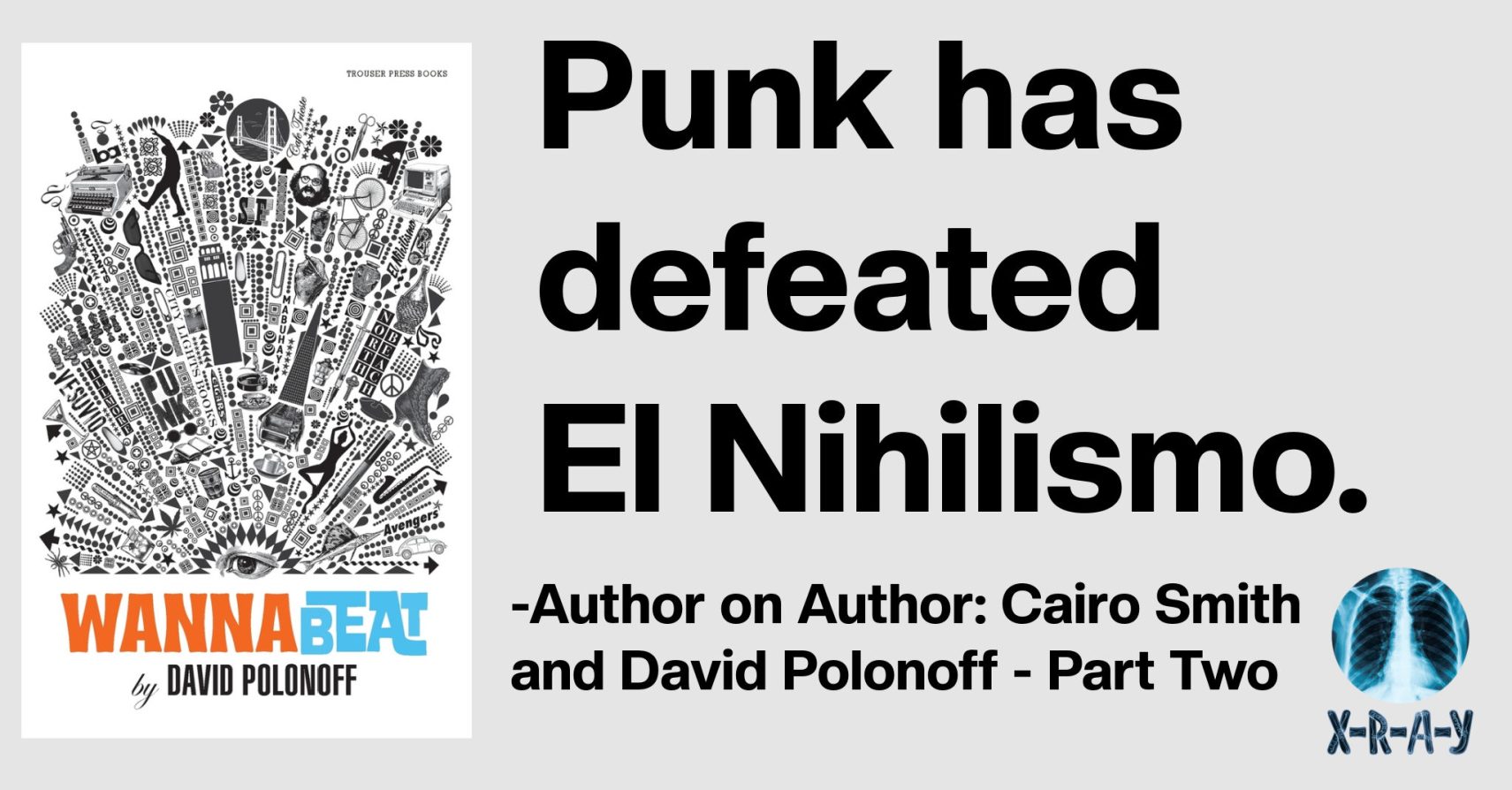
Part Two: Cairo’s Questions to David about Wannabeat (Trouser Press Books, 2024). Click here for Part One.
The Novel Within the Novel
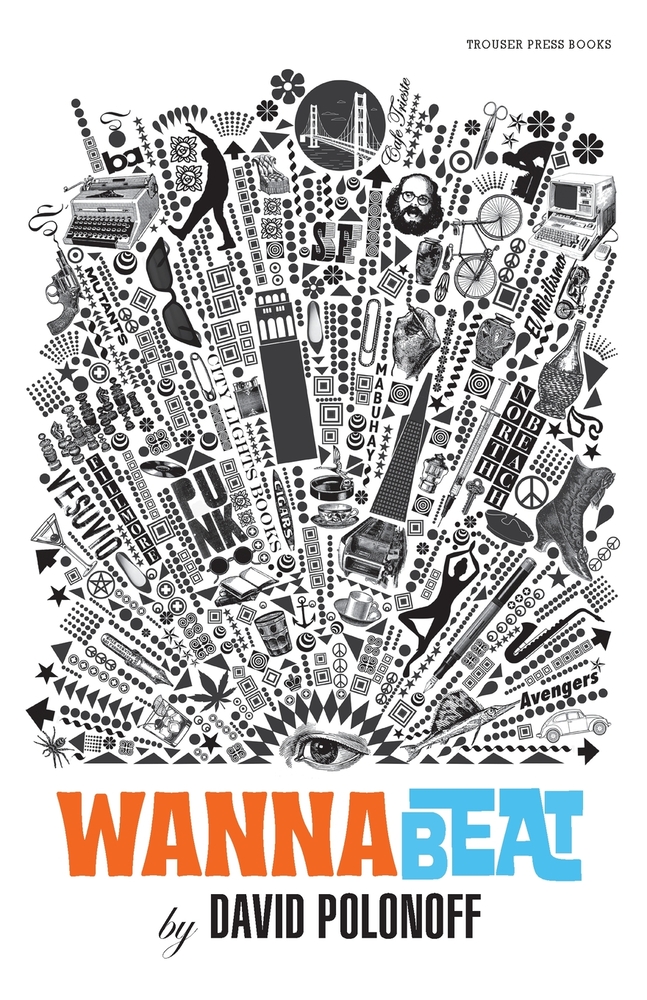 Cairo Smith: Your hero, Philip, spends much of WannaBeat working on (or avoiding working on) his book, which seems like a deliberate parallel to your own project. It features thinly veiled versions of the people around him (Sally Sassafras for Wendy, Heine for himself), an elaborate Gold Rush allegory, and eventually the arrival of El Nihilismo to destroy everything he’s built.
Is the novel-within-the-novel a parody of WannaBeat itself, or a record of an earlier failed attempt, or both, or neither? The El Nihilismo intervention reads almost like a joke about the fate of your own manuscript. And since Philip explicitly can’t finish his book, while you obviously finished yours – what changed in the intervening decades?
David Polonoff: The novel that Philip is writing in the book is his attempt to decipher his experience on a kind of cosmic scale, to make it mean something of mythic proportion. The names he gives his characters are not so much intended to veil their identities as to reveal their true identities, their totems. Moreover, he is trying to construct this meaning out of his experience at the same time as he is in the midst of it. WannaBeat, on the other hand, is Philip’s recounting of his experience from a later vantage point. He is not trying to draw a larger meaning out of events, just following the story of how they transpired and in so doing perhaps gain some understanding of his own motivations and emotions. There are allusions to the larger social and historical context but mostly insofar as these explain the assumptions and aspirations of Philip and the people around him. So WannaBeat and the novel-within-the-novel are two separate projects and not intended to be analogous or to provide commentary on each other.
Things get a little stickier when considered from the standpoint of me, the author, narrating elements of my own past through the fictional Philip. During my fraught years in late 1970s San Francisco, I did in fact attempt to write a novel, full of alchemical metaphors and philosophical allusions, recasting my life and social network into the days after the Gold Rush, only to give up about 70 pages in. Its inclusion in the book is emblematic of the many ways in which Philip, my augmented reality self, lacked the will or self-confidence or faith in his own powers to reach the literary glory he was seeking. My irl self was able to complete a novel about those same years due to my distance both from that time and from my conception of what a novel should be. I no longer felt the need to compress all of reality into one revelatory statement about history and humanity. It was enough to just tell the story and trust the process to reveal its own meaning, if any.
Stream of Drivel and the Architecture of WannaBeat
Cairo Smith: Philip repeatedly invokes “stream of drivel” as his writing method, an ironic deflation of automatic writing, stream of consciousness, the Beat typing-as-jazz ethos. And yet WannaBeat itself is notably well-constructed, with recurring characters, callback jokes, a clear three-act shape (arrival, the Washbag job, departure).
Your letter to me notes that your book has “essentially no plot” and is “a picaresque jumble around a loose timeline of disintegration.” I’d push back a bit. There’s more architecture here than you’re letting on. The book opens with Philip arriving and closes with him leaving on a Greyhound, arguing with himself. The Haight street fair gives you a reprise of the “what happened to everyone” theme from the oil spill bus. Was this really a subconscious emergence, or did you find yourself shaping a story circle of sorts as you conceptualized the book?
 David: Aha! You’ve found me out. As I’ve alluded, WannaBeat started out as a kind of investigative memoir and grew into full-fledged fiction. As such, it had a natural structure in the succession of actual events from which the fictional enlargements and modifications emerged. Also, the story takes place in a strictly delineated time frame, the two years (as you note in question 3) between my arrival and departure from San Francisco, so it came readymade with the endpoints of its narrative arc if not the keystone of its arch. As I created the characters, or rather creatively augmented them, some, like Rene the slacker cineast, Ralph and Dean and their motorcycles, Wendy the Scientology (adjacent) siren, became bigger stars and demanded a return engagement. When considering the next portion of the story I should write, I would often wonder what these characters had been up to and try to bring them into the scene. All of this was pretty organic. I didn’t set out with a strict plan or sequence, just a sense of the main episodes I wanted to capture.
But while I didn’t have a strictly mapped out narrative structure, I did have a thematic one that I was quite consciously following. WannaBeat echoes the theories of the French philosopher Lyotard which hold that the grand “meta-narratives” of post-Enlightenment culture – social liberation (Marx) and personal liberation (Freud) – have collapsed, leaving us with a choice between a nihilism provoked by their absence or play among the fragments they have left behind. This parallels Philip’s journey. He arrives in San Francisco at a point when the counterculture, with its dreams of The Revolution and Higher Consciousness, is definitively over. He searches for something new to give life meaning, throwing in his lot with a succession of groups laying claim to the New, all of which fall short due to their allegiance to worn-out meta-narratives. But then the advent of Punk reveals to Philip the possibility of creation without meaning, in other words, art as play. Punk has defeated El Nihilismo. Thematically, WannaBeat is more of a spiral than a circle. That is why I set the Haight Street fair, with its gentrified hippies, against the punk concert at the Napa State Hospital with its virtually indistinguishable performers and mental patients. One loop is closing and a new one is just starting to wind outward.
Period Piece or Recurring Template?
Cairo: You asked me whether Scenebux might become a period piece once the Thiel Bucks dry up. WannaBeat, though, is already a period piece, necessarily. 1976–1978 San Francisco, the year of Gerald Ford and Harvey Milk, KSAN and the Keystone Korner. The specificity is part of the pleasure. But there’s a difference between historical fiction set in a closed-off era and something that still speaks to the present. Do you see WannaBeat as primarily/purely a record of a particular moment, or as a template for a recurring type – the person who shows up late to any scene, any movement, any generation’s great project, trying to catch the last fumes? The parade of Baby Boomer “what I was doing ten years ago” confessions at the Haight fair suggests the former; the final bus ride self-interrogation (“maybe you’re not an artist at all”) suggests the latter. Obviously there are universalizable takeaways from any experience, I’m just wondering if you had any deliberate intention to make commentary applicable outside the subject era.
David: WannaBeat takes place in what I consider to be a particularly significant historical juncture, our culture’s first encounter with the “postmodern condition.” Jimmy Carter called it a “malaise.” Richard Hell called it the “blank generation.” The hipster/rock’n’roll/blue jeans/teen spirit ontology that had set the pace of postwar American life, both alternative and mainstream, from jitterbug through the beats and hippies ran out of steam. It was cultural stagflation. Everyone, especially artists, felt the emptiness and was searching for a new direction. Then came the Punk eruption, a kind of scream into the void, proving that new culture could still be created out of the ruins and paving the way for the recombinant aesthetics of remix and curation that have lasted to this day, albeit now algorithmically embodied. So even if WannaBeat were only a record of this specific period, I feel it would offer something of more general interest than a simple immersion in the aura of a world gone by, if only to the amateur cultural historians of Substack and people interested in how we got to where we are.
But I did intend, or at least hope, for the book to speak directly to the current world. I wanted to depict the perennial lure of bohemia as both a repository and prison of revolutionary desire. Philip comes to San Francisco to join his formerly radical friends in resisting the system, only to find them on their way to yuppiedom. Ostracized, he stumbles into the bohemian world of North Beach, discovering artists intent on reviving the Beat movement, with nightly poetry readings and rowdy disputation in the bars and cafes, reassuring him that his defiance of the upwardly mobile compulsion of his peers is not a mark of loserdom but part of a cultural rebellion and a harbinger of his literary triumph.
When I started writing WannaBeat in the prePandemic year of 2019, I keenly felt the contemporary lack of such a scene and wanted to conjure its memory and perhaps encourage its recreation. Then, lo and behold, as I was finishing the book, and the Pandemic was ebbing, there was suddenly just such a scene in the heterodox world of Dimes Square, KGB and Beckett’s basement, with readings every night, rowdy disputation in bars and social media, and artists intent on reviving the New York Downtown tradition. I began to see my work as creating a dialog with these bohemian neophytes, showing them the parallels with their predecessors along with some of the pitfalls of the path they were on. For as much as Philip needs the ferment of bohemia for inspiration and a belief in the value of his work, he is still unable to complete it. The quantum collisions of fellow artists can energize him, but it cannot supply the element he lacks, the ability to trust his own autonomous process and see it through to completion. I find that this clash between the dopamine rush of a creative social scene and the often solitary process of creation is what the zillennial readers of my book most identify with.
PS I do see Philip as, in your telling phrase “a template for a recurring type,” but not as the person who shows up too late to the scene. Rather he is the person who is somehow always out of step with the times, or has one foot in, one foot out of them. Too late for the counterculture, too early for Punk. The perennial outsider and participant-observer. Not the best template for a scenemaker, but a good one for a writer.
Ethnographer’s Exception
Cairo: Philip claims a kind of immunity throughout the book, the ability to “enter into any world or subculture and emerge unscathed.” He takes Wendy’s Scientology-adjacent vitamin seminars while privately considering it ridiculous. He attends the Hookers Ball as a helper for a TV crew. Ben in Scenebux, obviously, does the same with his Palladium fabrication.
Like Scenebux, though, WannaBeat keeps undermining this pose. Philip loses control of Daphne at the Trocadero and ends up puking in a bathroom stall. His clever participant-observation with Isis leaves him with “yoga sex” and Rex’s mockery. The Ethnographer’s Exception seems to be both Philip’s survival mechanism and his fundamental delusion. How much were you deliberately trying to rebuke this notion, and do you think this idea of assumed observer’s immunity ever has any validity?
David: Lol. I would venture that Ben’s entire sojourn in search of the T4 puppet masters proceeds under the auspices of something akin to the Ethnographer’s Exception, only in Ben’s case it’s a life and death necessity unlike Philip’s more self-serving scheming.
At one extreme the Ethnographer’s Exception (EE) is little more than an overdramatized, self-aggrandizing version of the familiar “go along to get along” tactic employed by the multitude as a way to maintain relationships at work, or with a spouse’s uncool friends, or, as in my case, with an art scene full of autofictionists a couple of generations younger. In these situations, no one is claiming a higher purpose in this gambit, just to maintain the peace. On the other extreme, the EE is a form of sociopathy without the mental illness or Asperger’s without the autism. A way of mimicking the gestures, language, and expressions that signal membership in a social group and acceptance of its ethos, while holding them in derision or, as when Ben is forced to say the Gamer Word, being “fully divorced from [their] textual meaning.”
Philip’s invocation of the EE lies between these alternatives. Through it, he believes he is gaining knowledge and insight and proving his freedom from social roles while also seeking to get laid and/or high – which as you point out, typically backfires. But unbeknownst to Philip, his whole existence is predicated on the EE. He keeps trying to turn his life and the people around him into literature, whether through stream-of-drivel autofiction or novelistic grandiosity. He makes himself the observer of his own reality, believing himself to not really be in it because he is writing it, and the people around him become the characters in his fiction. This saves him from the pain of living, setting real goals, finding true love, but introduces a new source of pain – the anguish of incompletion. When he can’t finish his novel and his streams of drivel fail to converge in one mighty river of prose, he must confront the fact that he has failed to cement his life and characters in this separate space of his imagination, and that he too is a participant in the real world along with everyone else. At which point he leans all the harder into the delusion that he is just gathering knowledge about life, doing research for when the next great project announces itself.
Philip never suspects that his belief in his immunity to experience is destroying the fulfillment that same experience might provide him. But I, as the author of his experience, very much wanted to highlight this aspect of his story. I believe that the observer’s role can offer a limited immunity. The semiotics of the multivarious communities constituting our world, are easy enough to simulate, allowing one to pass oneself off as a member or pass through unnoticed, echoing phrases without any commitment to their meaning. The risk is not exposure but the loss of an identity to be exposed. The ultimate Ethnographer’s Exception under whose aegis Philip is acting is the belief that he could become a working class hero, doing menial jobs, living paycheck to paycheck, washing dishes, cleaning oil slicks, writing on a makeshift card table, defying capitalism and hiding from his landlady; that he could enter into this proletarian world and emerge with his middle-class self unscarred. Instead, the work and the worry, the loss of respectability and the sheer day to day hopelessness of alienated labor wear him down, demoralize him and he must flee back home to reclaim his identity.
Pacing and Plotting
Cairo: WannaBeat moves fast, but I would say it achieves that speed through accumulation rather than momentum. It’s not a thriller in the airport novel sense, nor does it want to be. Each chapter is a self-contained set piece (the peyote warehouse, the Isis performance, the Hookers Ball, the Cramps show) rather than a domino that knocks over the next.
David: I love this formulation – speed through aggregation rather than sequential momentum. I picture this mode of composition as akin to dragging a narrative magnet through the metal filings of experience, letting them stick where they may. What’s interesting from this angle is that whenever I branched out into pure fiction, it was always after noting sections of the magnet that had not accumulated enough material.
Cairo: Is this the natural result of working from journals and memories, or a deliberate choice to mimic the structure of Philip’s life and how it feels like one thing after another after another, without cause and effect?
David: A little bit of both. I worked more from memory than from my journals. Even when I did consult the journals for corroboration, it was always the vividness of the memories that led the way. And, of course, memory distorts space and time, giving big dramatic events and quick flashes of recalled images equal time in the mind’s eyes, splitting up simultaneous happenings and collapsing months-long processes into a single blob. So, I ended up with conversations that don’t relate to anything that follows, characters that make an appearance and disappear, timelines that don’t quite parse. At first this bothered me and I wanted to figure out how things fit neatly together, both for the sake of the story’s coherence and my own past-self psychoanalysis. But then I realized that this disjointedness was in fact an accurate reflection of Philip’s experience – lost in events, aimless even in his overriding literary ambition, never quite able to take control of his life. So, I acceded to this one-thing-after-another-ad-infinitum structure and began to consciously implement it as the most fitting path for Philip’s story, rather than deliberately setting out to do so.
Cairo: We talk a lot in comparative literature studies about the rigid causality of Western storytelling. The traditional Western novel would have Wendy’s rejection lead to Isis lead to the firing lead to the departure, each thing causing the next. WannaBeat, though, mostly has things happening until they stop happening. Is that a rejection of narrative teleology with a deliberate effect intended? Is the structure itself commentary?
David: I wish I could take credit for the brilliant stratagems you impute to me, but my eschewal of narrative teleology was probably as much a product of laziness as of any metaphysical stance. At first, as I mentioned, I did try to tie the successive vignettes together by high-tensile causal links, spending an inordinate amount of time sneaking in foreshadowing details that would explain how Philip got from point A to point B, establishing the exact chronology between the Mabuhay’s first punk shows and the Sex Pistol’s performance at Winterland, mapping out the Baby Beats’ manifold relationships with City Lights Bookstore.
But there were just so many details leading to and from each event! Even if I was writing a strictly causal story, I would still have had to select the most salient of them. So why not just dispense with them altogether? Too many explanatory details, I realized, hinder the suspension of disbelief, making it look like you’re working overtime to sell the verisimilitude of the story. If you just make each scene as immersive and alive as possible, the links between them become kind of incidental, just as the images and actions we remember from dreams are often surrounded by the haziest of circumstances.
So, I just started focusing on the key events without fussing about what happened between them, and this way of writing started to take on its own rhythm. I felt like a deejay laying one track after another on the turnstile, each one suggested in some way by its predecessor but going on to produce a whole separate vibe. I was enjoying the benefits of discarding the Western storytelling regimen even though I hadn’t intentionally set out to do so, and I just kept on keeping on.
I must add that I did have one aesthetic model in mind throughout the whole writing process: Fellini’s Amarcord. In that film the camera floats from scene to scene, some of them flights of fantasy, some touchingly real, some slapstick, some surreal, some with recurrent characters, some with one-shot cameos. Scenes of disproportionate length and tone, each one self-contained and independent of the others. Together they combine to form an indelible picture of Fellini’s childhood town through a year in its life, a picture that has stayed with me longer than the details of the many meticulously plotted films or novels I have seen or read since.