
“Lurch to dispatch.”
“Go ahead.”
“Hey dispatch, we’ve got a problem up in European.”
“What do you mean problem?”
“I missed that last part, can you repeat?”
“What problem?”
“Yeah, up in European.”
“Lurch, what’s the problem?”
Lurch, a looming young man, new haircut, eyes slightly at odds with one another, handsome, stands in a corner of the museum’s European collection. He was only hired on a few weeks ago, but is catching on fairly quickly. Walk around, ask mothers to keep their children at arms length, no touching, no running. They’re no longer called security guards because of an incident a few years ago. Gallery Stewardship Professionals, the official title. The director of the museum didn’t love this choice as she associates it with boats. In the end though, it works. Captures the nature of the work that Lurch and his comrades have been tasked with. Steward the artifacts, sculptures, oil paintings, furniture, etc, into the future. Most days, stewardship means keeping kids from rubbing their boogery fingers all over the Monet on loan.
Lurch’s supervisor rounds the corner. A pale, slight man, who wears a suit coat one size too big and hates his job. His name is Clementine, but folks call him Lemons.
“What’s the problem, Lurch?” Lemons asks.
Lurch presses his two-way radio to his ear, thinking his boss’s voice came from there and not from right behind him.
Lemons taps Lurch on the shoulder and Lurch lurches around—a small yelp escapes his lips.
“Oh, Lemons,” Lurch says. “You’re so sneaky.”
Lemons is well known for his ability to dip in and out of the shadows.
“So, what’s up, Lurch?”
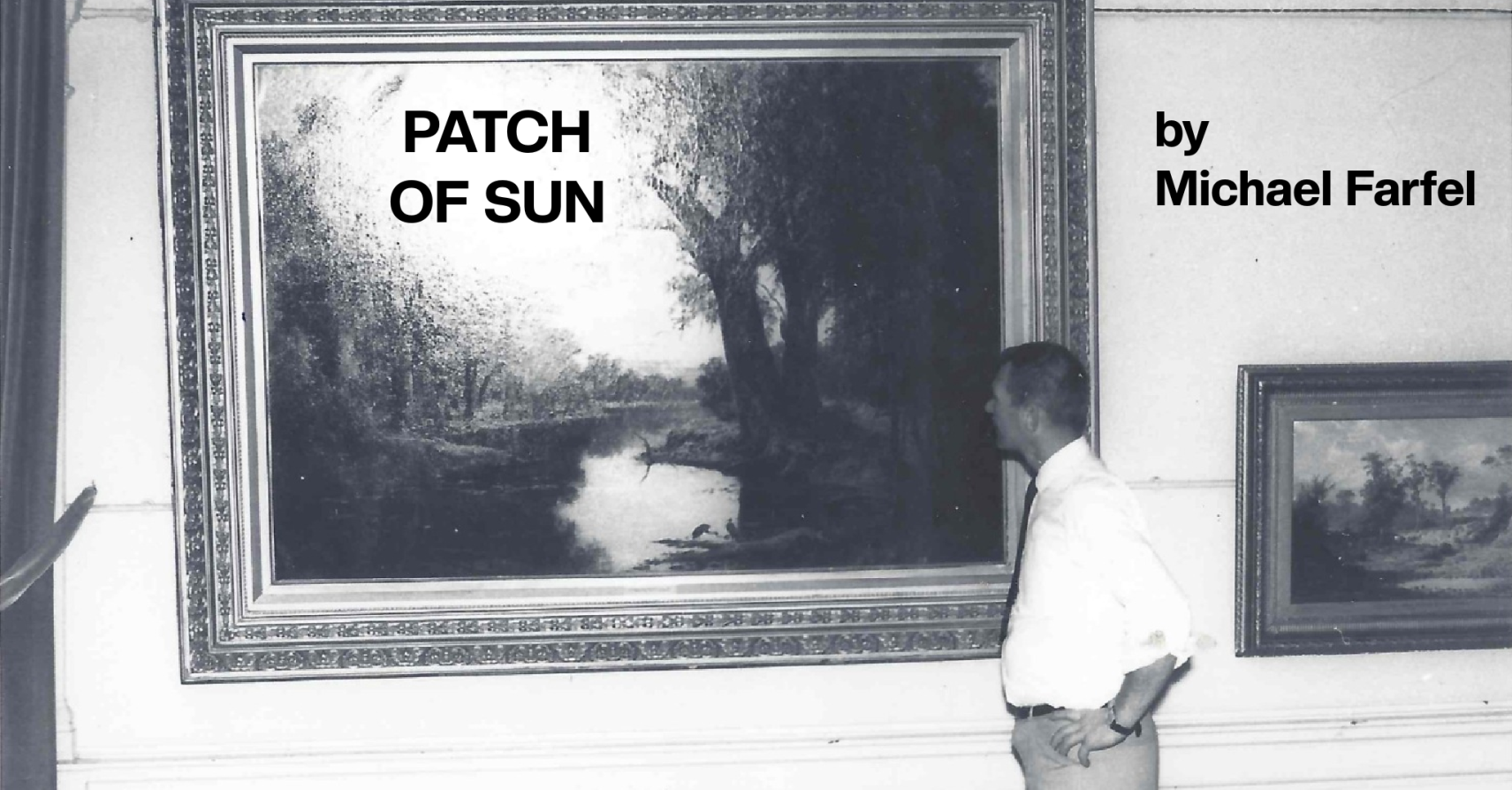
The two of them are standing in a wing of their European collection on the second floor of the museum. Lurch points to the bottom corner of an oil painting by the great master, Francisco Peawrile. Lemons’ stomach drops. There’s a mark that wasn’t there before. The painting, one of Lemons’ least favorite, is an uninteresting landscape. More than likely, it wasn’t ever meant to be hung in a museum, instead it was Francisco practicing some new technique. Most of the image is drab, except for a patch of sun which lays on a patch of grass which reflects sharply off the edges of a cluster of white flowers. A few v shapes, meant to be birds, dot a storm cloud. Uninspired, Lemons has always thought.
“Fuck,” Lemons says under his breath.
Lurch stands a bit taller, “what’d you say boss?”
“Stay here, just keep people out of this room. I’ll be right back.” Lemons leaves in a huff.
Protocol dictates that if art is ever defaced, then Lemons is to get the director on the phone. Instead, in order to gather his wits, Lemons decides to walk to her office. This’ll give him a second to catch his breath and remember what other procedures he’s likely failed to maintain in the lead up to said defacing. Shit, he remembers he’s supposed to take a picture on his phone. He’s only made it a few galleries away and turns back. He makes his way back through the portrait gallery, dodges a few sculptures, through modern and contemporary and is back in the room where Lurch should be. Instead, a few patrons have flocked to the piece in question.
“Hi folks, we actually need to close this area off for a few minutes for some routine maintenance. So sorry for the inconvenience,” he says. .
One of the patrons reaches out to touch the new mark on the painting. Lemons knows, in her mind she’s only helping. Reaching out as a way to confirm what she sees and therefore confirm the problem at hand.
“No, no, no,” Lemons pleads. “Ma’am, please no touching. Again, folks, I’ll have to ask you all to clear out.”
Lemons lifts his two-way radio to his mouth, “Lurch, my dude, where you at?”
There’s a long silence, the patrons dumbly looking on, and then a response from the radio, “commode.”
Lemons rubs his face with his free hand. “Folks, please. ”
The patrons are dumb-eyed, but eventually get the message and disperse.
“Dispatch, can you send someone to watch the landscape gallery for me?” Lemons says into his radio.
“10-4, boss, Gail is en route.”
“Have her bring some stanchions, please.”
“Gail to Lemons, over,”
“Go ahead Gail,” Lemons responds.
“I’m en route, over.”
“Copy that, Gail.”
Gail appears, carrying two stanchions. Gail is a shouldery young woman. Strong, her great uncle was a cop, wears combat boots, and keeps a general military aestethic—a haircut suggestive of danger.
“Okay Gail, I just need you to keep people out of the room. Stanchion off the entrance. I’ll be back.”
Before Gail can ask what’s going on, Lemons points to the mark on the painting and is finally able to make his way out of the gallery.
Lemons is thoroughly annoyed, it’s Friday, he’s had his three o’clock coffee, and they were so close to closing the building down for the day. As he walks past the sculptures, through the African gallery, past the sarcophagus, twists past a docent-led tour of veterans, he thinks of the root beer and TV dinner he had planned for the evening. Small beautiful things for a man like him make all the difference. He even remembered to fill his ice tray. Now, who knows how long he’ll have to be at work, watching through camera footage, reprimanding his staff for not keeping a better eye on things, and eventually—he makes an audible sound of pain as he thinks of this last thing—he might have to file a police report. Down the stairs, past the lobby desk.
Outside the director’s door, Lemons takes a deep breath before knocking.
“Who is it?” a voice from the other side.
“It’s Clementine,” Lemons responds.
“What is it?” The same voice.
“Defacement,” Lemons says.
The sound of shuffling paperwork and whispers meet him. He leans his ear against the door. The horrible realization that the room is full. He has stumbled into a collections team meeting.
For him, this is hell.
“Come in,” a new voice.
Lemons, ever-reluctantly, opens the door. And sure enough, he has wandered into the strangeness of a team meeting, of which he should have nothing to do. Archivists peer down from the rafters, conservators adjust their stethoscopes, curators speak in tongues, registrars play the fiddle. At least, they may as well. Lemons is an alien entering alien terrain. Well-meaning folks obsessed with an impossible task—maintaining the integrity of ephemeral objects for all eternity.
The director beckons him in, her head freshly shaved, fully freckled face, shockingly white teeth. She gestures for Lemons to sit—there is no place to sit.
“Defacement, you said, Clementine?” She asks with a hint of excitement. Everyone in the room, owl-like, watches Lemons every movement, sure that they can discern the nature of desecration just by the patterns of his face.
“Uh…” he stutters, the heat of the room’s gaze swelters in his throat. “Yes, the Francisco, oil, uh… Nature’s Hearth, no, Natural Heart…”
The director half-rises from her seat, “Reflections on Nature’s Heart.”
Lemons touches his head in acknowledgment, “yep, that’s the one. Marking on the bottom corner.”
A hush sweeps through the room. Lemons feels all moisture sap from his sinuses. Utter silence. They’re all waiting for something. Lemons waits too.
The director is now fully out of her chair. Slow, purposeful steps toward Lemons.
“A photograph?” she asks.
“No… the oil painting,” Lemons responds without thinking. “Oh, duh, yes. A picture. I took a picture.”
She’s at his side now. Shoulder to shoulder. A preparator stands behind him, looks down as Lemons fumbles with his phone. He had forgotten to take a picture in all the chaos. He knows this but pretends to mis-input the code for his lockscreen.
“Darn fat fingers,” he jokes. He has slender, gazelle-like fingers. That’s the joke. No one laughs. He puts his phone back in his pocket. “Let’s just go take a look.” He checks his watch. “I’m sure y’all wanna jump on this. Get out of here before the Friday traffic.”
He swears they hum yes in unison.
“Let’s,” the director says.
They stand in a horseshoe around the work of art. Each in postures of examination. Hands on chins, leaned forward, furrowed brows, tapping toes. Gail hovers behind the group. One eye on the painting and one eye scanning the world for nerdowells. She looks left to right, with Spartan precision. Her breathing calm and collected. She cracks each knuckle, one-by-one.
“Gail,” Lemons says without looking away from the painting. “You’re good to keep patrolling. Thanks for your help.”
“You sure, captain?” She asks. “I can start reviewing the camera footage, if you’d like.”
“Thank you, Gail. No. Just keep patrolling. Make sure the rest of the art is safe.”
“10-4,” she says. “I’ll see if I can find any other new markings.”
Lemons lets out a slow exhale. “Thank you.”
Not even Gail means to do this, but she gives a half salute as she walks out of the room. An accident of the moment. A hopeful gesture and she’s gone.
The director is the closest to the painting. Her nose is nearly touching it. She is squinting, her eyes in full concentration. She grabs the sleeve of her nearest subordinate, a shy young man, one of the part-time preparators.
“A spiral shape?” the director whispers.
“Looks more like a triangle to me,” the young man replies.
The director tilts her head until she has to bend one knee to get low enough to create a never before seen vantage point. “A triangle, you said?”
The young man is embarrassed, his cheeks turn red. “An isosceles,” he dares.
The director pulls another of her staff members close, this time the registrar, “a spiral shape, no?”
“I’m seeing more of an x. X marks the spot.”
“An x?” The director asks, holding onto the sound of the letter for as long as possible.
“I’m gonna leave you guys to it,” Lemons says. “I need to review the camera footage, see if we need to take any further action.”
“And what do you see, Clementine?” she asks Lemons.
“Oh… I don’t know. Kinda looks like Ohio from where I’m standing,” he says and walks out of the room.
Lemons has to move fast. If he shows even the slightest hesitation someone will corner him. Be it Gail—ever the inquisitive guard, she’ll likely have a clue or two to share with him, a hunch, perhaps a potential culprit. Lurch is around somewhere. He might ask about that promised raise at the six month mark. Lemons knows six months will never come. Lurch is one of hundreds of young folks that have passed through the institution in Lemons’ years of service. Kindly kids, bright eyed. He can always tell within the first minutes of training how long they’ll last. Lurch doesn’t even have an ID badge yet. It’ll be a miracle if he makes it that long. Worse yet, if Lemons’ not quick, the director will pull him back in with more questions about the crime scene:
who was watching this patch of earth, who trained whoever was meant to be watching this patch of earth, have the proper authorities been given notice, who gave such notice, where were you when whatever happened happened, what are the proper punishments for defilement of this sort, can we consider capital punishment, when?
He keeps moving. Back to his office so he can review the footage and get to the bottom of things. A singular quality of Lemons is that he’s a hopeful man. Here, he hopes that someone just accidentally bumped the painting in passing. This has happened a million times and will happen a million more times. It’s the reality of mixing fine art with middle-school tour groups. Artifacts will be touched. If it’s not behind glass, fingertips will ride their textures. Rarely is it ever nefarious—and when it is there’s nothing to be done but call on a higher authority. He takes a few deep breaths, brings up the appropriate software, finds the appropriate camera, scrolls back through time. Mothers jerk their strollers toward the art, docents moonwalk from patron to patron, his staff miraculously put their phones back into their pockets. Everything in reverse. Such beauty, he thinks, until he sees the moment he had hoped for. But there is no hope here—something else.
He has to playback the video a few times. A lightning quick spectre. A dark orb? No. He watches the video again, this time zoomed in. He’s too close now, the image scatters itself. Fragments of unreality. Even if he watches frame by frame, nothing is revealed. Again, slower, zoomed out. Certainly something flying. Was it thrown? He checks an adjacent camera. No one there to throw. He leans in and watches the video unfold, this time in real time. Whatever struck the painting didn’t bounce back, instead it rose. A creature, something with its own volition. Mammalian? No.
“A bird’s talon,” he says aloud, realizing what the strange shape on the canvas was.
The camera flickers for a moment and he sees the live feed. Hundreds of birds descend on the director and the rest in the landscape gallery. He nearly falls out of his chair. The camera flickers back, and sure enough, frozen in the frame a small black bird, touches its golden hoof to the painting. He runs out of the room and screeches into his radio, “birds!”
He only hears radio static as he hurries through the galleries. His mind is overwrought with unfeasible plans. There is no protocol for a sudden flock of cardinals. Or hawks. Or crows for that matter. He rounds the corner and stands for a breath to take in the carnage. Hundreds, perhaps thousands, of birds catapult through the room. The collections staff are each in versions of covered panic. Feathers—verboten in museum spaces—float through the air as the birds careen from one side of the room to the next.
Lemons freezes, and Gail bumps past him. She is alive. Prepared. Intoxicated. Affixed to her belt are all the tools she’d ever need. A small first aid kit, a flashlight, her radio, and to Lemons’ horror, an expandable steel baton. She’d asked if she could carry a gun, Lemons said no. She asked if she could carry a taser, Lemons refused that as well. She never mentioned the baton. In her mind this was a compromise.
“What if someone tries to take a painting, captain?” she had asked.
“Don’t call me captain, Gail.”
“Well what if it’s a gang of them, and the cops can’t get here in time? What if there’s a war and the police are protecting the city’s infrastructure?” she pressed.
“I’d hope you’d just want to be with your family,” Lemons had said.
Her first swing of the baton knocks a bird out of the sky with a sickening thwack. Blood and all of the dust of its life explode as it’s hurled against a far wall. She swings again, another thwack. Another dead bird. Patrons have amassed to watch the show. They are unsure if this isn’t some kind of performance art the front desk attendant had failed to mention. A visceral exploration of man’s imprudent relationship to nature. Another swing. This time catches the outstretched hand of one of the preparators—who yelps and cowers to the floor.
“Gail!” Lemons shouts. “Gail, you have to stop.” He lifts his radio to his mouth, “dispatch,” he says. “We’ve got birds.”
“Ten four,” dispatch replies.
Gail quickly shifts her focus, she’s on the ground, applying a bandage to the injured preparator. The squawk of the birds rebounds through the gallery. Lurch finally emerges from the restroom. He stands next to Lemons, both awe struck.
“Lurch, the emergency exit,” Lemons says as he pushes Lurch to a door on the far side of the room. Lemons uses Lurch as a shield. The patrons have begun to take videos on their phones. Someone is crying. The ground is slick with blood and bird shit. Lemons can taste the root beer, he’s so close. The emergency exit door swings open. Alarms blare. A patch of sunlight filters through the threshold. The birds sense their freedom. A single file line of their sleek bodies bustles out. A miraculous, beautiful happening.
Lemons and Lurch stand outside and watch the birds form dark shapes against the evening sky. They fly left and right, allow the wind to swirl them to and fro, and then they’re gone. Scattered—out of sight.
Michael Farfel has three novels with Montag Press: The Reluctant Journey of Manfred Bugsbee (2021) Glossy Eyed, Buzzy Fly (July 2024), and The Housesitter (2027). His work has appeared in publications such as X-R-A-Y Literary Magazine, Juked, HAD, and DIALOGIST. Those pieces and more can be found on his website: https://michaelfarfel.com.