
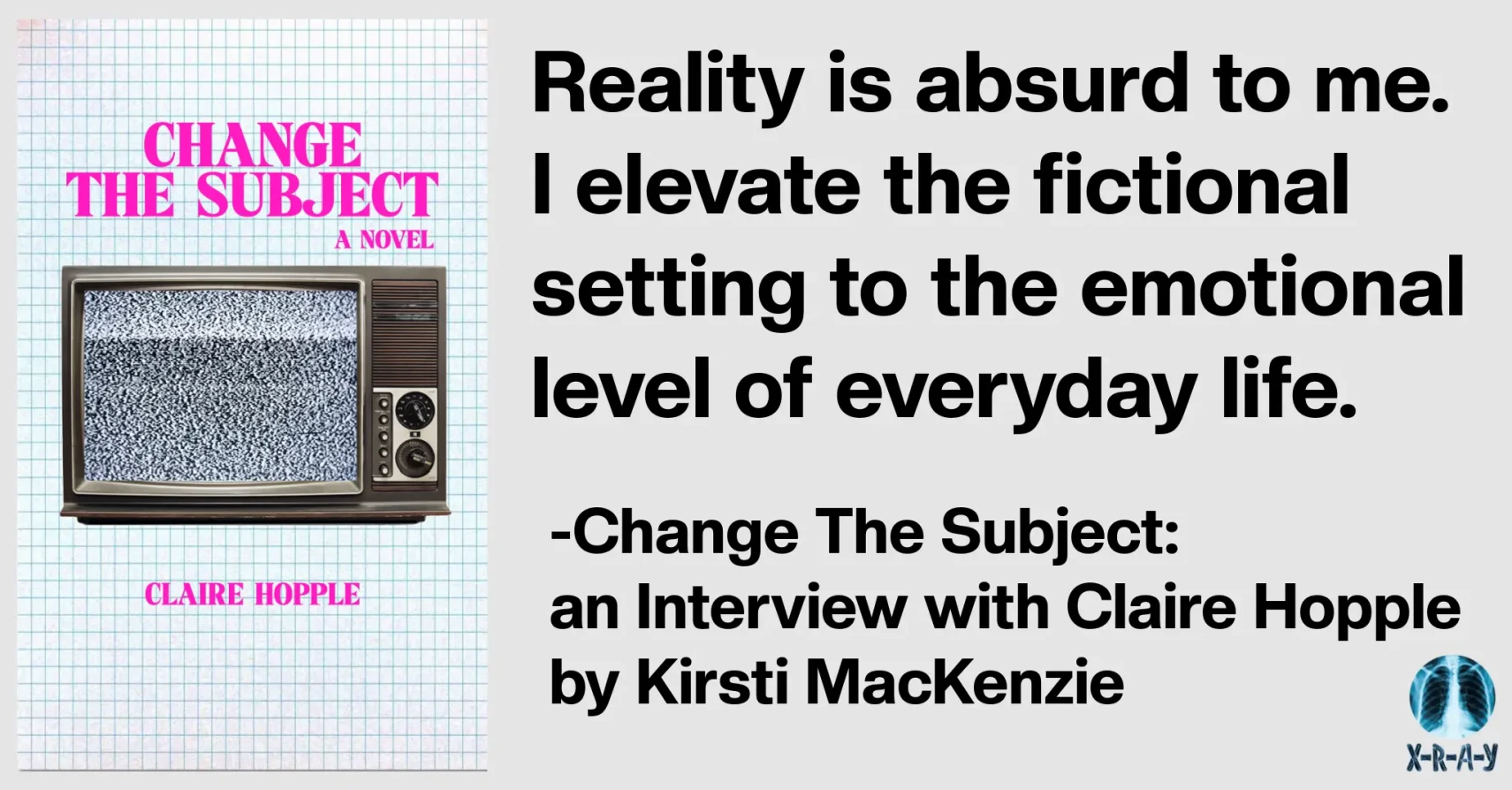

The older I get, the more I appreciate writers who leave a personal stamp on their work, so unmistakeable it couldn’t be anyone else on the page. Claire Hopple is one such author. Hopple’s absurdist, punny, tongue-in-cheek fiction has been a mainstay in indie lit for years. Few are as prolific as she is, and I’d know the cadence and tone of a Hopple story even in a blind read (the highest compliment I can give an author!) I was lucky enough to catch up with Claire and fire off a few questions about her latest novel, Change the Subject, available now with Rejection Letters Press.
Kirsti MacKenzie: I want to know the exact event you were at when you came up with the idea for proxying. Do you ever wish you were a proxy, and if so, what is your dream assignment? Conversely, do you wish someone could proxy for you during events?
Claire Hopple: I can’t remember where I was, but the weird thing is: this proxy concept was inspired by the show Arrested Development, even though I haven’t seen it in years. There’s a guy who represents the dad while he’s in prison by wearing a hat with a camera and mic that directs to a live feed so the dad can intervene with his family while he’s behind bars. I don’t think I could handle working as a proxy. It’s too much direct customer service, too much recorded footage, too much pressure. I do wish I could have one though, at times, especially in situations where it’d be preferable if I were an extrovert or someone with a different personality.
KM: Change the Subject deals, unintentionally or not, with social alienation. We all put on versions of ourselves, and proxying only makes that more noticeable. We are not mentally or emotionally present for so much of our lives, and proxying furthers that sense of being socially adrift. How much of Change the Subject was a conscious statement on alienation, if any?
CH: It was both conscious and unconscious. I think all creative acts at their core are about alienation because creativity is an attempt to bring people together, and you can only do that if you notice they’re apart.

KM: This is going to sound contrary, but I feel like so much of your writing thumbs its nose at grand statements, themes, or even premise. (I say this with a lot of admiration!) You have this continual ability to subvert expectation—for instance, the midpoint has this dramatic reversal, where the character breaks her assignment and inserts herself in the situation where she shouldn’t, only to have the effort fall flat. The real revelation is quieter, and funnier (“I regret to inform you I seem to care about what I’m doing”). To what degree are you conscious of your subversions, as a writer? Do they come as genuinely a surprise to you as they are to me, the reader?
CD: I want fiction to feel like real life, and real life doesn’t have a traditional story arc. I’m very conscious of this because it’s my way of grappling with existence, and I want to share that with people. Often I do not have everything mapped out, just use a handful of ideas that will eventually appear in the story, but I love to surprise myself too. Anything that feels overtly structural or rigid takes all the fun and the voice out of it for me.
KM: One hallmark of a Claire Hopple story is taking a comedy bit and seeing it all the way through to its furthest extent, to a point where an absurd premise feels logical. Is it more difficult to sustain this in a novel than a short story? How do you know when a bit or premise demands more room to be explored, rather than be a one-off, shorter piece?
CD: Reality is absurd to me. So absurdism through narrative is a working out of how it feels to live in mundanity. I elevate the fictional setting to the emotional level of everyday life, if that makes sense. And I don’t think I know when a premise demands more room to be explored other than what it tells me. You get possessed by the narrative and it does sort of pull you along, but I also historically have an issue with pacing. I wanna get it all out perhaps a little too quickly.
KM: Do you have a favourite Jeopardy contestant or moment? Looking for a real deep cut, if you’ve got one.
CD: Victoria Groce is my favorite player of all time. She is the epitome of grace, intelligence, cool, and genuine empathy. And my favorite Jeopardy! category is Before & After––or Before, During & After. Sometimes we just play curated clips of those on YouTube when we’re feeling really nerdy. John is really into the show, and so writing it into this novel was a dedication of sorts.
KM: At one point, Monica states “Everybody gets sick of themselves, tired of being trapped.” All the characters deal a bit with identity slippage, play, or substitution (her father’s statue, Graham’s smashed face, Monica’s meditation on the use of glasses or wigs, fake identities and names, witness protection). If you could snap your fingers and shift something about your identity, what would you change? Do you think it would stick?
CD: I think you’ve hit on the main theme of this book, so excellent work there. We can never be someone different than we are, we are in a sense trapped inside our own bodies and personalities, and that is both incredibly relieving and disappointing. There’s a lot to play with, a lot of ways to explore that concept and flesh it out. If I could change my identity, I would change it all the time just for the diverse perspectives.
KM: At one point, Monica’s boss says to her: “You’re making the work about yourself when you should be invisible.” So many people take on their work as a marker of identity, when really it has nothing to do with them—it was there before they were, and continues without them. Do you feel like proxying is as anonymous as it’s made to be, or might proxies begin to see their work as a continuous form of art, or a project (like a writer, or a career criminal)?
CD: I think human nature dictates that we always internalize things and incorporate external factors into our identities, even when there’s no basis for it, especially when it’s something we’re doing so often, proxying included. Sometimes we need someone like Monica’s boss to remind us that our entities are separate from what we do.
KM: Monica’s deli order is hella specific. I need to know—is that sandwich your ideal? Or do you have your own hyper-specific order? Please input here so I can Door Dash it to you.
CD: Ahh that would be AMAZING. Monica and I share the same sandwich preferences for sure.
KM: Let’s say you’re perusing Proxy Corp applications. What things stick out to you as the markers of a successful applicant? (Asking for a friend.)
CD: Adaptability, customer service experience, and working well under pressure. A lot of ADHD folks would be really good at proxying. I would probably hire them first.
Claire Hopple is the author of six books. Her stories have appeared in Southwest Review, Forever Mag, Wigleaf, Cleveland Review of Books, and others. More at clairehopple.com.
Kirsti MacKenzie (@KeersteeMack) is a writer and editor in chief of Major 7th Magazine. Her debut novel, BETTER TO BEG, is available from Sweet Trash/House of Vlad Press in Nov 2025. You can read the rest at kirstimackenzie.com.