
I was nursing a beer at Hoosier’s Bar in Cooke City, Montana, when he walked in. Little guy, about my age. Mid-twenties. He had blond dreadlocks and a scruffy goatee. There were a few people sitting at tables, but except for me, the bar was empty. With a dozen-or-so stools to choose from, Dreadlocks sat two down from me.
I’d been working on my beer for most of a Chiefs/Colts game. The fourth quarter was about to start. Until then, the only words I’d heard the bartender say were, “We’re out of that,” to the waitress and, “Drink up, we close in five hours,” to me.
The bartender—Big Mike, the waitress called him—had his back to the bar, which didn’t stop Dreadlocks from calling out, “I’m from Indiana!”
“Congratulations,” Big Mike told Dreadlocks, “I’m from Montana.”
“I thought I might get a free drink. You know, Hoosier’s.”
“One water, coming up,” said Big Mike.
Dreadlocks said if he’d wanted water, he would have stayed in his motel room. “Coors on tap, and one for my friend,” my new friend said.
I was happy for the beer. I could barely afford the one I was working on. “I appreciate you,” I said.
I had completed my first year in the MFA program at The University of Missouri-St. Louis, but I hadn’t written a decent story in six months. My girlfriend, Kaylee, had left me for Lance, a beetle specialist at the Saint Louis Zoo insectarium. Kaylee said Lance’s beetles had more self-awareness than I did. I couldn’t even make a story out of that. I dropped out before fall classes began.
The most successful story in our family belonged to my great-uncle Earl.
As a young man, he had been a groundskeeper at Sportsman’s Park in Saint Louis, the park where Stan Musial played. When Uncle Earl tired of that, he bought a used Nash Rambler, drove to California, and got a job clearing trails at Yosemite. One day in the woods, he met a hiker named Williams, who offered Uncle Earl a job at a San Francisco startup, Williams-Sonoma. Almost seventy years later, I gassed up my Civic and drove west, hoping my walk in the woods might lead to an adventure story.
There were no job openings at Yosemite. I tried Crater Lake, Mount Rainier, and Glacier. When I gave up becoming Jon Krakauer, I called my friend Bart in Saint Louis. Bart was a horticulturist at the Missouri Botanical Garden. He thought they might hire me in Maintenance. If I couldn’t get a job clearing trails, I could sweep pathways. I was on my way east when I met Dreadlocks.
I thanked him for the beer and said I wished I could return the favor. I told him I’d maxed out my card two weeks ago, that with luck, I had enough cash for gas and fast food to get me to Saint Louis. “I’m staying with my friend Bart until I get a job,” I said. “What part of Indiana are you from?”
“Salem, Oregon. I’m Ryan.”
“Nick.”
I had hit Cooke City late that afternoon. As I passed through town, I saw Hoosier’s. I’d been driving since sunrise, so I thought I’d kill time at the bar and fill up on free chips or nuts, then sleep in my car. No chips. No nuts. I had a grilled cheese on rye for dinner and called the dill pickle dessert.
“I’m looking good on this one,” said Ryan.
He was pointing at the game. The fourth quarter was underway. The Chiefs were near midfield, down 20 to 9, when Mahomes threw an incomplete pass. “Yes!” said Ryan, slapping his phone on the bar.
He said he’d been watching the game in his motel room (“the TV is the size of my phone”) and watching the odds on a gambling app. He thought that with the way things were going, he might as well have a drink or two. “I stand to make a killing,” he said.
Mahomes completed a pass to Travis Swift. The Chiefs were in Colts territory with most of the quarter to go. “I can’t believe these odds now,” said Ryan. “You’d have to be a fool to pass this up.” He gave his phone a tap.
“How often do the odds change?” I asked.
“Sometimes with every play.”
A few plays, a few taps later, the Chiefs were in the red zone. They scored. Mahomes completed a pass for the two-point conversion. Ryan grimaced, then tapped.
“Are you sticking with the Colts?”
“Totally.”
With less than five minutes to go, the Chiefs were in Colts’ territory again. In another few taps, they were inside the five. Mahomes was sacked on third down, but the field goal was good. Ryan slammed his phone on the bar.
“Do that again and you’re out of here,” said Big Mike.
Ryan picked up his phone and looked at the screen. “Holy crap!” he said before tapping.
The overtime played out much like the fourth quarter. A few plays before the Chiefs’ winning field goal, Ryan looked at his phone. “I can’t believe this!” he said, sliding his phone down the bar to me, face up. Insufficient funds, the screen read.
“A beer for my friend,” I told Big Mike. I could skimp on breakfast.
Between sips, Ryan said he’d been working on an Oregon sod farm. He was from Salem, but his father had come from Southern Indiana. Ryan had relatives there. A cousin had told Ryan that the nearby Princeton Toyota plant was hiring. Ryan said he’d earn three times what he’d been making on the farm. He had applied online, and he was due for an on-sight interview in five days. He was hitchhiking to Evansville, where he’d “crash” with his cousin. “Don’t suppose you’d like some company on your drive?” he asked me.
Ryan had sold his car for two thousand dollars before he left Oregon, “three hundred more than it was worth.” He put all but five hundred into his savings account. He planned to take a bus to Indiana, open an account there, and transfer his savings. Instead, he moved it all, close to three thousand dollars, into his online gaming account and hit the road thumbing. “What happens if you don’t get the job?’ I asked.
“Why wouldn’t I?”
After I told Ryan the condensed version of my failed career as an adventure writer, he asked me where I was staying the night.
“The Hotel Honda Civic,” I said.
Ryan offered to let me stay with him if I took him as far as Saint Louis. “No funny business,” he said. “Twin beds.”
That night in the motel room, we played video games on our phones. Ryan wanted to make the games “interesting,” but I said they were interesting enough. “How interesting were each of your Colt bets?” I asked.
“Two hundred,” he said, “on top of my first half K.”
When I pointed out to him that he’d been willing to hitchhike from Oregon to Saint Louis just to save about the same amount he’d lost with each additional bet, he said, “You have to spend it to make it, right?”—as if he’d been investing. The next morning, we invested in coffee and donuts, and drove east.
We had a lot in common. Music, for one. We listened to hip-hop from Billings to Big Timber and oldies after that. Talking Heads, The Cure, The Clash. Super oldies like Hendrix and The Stones. We agreed that the planet was on fire and the country was in trouble. We thought Dune: Part Two was overrated and Furiosa: A Mad Max Saga killed. We’d both been recently dumped by girlfriends.
The passing scenery was brown.
After driving almost twelve hours, we found a dive motel off I-90 in Presho, South Dakota. We bought pizza from a food truck and played Brawl Stars in our room. Before we went to bed (twins), I called Bart in Saint Louis and asked if Ryan could stay the following night. I planned to drop him off east of the Arch the next morning.
We left Presho after eating some cold McDonald’s Hotcakes. That day, as we listened to hip-hop and grunge, Ryan kept looking at his phone. Free gaming, I guessed. Just west of Columbia, Missouri, he put his phone down and asked, “So, Nick, do you still want to write stories?”
I told him that I did.
“I’ve got one for you,” he said.
“I’m listening.”
The success story in Ryan’s family belonged to a distant aunt and uncle. For purposes of this story, I’ll call them George, from the Greek Georgios, meaning farmer, and Lurleen, from the German name Lorelei, as in temptress. They owned a thousand-acre farm in Southern Indiana at a time when the Union Army needed corn. George and Lurleen fed Grant’s troops and were paid well to do it.
“They kicked ass,” said Ryan. “Both their sons were killed at Vicksburg, but the rest of the family didn’t give a damn. They were pulling for the South.”
According to family legend, after the war, not long after George died, Lurleen sold the farm and moved to a small Southern Indiana town which I will call X. As in marks the spot. Then she took all the money from the sale and all the savings from the corn and bought gold jewelry. “She wore it to church on Sundays. That way the family would see it,” said Ryan. “She wanted to get their hopes up before she checked out.”
Months before Lurleen died, as though she knew she soon would, she took her jewelry to the undertaker and instructed him to put it all on her before putting her in the ground beside George. She swore the undertaker to secrecy. The family would wonder where the gold went, but they’d know why they didn’t get it. “It was Lurleen’s way of getting back at the family for blowing off her sons’ deaths,” said Ryan.
“Why are you telling me this now?” I asked, though I had my suspicions.
“Almost five thousand dollars an ounce, last I checked,” he answered. “I can cut and replace grass like you’d never know I’d been there.”
“How long have you been planning this?”
Ryan said he’d heard the story when he was a kid, but the idea came to him while he was working on the sod farm, when he saw how easy it would be to cover his tracks. He said it was his last resort. “I know she doesn’t need it anymore, but who wants to rob his aunt’s grave?”
“Someone who lost big at Hoosier’s?”
Ryan answered by saying he hoped his aunt would understand, as though they were in touch. He said he would have told me sooner, but he needed a ride. He was afraid I might not have given him one if I’d known what he was planning, but as we neared my endpoint, he thought he had nothing to lose. “I have a proposition for you,” he said.
That night in Presho, Ryan had googled the location of X’s oldest graveyard. “It’s outside of town in the middle of nowhere,” he said as we drove. “No way we’ll get caught.” If I was “in,” he’d call his cousin and say he’d changed his mind, that he got halfway through Missouri and decided to return to Oregon. Ryan said he couldn’t risk anyone seeing him anywhere near X. He doubted he was the only one in the family who’d heard about the gold, but there was some sort of “bullshit legend” that anyone who took it would wish they hadn’t. He was betting no one had had the balls to have a look until him, but if anyone would see him and then notice a difference in Lurleen’s grave (“it might sink some,” he said), they might decide to look. “My reputation isn’t the greatest. I’d be the first one they’d suspect.”
Ryan thought we should go to Lurleen’s grave that night. Then, just to be safe, we should pawn the gold a safe distance away, a place where he’d have a head start to Oregon and I’d be close to Saint Louis. He’d been searching Memphis pawn shops. “I’ll cut you in for twenty percent,” he said.
“What would I tell Bart about tonight?” I asked—out of curiosity, mostly. Well, partly. “He’s expecting us.”
“We had car trouble,” said Ryan. “We’re in Columbia, Missouri, tell him. You need a new transmission. They have to order it, but you’ll see him in a few days.”
Ryan said all I had to do was drive and help him dig up and fill in. He’d pay for a shovel, a spade, and whatever else we needed. I didn’t even have to look at Lurleen if I didn’t want to. As an added incentive, he said, “We can check out Beale Street. Hendrix and Jagger were into those guys.”
I had no idea what a gold ring or necklace would weigh. But fingers full of rings . . . wrists and neck decked out like some Egyptian queen . . . at five thousand dollars an ounce . . .
My idea of the afterlife is that your spirit joins all the spirits. As part of the Big Spirit, you’ll realize lots of things that once seemed important to you aren’t important at all. Gold, for one.
As we closed in on Columbia, I considered that Lurleen might even hope Ryan would take her gold. She’d be helping a living relative out, making up for what she’d done to her dead ones. She’d also be helping me out with a story. I could call it fiction, and who’d believe otherwise? If a reader did believe otherwise, how could they prove it? All I’d have to do is change the names and un-disclose the places in case anyone decides to go grave hunting. The odds of anyone in Ryan’s family reading it were slim to none. The only risk I’d be taking would be if the graveyard isn’t in the middle of nowhere, in which case I drive away.
“Thirty percent,” I said. “We can use my flashlight.”
“Twenty-five,” said Ryan.
“Deal. And maybe you should buy a few bags of dirt. For sinkage.”
“Good thinking.”
“We’re stuck in Columbia, Missouri,” I told Bart. “My transmission went out. My friend’s hitching back to Oregon, but I’ll see you in a few days.”
“Sweet,” said Ryan.
At a Lowe’s self-checkout in Columbia, Ryan paid for a spade, a shovel, three 40-pound bags of dirt, two pair of padded gloves, and two tarps. Cash. “We can’t leave a paper trail,” said Ryan, as if he’d done this before. East of Columbia, he called his Indiana cousin. “I had second thoughts about Toyota. They can hire a robot. I’m on my way to Oregon.”
After sunset, we passed the Arch, crossed the Mississippi, and stopped at an Illinois Wendy’s to pick up burgers for dinner and cookies for later. The plan was to press on to the cemetery, do the deed, double back on I-64, and take I-57 to Memphis. The drive-through clerk sounded like he might have put weed in his Frosty. Aside from him, who didn’t seem like he could spot Wendy in a lineup, no one would see us within two hundred miles of X.
We passed through town around midnight. “Take a right (or left) in a half mile. How did people do it before GPS?” said Ryan.
“You mean find their way to cemeteries to dig up a grave?”
“Then hang the first left (or right), smart ass.”
Before we turned, we passed six (or eight) houses, all with big yards and lit porch lights (possibly). After we turned, the road became gravel. Houses were spaced every half mile or so. The fields between them were empty. The moon was a fingernail clipping.
Eventually, we turned one way or the other. Soon, surrounded by the most trees we’d seen since town, a field of tombstones came nearer. “Cut the lights and pull over,” said Ryan.
For a cemetery outside a small town, it was larger than I’d expected. A bigger town had grown small, I guessed. I grabbed my flashlight from under the front seat. With its beam leading the way, we walked down row after tombstone row.
There were graves dating back to the early nineteenth century. Some of the oldest stones were leaning almost to the ground. I could barely make out the lettering. Vietnam dead. World War I, World War II. I assumed George and Lurleen’s sons were in the ground at Vicksburg. Husbands, sons, daughters, wives. Plastic flowers, American flags. Stones with embedded oval photos. Fifteen, twenty minutes into our search, the beam lit George and Lurleen.
“Showtime,” said Ryan.
Ryan seemed to know what he was doing. First, we spread the tarps on either side of the grave—one tarp on top of George. “We can’t leave dirt anywhere,” said Ryan. As I aimed the flashlight, Ryan took the spade and, starting at the head of the grave, cut a line of two-inch-or-so deep, spade-head lengths across the grave’s width, leaving the loosened line of grass in place. With the shovel, he chopped the line in four equal pieces. He scooped up each piece, stacked them on the George tarp, and made his way down Lurleen’s grave. Eight sod-stacks in all. Inside of thirty minutes, we stood beside a grave-sized rectangle of dirt.
“Dig up what I break up,” said Ryan, handing me the shovel. I rested the flashlight on a sod-stack and aimed it toward the grave. Accompanied by the sounds of blades meeting dirt and dirt meeting tarp (the second tarp), plus the occasional owl hoot, we worked.
I’d guess the temperature was in the low thirties. I wouldn’t say the ground was frozen, but digging was hard work. Within minutes, we peeled off our sweatshirts. A slight wind from the east blew our breaths over George.
One Sunday afternoon in Kaylee’s bed, in a pivotal time of our relationship, we were so focused on each other that neither of us heard the door to her apartment opening. Suddenly, Lance-the-beetle-guy was clearing his throat at the foot of the bed. Kaylee pivoted.
As for Ryan and me, we should have heard the car coming down the long gravel stretch well before the cemetery turnoff. By the time we did, its headlights were hitting the turn. “Leave everything,” said Ryan. “Hurry!” he shout-whispered, halfway to my car.
I was afraid of being caught, but to be honest, I felt an equal amount of disappointment. Disappointment at the thought of losing out on stealing gold from someone’s grave. Who would have thought? Maybe Kaylee was right. I was short on self-awareness. Soon, I’d be aware of more.
I’d driven close to a half-mile before Ryan, in the front seat on his knees, facing the rear window, said, “They must have kept going. Haul ass back.”
We U-turned back to the graveyard. After I parked, Ryan grabbed his backpack from the trunk and emptied his clothes into the backseat. He planned to fill his pack with jewelry. Then we hurried to the grave and picked up where we’d left off. The pile of dirt grew higher.
Two hours later, including a chocolate chunk cookie break and a discussion of how many rings would weigh an ounce, we stood waist high in the grave. It seemed to me that the spade in Ryan’s hand was slowing down, as if it was having second thoughts; but soon it met the casket with a thump.
After I scraped the dirt off the lid, Ryan just stood there. I grabbed the spade from him and used its point to pry the casket open—wide enough for me to get a hand in and lift. Ryan reached up to the sod, grabbed the flashlight, and lit up what was left of Lurleen.
“It’s true,” Ryan said as though stunned.
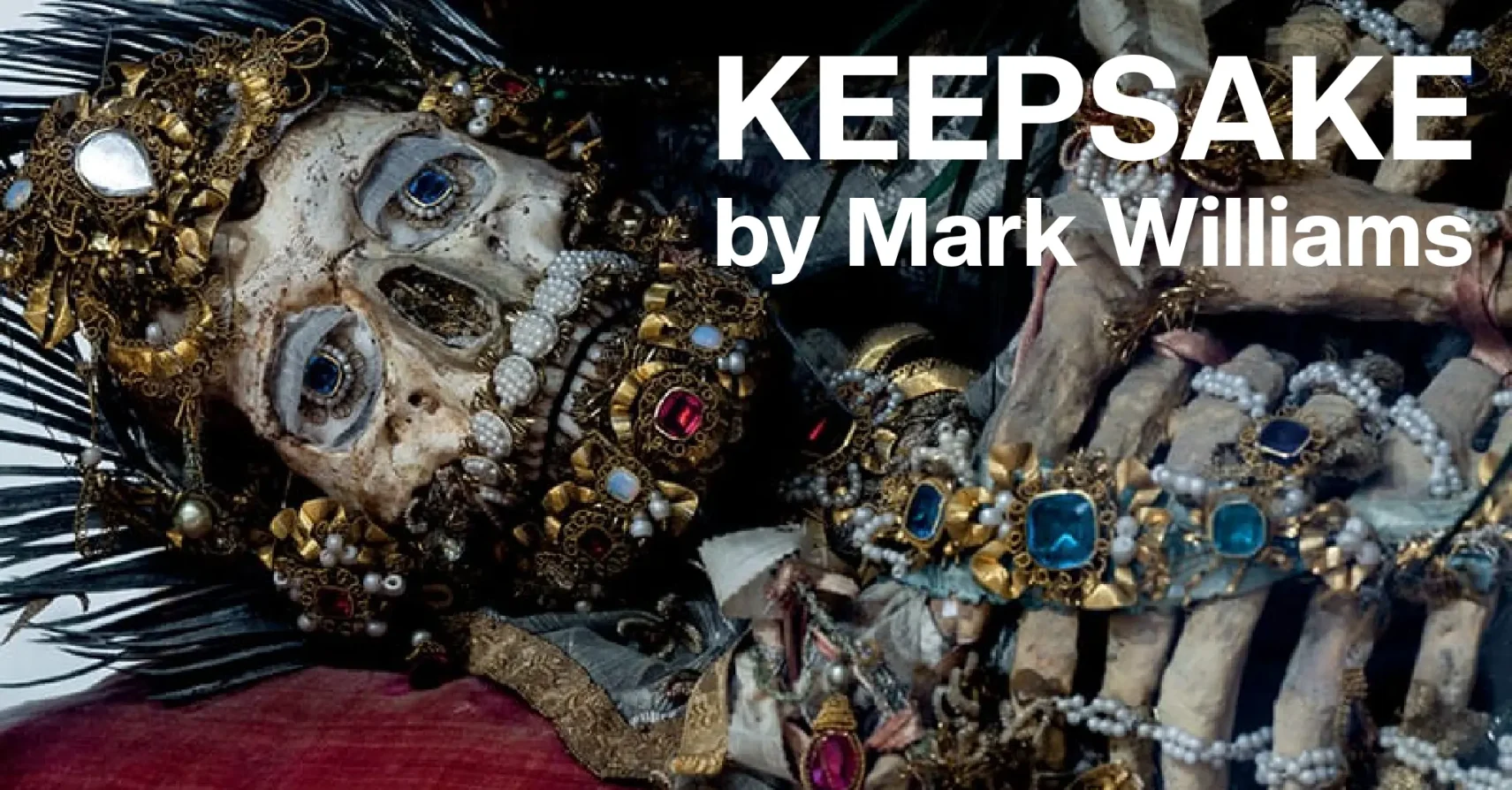
To me, a human skull looks like it’s grinning. Smothered in gold as Lurleen’s bones were, her grin seemed even bigger. Dozens of rings. Necklaces on necklaces. Bracelets halfway to her elbows. Brooches and pins, fallen between ribs. Even some kind of gold headband. All of it gleamed in the flashlight beam.
It was almost three o’clock in the morning. I guessed it would take another two hours to fill in dirt and replace sod. The sun would be rising by six. “We’d better get going,” I said as Ryan just stood there, staring at Lurleen. “Get your backpack, Ryan,” I said, “and leave the flashlight with me.” Without a word, he handed me the light and hoisted himself up.
Carefully, so as not to disturb Lurleen, I slid at least a half-dozen bracelets off one wrist and twice that many rings from fingers. And that was only one hand’s worth. I reached up and put it all on a sod-stack.
In our hurry to get back to the grave, Ryan had dropped his backpack at the head of George and Lurleen’s row, a quick forty or fifty feet away from their graves. He should have been back by now. “Ryan,” I called out just before I heard what sounded like a car door shut.
In no time, I was out of the grave and running to my car, the only car I saw, thank God. There, in the passenger seat, sat Ryan. When I opened the door he said, “Seeing her like that . . . I can’t do it.”
I reminded Ryan that he’d said the gold no longer helped out Lurleen, that the relatives she’d hoped to spite were long gone. “Her spirit might rest easier if the gold was gone too,” I said.
“We can’t do it,” said Ryan.
When I’m not trimming shrubs or picking up botanical garden litter, I’m writing, writing about how, by sunrise, Ryan and I had returned the gold, refilled the grave, and replaced the sod. Sitting at a Donut Bank table in Evansville, Ryan quietly reasoned that now even if someone sees the grave has sunk and digs it up, they’ll see all that gold and think no one had ever tried to rob it. No thief would leave all that.
A fruit fritter later, Ryan called his cousin and said he’d changed his mind again. For all I know, Ryan’s putting doorhandles on Highlanders and searching odds online. The last time I spoke to him, he was sitting in my car in front of his cousin’s house. “About my story,” I said, “just to be safe, I’ll make up everyone’s names. I won’t name the town or give directions to the graveyard. For sure, I’ll call it fiction, but are you still okay with me writing this?”
“No problem,” he said. “Who’s going to read it anyway?”
I think it only took one look at Lurleen for Ryan to learn that he was a better person than he’d thought, that his reputation wasn’t completely justified. Or maybe the Legend of Lurleen got to him. Ryan wasn’t the only person to learn about himself. If it wasn’t for his road to Damascus moment, I would have been on the road to Memphis. But if you’re reading this, know that, aside from driving Ryan to his cousin’s house, I’ll deny everything, including the ring I keep in my left pocket, a keepsake to remind myself who I am.
Mark Williams’s fiction has appeared in “Eclectica,” “Valparaiso Fiction Review,” “The Baffler,” “Cleaver,” “The First Line,” “The Main Street Rag,” and other journals and anthologies. His poems have appeared in “The Southern Review,” “New Ohio Review,” “ONE ART,” “Rattle,” “Boudin,” and elsewhere. He is the author of the poetry collections, “Carrying On” (Kelsay Books) and “Life: So Much to Cling To” (Kelsay Books). He lives in Evansville, Indiana, with his wife, DeeGee, their dog, Dodger, and their cat, Zany Grey.