
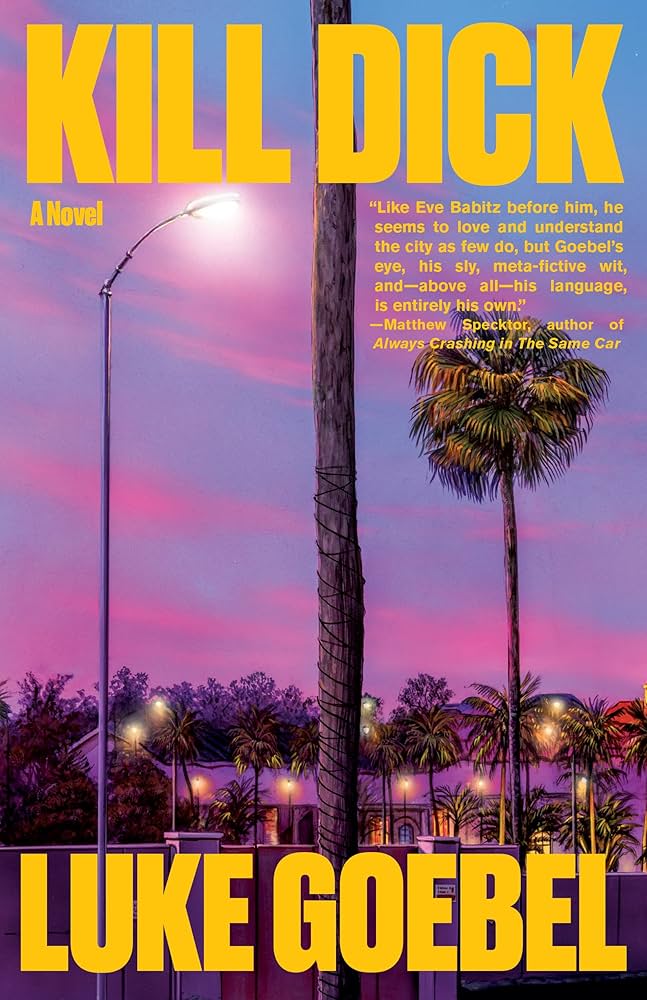
 Luke Goebel is a unicorn in the literary world: an outlaw writer with an underground classic in the indie lit community (Fourteen Stories, None of Them Are Yours, 2014) who has also collaborated on screenplays for two major Hollywood films, Causeway and Eileen, cowritten with Ottessa Moshfegh (the two married in 2018). His new novel, Kill Dick, seeks to bridge these worlds, bringing all of the fire, guts, and intelligence of an experimental indie to a page-turning sunshine noir thriller that feels ready for the big screen (and is in the works). The result is an imminently readable crime novel that takes big chances, cites political and esoteric thinkers like Edward Said and Jean Baudrillard, and somehow still feels like a beach read you want to devour by the pool this summer. We spoke via FaceTime, me in my attic office in Portland, Oregon, Luke in his 1994 Eddie Bauer Ford Explorer parked on Figueroa Street in sunny Los Angeles.
Kevin Maloney: One of the things I was most struck by in Kill Dick is that you start the novel in third person, but a page in, the protagonist, Susie Vogelman, starts talking to the reader, breaking the third wall. A page later, she tells us she’s going back to the third person. I’m curious why you decided to show your cards at that moment and indicate to us, the reader, okay, this is who’s telling you the story. What was the thinking behind that?
Luke Goebel: I’ve always been experimental with metafiction. My first novel [Fourteen Stories, None of Them Are Yours] is woven out of short stories that are invaded by parentheticals and double parentheticals and brackets where I, Luke, through a persona, is speaking directly to the audience and commenting on why I wrote these stories while driving a 31-foot Breaking Bad RV with an illegal object in the side drawer of the bedroom (because my brother left it to me and then died). I was transporting the RV back to its home in Oregon. I probably shouldn’t have been driving a flame-shooting bad RV loaded with felony-charges-bait, but you gotta be a little outlaw in this world.
That said: a good outlaw has humility. I’m not like promoting guns, et al, as I’ve had too many of them pointed at my head. I do think lately, in this current Trump thug-ring-criminal administration and unraveling world, that if you’re gonna make a bugout spot you might want to make sure it can host a diverse community and that you all have some ways to protect yourselves. I’ll try not to roam in my answers much further. But it’s time to form alliances that could survive together for a little while in case the real shit hits the fan.
I ended up crashing into an Acura in Manhattan Beach. I caught the bumper on the side of this Acura and tore the entire side of the vehicle. The cops came while I was kicking my chrome bumper back into place. I was in house slippers. My buddy called me and was like, “Yo, we’re across the street from Reese Witherspoon’s in Brentwood Circle. You should come. It’s a gated community. It’s sick. We got a pool. There’s this artist here who’d love to meet you.” This was before I had met Ottessa or had the honor of having the most brilliant, beautiful wife on the planet. I was like, “Well, I’m in a bit of a bind. I really hope these cops don’t decide to search my vehicle. I’m headed over your way.”
Which I did, and that became the moment that I met my muse, “Susie.” She wasn’t as young as Susie is in the book, but she had a similar situation where she was wealthy and had it all, but had failed as an artist. I thought: this is a character I’m interested in. An adult child of fortune, living off the fat of the land who has her kingdom in L.A., on the Westside with the tile pool and the beautiful home, but who has failed as an artist. You could have it all, but if you can’t have a thing you dream of, you’ve got nothing, right? I was finishing that first novel and needed a new subject.
It wasn’t until after Kill Dick had already been accepted for publication that I thought: what if I made the book a novelization where she’s been on trial? KILL DICK was supposedly done. I mean, it was accepted. I knew it had a home. Still, I wanted more out of it. I didn’t have to pretend like I had to behave and be a decent human being anymore. I was like, It’s getting published. Let’s push the limits.
At the same time, I read Bret Easton Ellis’ The Shards, and I thought: I wonder what would happen if Susie started talking to us?
I’m sure it’s been done, but I’ve never read a book that does the first and third handing off, where the character is like, “I’ll tell you some shit and then I’m going to dip.”
KM: Many of the characters in Kill Dick are in flux. Royal-Lee’s pronouns switch from “he/him” to “she/her” before settling into “they/them.” Phil Krolik takes on the persona of “Peter” and wears a disguise for a large part of the novel. Susie is a kind of chameleon, drifting between the art world and the underworld and the homes of the ultra rich. I’m curious about your decision to have three characters who exist without a stable sense of identity. Is that something you set out to do or did the characters refuse to be pinned down as you were writing it?
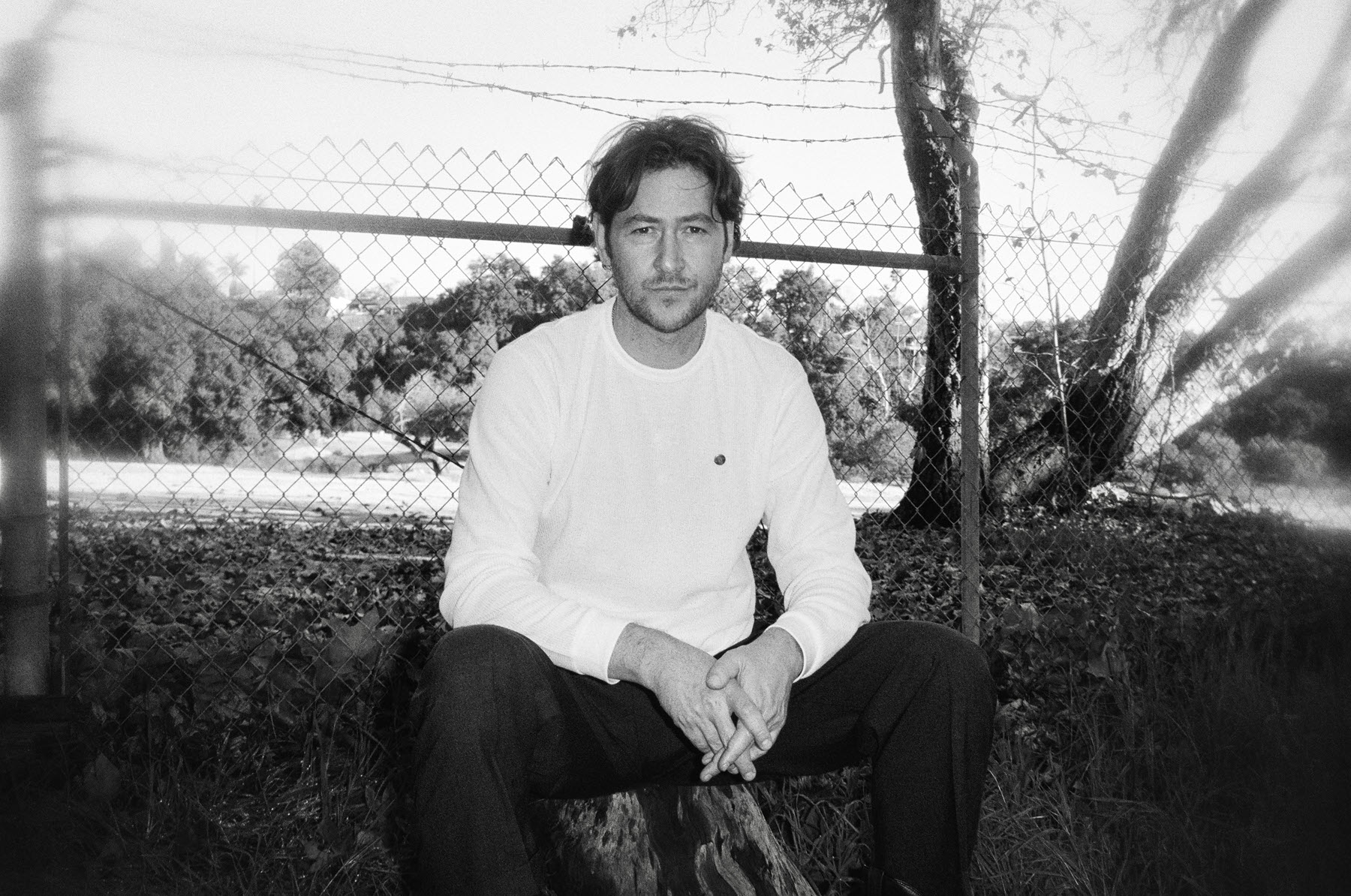 Photo by Jaxon Whittington
LG: In L.A… in America, you’re born into a world that doesn’t make sense, that is full of traps and danger and desperation and manipulation and deception, but you’re asked to pay your taxes and follow the rules and follow the laws and present yourself on an internet that never forgives and make statements that you’re going to be held to later. But Purdue Pharma doesn’t have to fucking behave. Donald Trump doesn’t have to fucking behave. Kash Patel doesn’t have to fucking behave. Elon Musk doesn’t have to behave. And I don’t want to rant. This is where you can just read Foucault’s work on the “outlaw” and surveillance and French penal colonies for children and get it all in better writing than I’m gonna speak to in my Ford Explorer on Figueroa. But none of these bad people have to be held accountable for the shit that they do or identify as–they’re all hiding, in the bad kind of drag, pretending they’re conservative and Christian when really they’re people who harm children and amass wealth without regard for mass suffering and the way their systems deprive life, liberty, and the development of the human spirit and wisdom and happiness. They can be as slippery as eel shit all they want. But we, as the average person, are pigeonholed, forced to self identify as this single thing. When all people are fluid and multi-factional, fractional, and free. So that’s not reality. We aren’t single things. We are reflexive subjects that are engaging in a world that’s fluid, and we’re fluid and we’re evolving. But Foucault knew we would all be watching each other in the voluntary panopticon of shame and hatred–while the fat cats fuck us all. They got us tearing each other down while they rule, and we are jealous of the air time each of us gets in the voluntary observation we are dying to be prisoners inside. So there’s that. But I think about what a real outlaw is and what it offers us, to accept one’s place as one of the outlaws, and to forsake the folds of insider status.
Having grown up in Portland in the ’90s, there was this strong undercurrent of direct action that was part of the culture with Earth First and the Animal Liberation Front. People took on aliases and false identities–and I’m not claiming I blew up any logging equipment but I probably should have and I definitely should have helped liberate animals. There was a need, though, even in the circles I lived in, to not be easily identified all the time. You would take on, or play with, identity in a way that is—you know—I’m not gonna just give you a report on who I am. Why would I? I’ve got tricks up my sleeve, because I live in a world that’s full of tricks up its sleeve.
This book is a form of direct action. The plot is direct action. It ends with the murder of a CEO who has been the owner of a company that has been responsible, at least in part, for the murder or killing of 500,000 people or more through deceptive practices in the pharmaceutical opioid industry. If those people aren’t gonna be held accountable, if they’re not gonna make themselves known, why should Susie reveal herself in full? She’s playing games with who she is. Phil Krolik has to put on disguises because he’s doing things that are eventually gonna lead to the decapitation of the CEO.
KM: You mentioned some of the theorists that inform this book, which you speak of explicitly in the text. That’s something that was new to me, at least in the sunshine noir / thriller genre, citing thinkers and philosophers at length. Was that there from the beginning? Did you always plan to weave together a noir genre thriller with the theorists that inform Kill Dick as a whole?
LG: The book of the mind is something that we’ve largely lost. George Orwell. D.H. Lawrence. Edith Wharton. Dorothy Rothschild Parker. Aldous Huxley… these were people who lived on the estates of what would today be billionaires and had access to and could see the workings of the elite.
I have had some access to some inner worlds of billionaires, for rather short periods of time. But I have infiltrated their homes for brief periods. Also, I’ve been an addict. I’ve lived in vehicles. I’ve lived on the street. I lived above a strip club in San Francisco for $75 a week with one bathroom for 30 or 70 of us (don’t know the pop.) I rented someone’s couch in an RV in San Francisco for a month and had to track the RV around to find my couch. I had romantic experiences for the opportunity of a bed when I was young. I was a mess. So it’s fascinating that I also now find myself with the artists of the day: Simone Leigh and Barbara Kruger and Alex Israel (who gave me a piece of his gorgeous painting for my cover)—Simone Leigh was honored at the LACMA Gala A+F this year, she’s amazing, etc., and working with producers and knowing, as I said, a few billionaires. It’s crazy that I’ve had this range of experience. I’m so fortunate and blessed and grateful, to God and my family that didn’t give up on me, to be sober. I wish that I would have helped my brother, Carl S. Goebel, more, and he would have gotten sober. We were both addicts, and he died, and I didn’t. I owe something for this and I feel something–sorrow and shame.
I wanted to write about where we are in the world. I wanted to use the vantage points that I have gathered from being in multiple stratified sections of this world. I wanted to talk about what I saw happening in 2016 with the giant deceptive campaign of QAnon, Trump’s “Lock Her Up,” blood libel, the division of the nation, Bernie vs. Hillary, and the failure of the Democratic Party to represent the working citizen. The way in which we had lost our course in America, if we ever had it to begin with. I wanted to talk about these kinds of things: how does power work? How does identity work? How does media work? Because I wanted to get people to care about my dead brother. I wanted to get people to care about the people who are on the fucking street in their tents, and I wanted to get people to feel like there’s an active imagination for resistance in this country and in this world still.
We feel so disempowered. We use our phones to burn coal to fucking post on social media. That’s not enough. These kinds of theorists were always a part of that project. The bad version is: you’re just a dude ranting. But why would I do that when I can, in one line, or two lines, refer to some of the greatest writing and thinking that’s ever happened in at least our culture, at least in the tradition that we have access to? Talk about Edward Said. Talk about Simone de Beauvoir. Talk about Judith Butler. Talk about Baudrillard. There are blueprints for how we can map consciousness, and those blueprints for consciousness can give us a roadmap on how to take action to make a better world. I always wanted to talk about bigger things, like how do I process the death of my brother? Even going back to the Sophoclean dilemma: what do you do when you know who is partially responsible for the death of your blood? Do you take action, which, of course, goes from Hamlet to terrorism? What the fuck do you do when you know that there are people who are very, very, very rich and very powerful who are manipulating, deceiving, and destroying our Earth?
We need to look back to when literature was saying something. A lot of books now are like television. They are just a little bit about my identity and a little bit about: I want to go fucking shopping, and I want my part, and the capitalist dream. I wanted something that was taking a more steady aim at: how do we survive on a day to day basis, just so that we don’t feel so fucking disheartened? How do we ask the bigger questions of: what do we owe each other, and how do we make a real impact and change who’s running things? I knew I had to turn that into media, because people are addicted to their phones, their Netflix subscriptions, and the comfort of loving a pretty girl and a bloody knife. If I’m gonna make people care about my dead brother, I’ve got to dress it up in this serial killer. If I’m gonna make people care about 500,000 dead from opioids.
I have so much respect for Empire of Pain, but to get people to care about this, the best way to do it is to dress it up as a thriller, sunshine noir, and give people a genre that they recognize. And from there, make a series out of it. Now you’ve got millions of people watching it and thinking about it and talking about it. If I would have written a book that didn’t have plot and genre, I think it would have been harder to get people to care.
KM: One thing I thought of while reading Kill Dick is that it could only take place in L.A. Everybody in this book is either extremely wealthy and powerful or they’re living on Skid Row. Very few people exist anywhere in between. The only other book I could think of that feels so rooted in L.A. is Brett Easton Ellis’s Less Than Zero. Did you set out to write an L.A. novel or does that feel incidental?
LG: I very much set out to write an L.A. novel. In a San Francisco novel or noir, the sphere of influence is very small. In Portland, it would probably be absurd. But in L.A., the tendrils go so far. That’s why it was called “the octopus.” That’s what they called Universal and RCA, Jules Stein and Lou Wasserman’s world. They had their tentacles in everything. They ended up backing Reagan as governor so they could continue to do what they were doing and avoid some of the anti-monopoly practices, which then shaped the country forever.
I wanted the story to be about the opioid epidemic, about the Sackler family, but also about that being a holograph of these larger structures of deception, control, manipulation, and avoidance of responsibility. I think it had to be an L.A. novel because it had to be able to wrestle with and grapple with stakes that feel like they could reach the entire population of Earth. L.A. has that portal of perception, that pop, where it’s like: this is the dream center of the collective consciousness.
I wanted to take aim at systems and structures of power and deception. And L.A. is a great place for that, not because we’re so inherently deceptive or so inherently corrupt. We are just a collection of intelligent people who are looking at the world and reflecting it in a way that gives us the ability to see it and question it.
There really isn’t a lot of middle class in the book. But I think that’s sort of like in Shakespeare when you start Romeo and Juliet with the rulers of the town or the city because they represent the whole. I’m representing the high and the low partly because the middle class isn’t just disappearing, it’s becoming increasingly irrelevant. No one’s looking out for their interest, including them. They’re voting for fucking Trump. The idea of a functioning middle class that has representation in this country is gone. They’re removed from the book in the same way that, like Susie’s dad says, everybody in this world either has an AR 15 or an automatic weapon, or they’ve opted out of the conversation. Obviously that’s hyperbole, but it’s also sort of true.
KM: There’s a secret organization in Kill Dick called the “Church of White Illumination” that reminded me of the Illuminati or Scientology or Bohemian Grove, any organization that is kind of invisible but has tons of power. In the novel, especially because of the characters’ addictions, it’s almost like they’re puppets, but they’re yearning to cut the strings. To what extent are these organizations actually able to control us and to what extent are we free?
LG: I think that essentially the book is Susie cutting the strings from being a puppet. She is born into a world in very close proximity to powerful forces and people who control and create the conditions of her life, including her addiction. The book is about her exercising her own free will in a way that isn’t determined by those forces, giving herself agency, sobriety, power, fame, money, success, and creative expression. So, she wins big.
When I started writing this book, it was 2016, and I became very interested in QAnon. Growing up in Portland, Oregon, and going to Rainbow Gatherings and running around the forests naked, sharing everything, calling Kesey when I was 12, getting to know Mountain Girl, getting to hang out with Neil Young for a couple of days, getting on Dylan’s tour bus, and being a part of this consciousness of some kind of a resistance that was intelligent and creative. Part of the conversation was always about these forces. You can go down all these rabbit holes, which the internet has made into a full time schizophrenic hobby, which is not gonna help anyone. Part of what the book is making fun of and critiquing is my own stupidity of going down those trails being like, I’m gonna figure out the universe. It’s like, you’re not. You’re not gonna figure it out.
I didn’t have all the answers, and I don’t want to have all the answers. But I started to ask the questions. Now that some of this stuff has come out, we’re like, okay, the good news is, we don’t all feel so gaslit. There are concerted efforts that are evil to shape the future of the world. I think we can agree on that. Now the question is, what do we do about it and how much power do these people have? It’s fucking terrifying.
I just watched this documentary The AI Doc: Or How I Became an Apocaloptimist, which has its flaws, but they talk to people who are at the five major AI entities that are shaping the future, and shit is coming fast. It’s coming hard. They have weapons now, like in Venezuela, where people start bleeding out of their ears. They’ve got the coming of robots and AI-run military operations. We’re all living in this pressure chamber of anxiety and horror, and yet we’re so desensitized. The way that it’s delivered to us is so constant and mediated through the commercial nature of the feed that we just talk about it at dinner while we spend too much on food. It’s like… what do we do to resist? What could resistance even look like? Maybe, it looks like Susie.
KM: You mention a kind of hippie youth in the Pacific Northwest: Rainbow Gatherings… hanging out with Kesey and Mountain Girl and Neil Young. There was an innocence and purity to the art in the late 60s and early 70s. It was an art of resistance. In Kill Dick, you talk about how corrupted the art world has become with the Sackler family (the “Sickler” family in your novel) investing in art while having influence over museums, controlling what gets put in the museums, which is just a way for them to get even richer. How do you, as an artist, try to find purity in your work despite all the corruption?
LG: First of all, I wouldn’t say that I was a hippie. I was as influenced by Kurt Cobain and my admiration for the Black Panthers. My education at Lincoln High School–after I got kicked out of three others… they did one thing right. We read People’s History of the United States by Howard Zinn, and there was this collective underground resistance in the teachers and in us students getting ripped at the park skipping classes and smoking Camels; there was a breath of awareness that included a vast range of underground influences.
This was a shift for me culturally, as I first grew up in a small town in Ohio of 2500 in a monoculture, and then I moved to Portland when I was 11. The thing that I had as a young person in Minster, Ohio, that was different from the monoculture was the lyrics. I was interested in Bob Dylan. I was interested in Joni Mitchell. I was interested in Neil Young… the Grateful Dead… the work of Robert Hunter. My dad had some old blues and outlaw country: Mickey Newbury and Townes Van Zandt. My mom loved Judy Collins and Phoebe Snow. Dad loved Hendrix. You look back to Harry Smith, who saved and anthologized American folk music, which reinvigorated that whole movement. Or Bob Dylan’s interest in lyrics and how that spread through the counterculture. Of course, Dylan was connected to Ginsburg and the Beats and he connected this to the Beatles and everyone else, but that lineage really comes from the black tradition in this country and poor white folk too: work songs that were for working, songs that were for resistance, songs that were for communicating resistance movements with lyrics that the oppressors couldn’t understand. That black and poor white tradition of folk and rock is an act of the spirit of poetry being translated across the era… the eons. I look at Sturgill Simpson right now, and he’s doing it for me in terms of being an outlaw who’s speaking out about the system and is giving us lyrical brilliance. Go listen to “Ain’t That A Bitch” off Mutiny After Midnight, an album that’s breaking the stranglehold of Spotify and streamers ruining the music industry.
I think it’s important not to turn names into oversimplified brands. I called Kesey because I read One Flew Over the Cuckoo’s Nest. I had no idea that he was part of the acid test. I had no idea of anything. I was a dumb kid. I was 12. I’d just moved to Portland and had my femur snapped by an abusive man. I was on drugs and reading. I was like, “I relate to that idea of monocultures and then being outside of the monoculture.” And maybe it just spoke to my own insanity or the fact that I knew someday I’d be in a mental institution, but I was like, “I like this guy.” So I called Kesey. Six years later, I was in my first rehab. I was reading Tom Wolf, and I was like, Oh, shit, that’s who that was! I called again, and I was like, “Hey, is Ken there again? I called when I was 12.” Faye, Ken’s wife, said, “He died a week ago.” I said, “You want me to come help? Like, mow the lawn or pack shit up or anything?” She said, “Where are you?” I said, “I’m in rehab in Minnesota.” She said, “Honey, you just stay there. The neighbor kids are mowing.”
There is something beautiful. There is something meaningful. There is something that connects us to a higher organizing principle of art, love, God, humanity. Every moment we’re losing our way and we’re in total devastation. And yet, the spirit of poetry subsists. And yet, brilliant minds make beautiful things to capture the glory and wonder of existence. That’s what art is supposed to do, and a lot of people are still doing it. But it’s not in speech making like I’m doing, it’s humbly done on the level of the word or in the art.
Susie’s 19, and she’s on dope. She’s frustrated that she doesn’t have it yet, so she’s criticizing everyone, which is an essential part of being young and being an artist, but I think it may also be something that’s more detrimental that we have to look at right now, which is that people would rather tear shit down than hold shit up. Maybe that’s hypocritical, because I’ve got a character who is doing that, but she’s a character. And while she’s doing that, she’s also on the road to taking direct action to being a radical performance artist in the tradition of Nan Golden and Cindy Sherman. Yes, there’s a problem with the art world, and the book is about the Sickler family, this family that makes Oxy, and they play the art world. They are using the art world for their prestige, and so there’s an inherent criticism that has to be made of the art world. But also there are some amazing artists right now. I think Tala Madani is fucking incredible. I think Charles Ray is a genius. I think Simone Leigh is fucking incredible. Alex Israel is a dear friend, talent, and gave me his art for my cover. I love him for always being ALEX. He LOVES L.A.
I think the problem, if there is a problem, is that the old ways that we used to find and share that work have been removed. The main taste-making outlets are no longer so relevant. So now everyone’s got a different screen. Everybody’s got an opinion. Everybody’s an influencer. We’re awash with so much media that nobody knows what to do. It’s harder than ever to break through. We see war images censored on social media instead of in newspapers with nothing else to see but typeface and the occasional watch advertisement. But then, again, Sturgill Simpson is fucking topping the charts with a physical release only album, Mutiny After Midnight. KILL DICK is on the sidewalk. Simpson is fucking amazing. With an opening track called “Make America Fuk Again.” So, we’re not going down. We’re just in a very, very tight spot. And we always have been.
KM: Your last book came out in 2014. This book’s coming out in 2026. I know you worked on at least two movies during that time, and I assume there are others that maybe didn’t end up getting made. After working on a lot of screenplays and working in film, what’s it like writing specifically for the page? Did your time writing screenplays influence this book?
LG: I wrote this novel four times over 10 years and I wrote all the time. When I wasn’t writing screenplays with Ottessa or alone, we’d go write our books. We were always working authors. I would work with her at home and then I would go to my little office in Westlake off of MacArthur Park. We had this little shotgun apartment, and I would go there, or later when we moved, I’d go out to the little cabin on the property in Pasadena. So, I was always writing. I learned a ton about how to write a novel from writing screenplays, but even before that, just from meeting Ottessa and being like, “Oh, right, you can have integrity, and you can say something, and you can still have a fucking story and a plot.” I’m radical. I don’t believe in plot. Through her, I was like, “Wait a minute, you’re gonna have both.”
McGlue is an amazing piece of writing in terms of dialect and speech and prose. And yet there is a story that is gripping. There’s a murder. There’s a love story. So, just from knowing her and then from working in scripts, I started to realize it’s not enough to just tunnel Virginia Wolff style. You can’t just do fucking 30-minute “Dark Star”s. You need to have a skeleton of a story and a theme and characters that want something. That’s the essential nature of a film. The character wants something. We relate to them wanting it. The Safdies have perfected this. Having that in a book is what I learned from screenwriting and from being with Ottessa. For the first time, I was considering that I’d like to have readers. Fourteen Stories had a cult following and sold a few thousand copies. But I wanted to write something that was more of an attempt at a commercial novel. I’ve sold more presales of KILL DICK than I sold of my first book in twelve years. We are in second printing already and the first printing was 5,000.
The amazing thing about Kill Dick, if it’s doing what I think it’s doing, is that people are like, “I want to keep reading this.” And yet it’s doing all this other stuff that I always wanted to do at a level of sentence, syntax, prose, meaning, theory, ideas. Susie wants to be an artist. She’s got roadblocks in front of her: her addiction, her abusive father, his connection to nefarious and horrible people.
But it’s not about what happens in a book. Some of what I really admire about Brett Easton Ellis’s work is that he’s not shackled to everything coming together, and it being, like, “Oh, there’s that story.” It’s not about that. It’s about atmosphere. It is about observation. It’s about life itself. It’s about making museum quality art out of the world around you, and then making you go, “But wait a minute. It’s not a museum. It’s alive. What do I owe it?”
There’s a scene in Brian DePalma’s Body Double where Jake Scully goes to the mall with the parking garage in Beverly Hills on Rodeo Drive, and he watches this woman shopping for lingerie, and it’s just this amazing scene. It doesn’t really move the needle on plot. You look at American Gigolo or the first 20 minutes of Dressed to Kill. These aren’t moves of plot. These are feelings and sensations and desires. You couldn’t even necessarily put into language what they are. You could write an essay about it, but they’re embedded in and part of a skeleton that tells a story that has a plot that we all can relate to or that we’re interested in. So, I think it’s about both.
It’s about combing the gnat’s eyelashes. It’s about the pestilence on the wing in the angel for Marquez. It’s about the delight and wonder of experience, insistence, and consciousness, but you’ve got to have something that makes people want to keep reading so that they can experience those moments of revelry.