Scott Laudati

Scott Laudati is the author of Play The Devil and Camp Winapooka. He runs Bone Machine from a trap house in Hereford, TX with his dog, Josie. Visit him anywhere @ScottLaudati

STUFF YOUR FACE WITH SCOTT LAUDATI by Scott Laudati

A special offshoot of our Recommends series, where Scott Laudati enjoys the planet’s best foodstuffs and eateries. 

The Title Fight: Frank Pepe’s VS. Sally’s. New Haven, CT

Once upon a time, back in the closed society that was 1990’s Staten Island, there was a wholesome order. Our fathers grew up in our houses before us and so we ate the same pizza on Friday nights they’d always eaten, because we were still Catholics then, and we didn’t consume meat on Fridays to honor Jesus’ sacrifice of his own flesh. You knew your local pizza guys by name, and if you’d done good in school they’d send you home with a ball of dough to play with, and when it was time for a birthday party you’d order ten pies from them, not the new place down the street with coupons, and you’d sign your tab with a handshake, because trust maintains loyalty, and that kind of thing was really important in those days. But sometimes you had basketball practice across town. And if another father was driving you home you’d stop at his favorite joint, which he’d swear was the best on earth, and you’d be introduced to something totally new. If you went northeast (where the Brooklyn escapees landed), you might end up with a Sicilian pie. If you went closer to Bayonne (Denino’s), no matter who you were with you got the garbage pie (this was an Island favorite). Each neighborhood had something they specialized in, from stromboli to rice balls. There was one constant no matter where you went, though: it was always good. It had to be. The law of the land demanded it.Our fathers were all cops, firefighters, or sanitation workers. Each morning and night they would leave their Alamos and venture to the alien worlds of the other boroughs. I didn’t understand them as separate entities back then, and they were as relevant to me as Nicaragua and Ohio. My dad, like the other dads, had gone to battle in New York City in the ’70s and ’80s, so there was no way they were bringing their families there for a day trip. But, like archeologists going out into the jungle, sometimes they’d return with artifacts. My father was stationed in Little Italy, and every now and then he’d come home with a Lombardi’s pie. Or Tommy The Tank down the street, his dad was up on 125th in East Harlem, and he’d bring home Patsy’s three days a week. So I was always curious about the pizza world beyond my own, because those ovens they used out there in the foreign lands of the City, they were already ancient by 1990, and they did something to a sheet of mozzarella and a thin crust of dough no modern ovens could. I wanted to find the best. And in a world before the internet, word of mouth was the only way to map a trail.

Pizza is one of those things that can immediately bond two people that otherwise have nothing in common. More so than even a sports team, because you both know you’re part of the smallest fraternity on earth. I got invited to the birthday party of a painter my age who lived in the backroom of a third story art gallery above a Crown Fried Chicken on the worst block in Newark, NJ. We’d never met before. His girlfriend’s dad was smoking crack out the window and his cat had just stolen one of my cousin’s chicken wings and was growling at anyone who got close. The painter put on a Spumoni Gardens hat, which is like throwing up a gang sign to the right person, and then we teleported to the roof and geeked out about all the legendary slices we’d had over a pack of cigarettes. I had a BA in pizza but this dude was a Doctor. He knew where the basil came from that Di Fara’s used. He had the secret Spumoni Gardens recipe many had died for. And he said something I’d never heard before. He said, “The best pizza comes from New Haven.”

 FRANK PEPE PIZZERIA NAPOLETANA New Haven, CTThe lists get longer every year, but the top spots never change. Frank Pepe’s is always first or second. Frank and his wife, Filomena, came to New Haven from Italy in 1920. They spent a few years walking around the Little Italy of Wooster Street selling tomato pies until they could afford a store. In 1925, history was made as Frank Pepe Pizzeria Napoletana opened its doors. It’s hopped back and forth a few times between its current 163 Wooster Street location and the place next door (157 Wooster Street), but the same oven’s been used since 1925. And it’s a beauty. It’s a white tiled coal oven that stretches almost wall to wall, making it more than double what a New York oven could ever be. The original pies didn’t have cheese because there was no refrigeration, so you either got a tomato pie or tomato pie with anchovies. In the 1960s Frank Pepe secured his name in the history books when he invented the clam pie. When I was a kid this specialty was only found in a few restaurants, but now the clam pie is available everywhere, and exists in the cannon up there with pepperoni as one of the few acceptable toppings. The same guy’s been shucking the clams for 40 years. The turnover rate is small. Most of the staff shares the family name.  SALLY’S APIZZA New Haven, CTSally’s is the other top spot and they jockey back and forth with Pepe’s. They’re only a few feet away from each other and I guess Sally’s main advantage is that on the one-way street you pass it first. The sign that greets you hanging above the front door immediately pulls you into the family-style tavern. Where Frank Pepe’s clean white pizza oven and kitchen make you feel like you’re going to your Grandparents’ house for a Sunday dinner, Sally’s reminds you of the local bar you’d stop at when you go back to your hometown. The walls are the wood panel of your childhood basement. The floor is a dull brown tile like your friend’s house whose parents still smoked inside. It’s almost as old as Frank Pepe’s but it doesn’t look classic. And it’s still lit by the same stained glass lampshades that hang above pool tables in midwest bars. You can’t ask for a better setting to melt the roof of your mouth and extinguish it with a fountain soda. No one who’s ever sat there has asked for more. There is no more.  

The Verdict

It would be stupid to declare a winner here. The two best pies on earth exist within half-a-block of each other. They have the same oblong oval shape. They have the same thin crust—well charred but not burnt. The interior of each restaurant feels like two sides of the same home. And the same family is behind both of them (sisters, daughters, and sons bleed through both family trees)! It’s like deciding between your favorite dog or your favorite band. I like Sally’s better, but only by the smallest margin in voting history. And it could just be the novelty. The first few times I went to New Haven, Sally’s had weird hours and it was never open, so I ate a lot of Frank Pepe’s, which blew everything else I’d ever eaten out of the water. But when I finally got ahold of a Sally’s tomato and cheese pie, I felt like I’d bitten into the main conductor of the Universe. It was almost spiritual, a realization that as men we didn't deserve something this good, and yet, whatever’s in charge still decided to give it to us. It was The Holy Grail. Now that you know you’re in good hands at either Pepe’s or Sally’s, I’ll give you some advice. Back when I started going to New Haven you could get a table and eat inside. If you attempt to do this now you will ruin the experience, because you’ll be waiting and starving for hours. Call ahead and order your pie at least an hour early. You’ll see the word APIZZA everywhere, it’s pronounced “ah-beetz,” but if like me, you feel stupid saying that, you can tell the nice lady on the phone you want a “Large tomato and cheese pie.” When you arrive you’ll see a line in front (this goes for both Sally’s and Pepe’s). These are the people waiting to dine inside and they’ll be there forever. Walk right past them (they’ll be mad), and enter. A kid will be sitting at a table. Tell him you want to pay cash. He’ll send you inside the restaurant and you’ll have a minute or two to look around, take a quick picture, marvel at that ancient wonder of a pizza oven, and then you’ll get your pizza. On the way out that kid who sent you in will have a bucket of plates, cutlery, and napkins. Give him a small tip, take what you need, and then head back out. There’s a great little park in-between Sally’s and Pepe’s with a bench you can sit and eat. Or, you can go one block north to Wooster Square Park, a beautiful brownstone-lined patch of grass no one is ever at and eat your pizza in peace, looking up between bites at some of the only original architecture left in a city that used to be known for its elegance and gentry. The real winner of the pizza wars is New Haven. My head still shakes every time I say that.  Follow Scott’s international adventures, food-based and otherwise, on his YouTube channel.

Continue Reading...

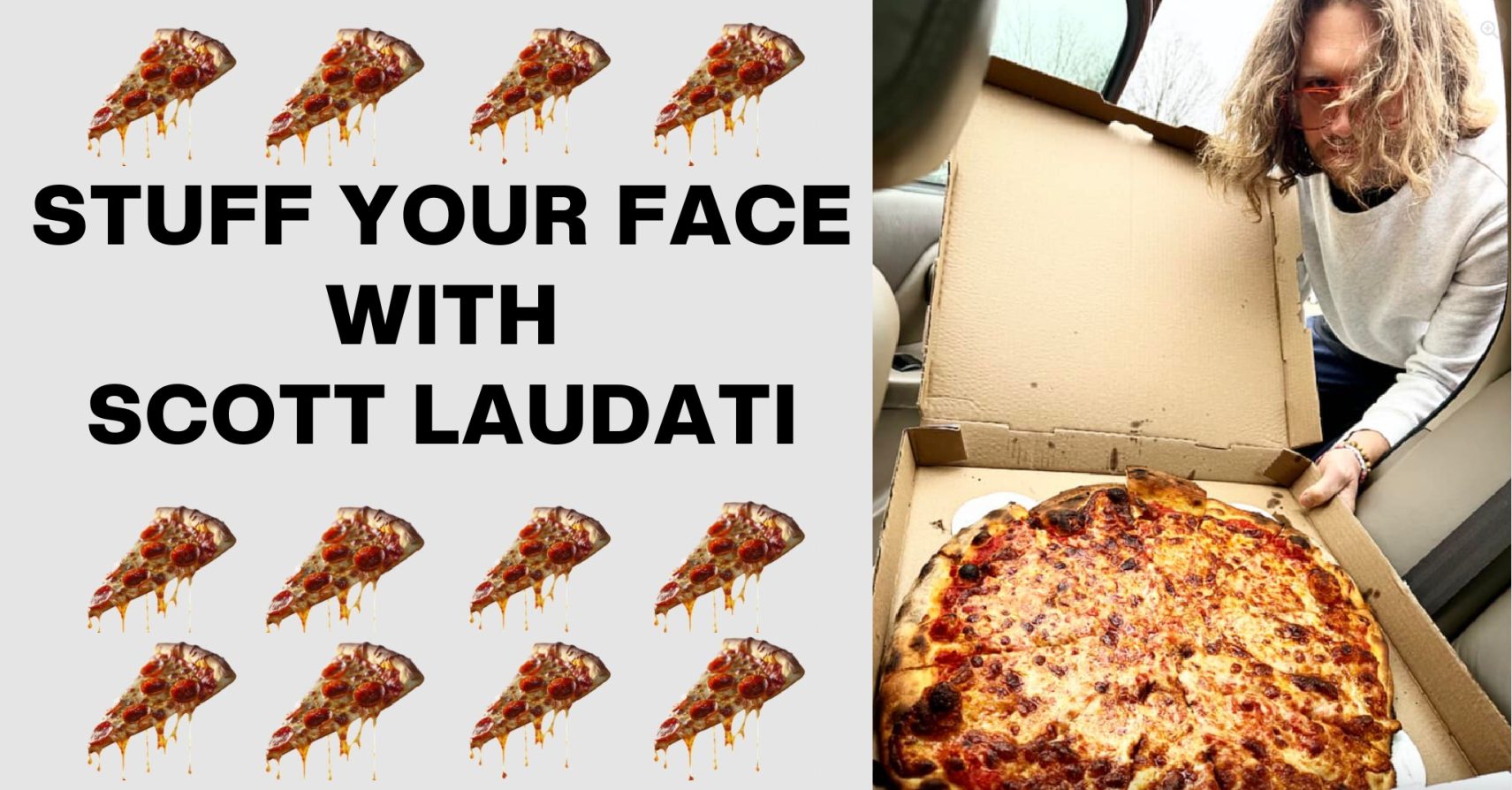
STUFF YOUR FACE WITH SCOTT LAUDATI by Scott Laudati

A special offshoot of our Recommends series, where Scott Laudati enjoys the planet’s best foodstuffs and eateries.New York City, 2010. It’s a 24-hour city. Budweisers are $3. We complain about the rent but a one bedroom is $950. Something big is happening every night in Brooklyn. The So So Glos are playing in a loft and our friend Dasha knows the door code. The garment building hasn’t been annexed by Netflix yet, its basement is rented by an old Marxist who calls it “The CCCP Gallery” and Drew is having his art show there tomorrow. And most importantly, pizza, which we eat on the way into the party and then again on the way home, is $1.50 a slice, and every block has a lit storefront where men are stretching dough and spreading sauce until last call.This city does not exist anymore. I don’t know when exactly it happened. One day the bodega became a grocery store. Then it was demolished entirely and a one story building became a ten floor high rise. The Budweisers don’t come with a shot special anymore, they are just $7 now. And your friends, who you sat in parks with, helped move couches down impossible flights of stairs, they just disappear. Where did they go? Why didn’t anyone invite you? Suddenly you’re all alone with no friends, nowhere you can afford to drink, no galleries to just pop into on your way home, and you ask yourself, “Did I make it all up?”This is a New York City tale as old as time, though. It’s never been a place anyone stayed ’til the end. And if you’re the last one left it means you didn’t get the girl or the memo, and now you’re forty with roommates. But something is happening here that has never happened before. New York City is losing its pizza. It’s losing it to indifference, to age, to a change in taste, but mainly—it’s money. The landlords have chased out everything else that once made New York great, and now they’re coming for the pizza.Most people won’t care, because most people have terrible taste. You see, not all pizza is being targeted. Every day, in every former working class (ghetto) neighborhood, a small storefront transforms into a hipster-hell zone with pizza at its core, but you would never know that at first glance. Because you’d have to wade through the Japanese models who are never eating or doing anything really but getting their picture taken. Or the other influencers posing with whatever sets this pizza joint apart from the other one-hundred vaguely punk rock, sweaty, mandatory four-hundred pencil tattoos on the cook’s arms. And the gimmick always comes across like it was conceived in a boardroom. Like a cute cup of ice cream, or the merch that repurposes Basquiat’s crown in “fun” new ways. “Edginess.” “No conformity.” Somehow your slice is always charred. It takes twenty-five mins to come out because they have to grate fresh parmesan over one slice at a time. But you can get laid at this place. And a band in Ridgewood will eventually write a song about it. So if that’s your idea of a good time, rock ‘n’ roll. But it’s not my thing. I like real pizza. I like it served by two brothers who took over the business from dad and now their rent’s about to become unaffordable after sixty years. Or a brother yelling at his sister to hurry up with the cup of Coke she’s filling from an ancient soda fountain. He takes the soda, slides two slices over the counter to you, and says, “$6.” Nothing in this city has cost $6 in almost a decade. You can smell old New York emanating off the wood-paneled walls of these joints. The ingredients are always fresh. The pies haven’t been sitting around and getting reheated all day. A man who loved pizza founded this place with his family’s name, and he put his blood into it because as far back as his line went it was all leading to this, and now his children remember that legacy, the struggle, the commitment, what it took to put food onto their tables after grueling hours, and so they put their souls into it, and whether you show up on Monday at 11 a.m. or Saturday at 10 p.m. every slice has been made with the same care and pride.Here are my Top 3, gold-medal, all killer, Peoples’ Champ winners of Williamsburg: Tony’s Pizza (Graham Ave.)I wanted to start with my favorite. This is the place I walk my dog to. Somehow they’ve kept this small room looking exactly like the Italian restaurants you remember from your childhood. The ones you went to after basketball games when your coach was buying for the whole team. They’ve got the small tables with the red-checkered table cloth. The old-timers from the block drink espresso and dunk a biscotti in like it’s Pisan fondu. They look a little side-eyed when you walk in with a dog, because this is an old-school neighborhood, but they break when she jumps on them and looks for a pet. Two brothers run around doing the prep work, if you want to talk they stop and talk, they’re funny, they’re tough, and two very pretty girls take your order, pet your dog, and if you’ve said the right thing you might even get a wink and a smile as they hand you your plate. And this triangle that’s on the plate, it’s a Mona Lisa, it’s a hug from your mom, it’s perfect. It unravels in your mouth with each bite. It’s not just mozzarella, there’re hints of other cheeses, like parmesan, maybe pecorino, a sharp cheese but a subtle note, and little flakes of oregano to round it out. There’s good distance between the crust, the sauce, and the cheese. Light on the oil, no char. It’s a clean slice you can eat in front of someone and not need a napkin. A famous pizza critic gave this place a 7.9. Only someone from Boston would miss the subtleties that make this pizza exquisite. Tony’s gets a 9.5 every time. No debate.     Sal’s Pizza (Lorimer St.)Sal’s is pretty much the same vibe as Tony’s, and at $3.50 a slice, they’ve got a lock on the cheapest pizza in Williamsburg. There’s not as much in way of ambiance as Tony’s, but that’s not Sal’s fault. The stretch of Lorimer Street it’s been on for decades has flipped to the yuppies with expensive baby strollers, so there’re no Italians out front talking about the old days like Tony’s. But that’s okay because the pizza comes out quick, and when you take that first bite the cheese stretches out but snaps before it slops on your chin or shirt. And it’s a great slice. It’s so simple I feel stupid even writing about it. Sal found three things that can’t be improved when you put them together. The hipster spots will hire a guy on a unicycle to spread honey from an upstate bee farm on a slice and charge you $8 for it, and if you’re from the midwest you’ll be dazzled by the spectacle, and if you’re an idiot your brain will tell you it tastes better because you’ve got every color of the rainbow staring at you. But we need you to be better. We need you to realize a great song isn’t just an endless chorus. What makes it a piece of art is your need to return to it. Not just a box to check on your bucket list, but something to live with. To spend your days itching to go back again.  How can Sal’s charge so little for a slice and cover the rent? Well, luckily this ain’t Papa Johns, and the guy who owns Sal’s is usually behind the counter, so you can ask him these kinds of questions. “I bought the business from Sal a long time ago,” he says, “And Sal owned the building when he opened up.” Here we have the American Dream. A man who owes nothing to no one. A man who bet on himself and won. So now the prices don’t have to rise with inflation. The ingredients don’t have to take a hit to cover the bottom line. This is what we call a victory in the game of Capitalism. Sal’s gets a 9. I’ve never had a mediocre slice. Vinnie’s Pizza (Bedford Ave.)Vinnie’s is the correct way to bridge the old and whatever this nightmare is that’s happening now. It’s been on Bedford Ave. since 1960, but if I didn’t just tell you that you’d never guess it’s eligible for Social Security. Aside from the classic New York style pizza, the interior of Vinnie’s is a time capsule of the Williamsburg that existed when I moved here, when it was more like the Lower East Side and less like a tech-boy playground. Street art and pizza paintings decorate the walls, a thousand band stickers are on the door, and a Ninja Turtles bench out front brings a smile to the face of everyone born in the mid-’80s. There’s a body type I associate with Vinnie’s that I never even see here anymore—a fat dude in skinny jeans, in a tight band shirt with a balding head and big full red beard. Does that make sense? It’s punk rock but I can’t really tell you why. Maybe it’s because I ran into Andrew W.K. there once at 2 a.m. Vinnie’s has none of the Italian thing that I usually require with my food. This should be a deal-breaker, especially where I’m from. We require authenticity here in New York above everything else, but there’s this ability skateboarders and artists and punks and trans kids have when they find a neighborhood that’s been abused and neglected by time. They take all the influences, the blank spaces, the garbage, the possibility of redemption, and through raw power they build their own thing, and this hustle brings a level of cool that supersedes any idea of what a neighborhood or restaurant is “supposed to be.” This is Vinnie’s. It’s the original punk rock pizza of Williamsburg, on a block that less than two decades ago was the raddest place in New York. And though it’s become one of the most expensive pieces of real estate on earth, Vinnie’s is actually still pretty close to the roots. A slice is less than $4. It tastes exactly like a slice of pizza should. It’s like a Budweiser. It’s consistent every time. There are no frills. It’s just awesome tangy cheese over a sweet sauce. And it’s open late. Fun fact, last time I was there Kieren Culkin was dragging a kid and a kid’s basketball hoop angrily past the Ninja Turtles bench looking like every choice he’d ever made was the wrong one. I’ve also seen Rosamund Pike on that corner as well as Michael Cera, Nas, Sean Penn, and Willa Ferryra. If you’re visiting, grab a slice at Vinnie’s and sit on that Ninja Turtles bench. You’ll see someone.

Continue Reading...

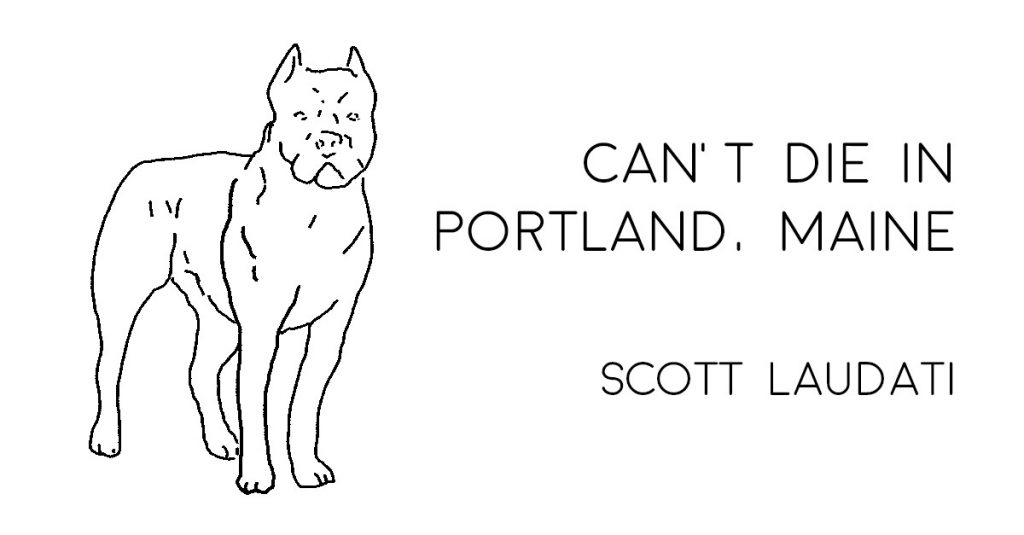
CAN’T DIE IN PORTLAND, MAINE by Scott Laudati

It was summer everywhere but Portland, Maine. From Brooklyn to Portsmouth road crews sat along I-95 and stared longingly into the finality of their existence. This was it. The winters too cold and the summers too hot. Fall was spoken about with the nostalgia of an old folk song, and spring, of course, ran shorter than a rainy weekend. The crews spent the entirety of these uncomfortable months working on the sides of roads while everyone sped by on their way to somewhere better, or worse. The only time the two groups interacted was when a motorist fell asleep and drove over the short wall of orange cones. “At least we have a job,” one hardhat probably said to the other. And none of them ever walked into traffic; they never even thought about it. But Seal thought about it as he drove past those crews on his way straight north from New York City. In fact, it was all he thought about. Of his existence. Of walking into traffic and freeing himself from the nightmare of being a man.

Seal liked Portland because he never sweat there. It was the beginning of June when he drove by the 7-11 on Congress Street and parked his car behind Longfellow Square. He stopped to play a game of pinball in a laundromat then walked down to Casco Bay. He saw a few crabs running in the muck left behind by a receding tide. He smelled his favorite smell: the chopped bait used in lobster trapsa rotting stink caked into the wooden hulls of lobster boats and imbedded deep beneath the nails of watermena stink that grew stronger as their boats headed back to the docks after a day at sea. And he saw his favorite bird: the black backed gull, almost the size of a pelican. Dozens of them gathered and erupted with long calls just as returning lobster boats became visible. The gulls sailed down on the docks with singular focus, arguing for prime spots where a few scraps might get tossed their way.

Yes, Seal liked Portland. He didn’t like kids and their fat parents bumbling around complaining about the price of lobster rolls. Or how they waited in line for hours to try French fries dipped in duck grease. Or how his serenity was continually broken by car horns and idiots screwing up the simple crosswalk directions in ways only tourists can. But all in all, he thought Portland was probably his favorite city. 

Seal didn’t know why he cared about having a favorite city. He was 35 and totally broke; a feat he couldn’t quite understand being that his whole previous year had been spent under piers in Brooklyn rebuilding dock pilings. And when he tried, he couldn’t really remember anything from that time. He wanted to. He wanted to explain to everyone the way your hands feel in January when seawater gets under your gloves. The real maddening blind rage your body goes into when you can feel parts of it dying for $22 an hour. He wanted to tell them that quitting was the only sane thing to do in an insane world. But nobody actually cares about anyone else, so he didn’t bother. And he was thinking about that last winter now and it didn’t seem like it had really been him who’d gone through it. What did his mind do while he hit concrete with a hammer 40 hours a week, week after week? He had no idea. He could remember his ex-girlfriends. His priests. The people he’d once called his best friends. The moment when it all stopped being possible and everything just morphed into varying levels of impossible. What was the point? Did he ever really have a chance?

Now 35 years had gone by. A whole lifetime and nothing to show for it.

He stepped into the water of Casco Baythe freezing water, replenished daily with new freezing water brought down by the Labrador Current from Halifax and beyond. He cursed but he was committed. After all, it was the same familiar cold he’d known on those days floating under the piers that finally brought him to this. The days spent soaking wet, icicles growing off his clothes and weighing him down like his limbs were the branches of an old tree, sailing into the eternal blackness of a pit whose middle saw no light, the sounds of a city above muffled and rounded out into some inaudible animal roar, like he was sailing around the Congo itself, but caught there in the real heart of darkness, seeing no more than the radius of his headlamp, or occasionally when a hose or machine exploded unexpectedly he might get a second to see his surroundings until the fireball or a fountain of sparks arched into the river, plummeting his world back into the unimaginable desert of darkness again.

Yes. He was going to kill himself one way or the other. It’ll be a better world without me, he thought, one less loser consuming the dwindling water supply. He was up to his neck now. Well, here we go. He took one last breath as a commotion began up on a docka high New England dock that had to account for the 30-foot swing between tides. He turned to look and saw the same crowd who just before had been ruining his peace with stupid human moments like: “See how fat I look? That’s a terrible picture, take another one!” and their dad or boyfriend grumbled that this wasn’t what they’d spent all year working for, but still, feeling obligated to prove to their friends watching on the internet that their lives were perfect, repositioned themselves for a more professional stance, and hoped somehow that through a filter or maybe God’s love this next picture would suffice, and they wouldn’t have to endure any more berating in front of the other tourists.

But now they all pointed at Seal, screaming, “HELP.”

That was when he saw a dog, thrashing wildly under the dock, being bounced against barnacle covered pier legs and letting out a fading yelp with each hit. Seal hated people, all people, on some days even his own mother, but he loved dogs, all dogs, and he didn’t hesitate a second before swimming madly to the drowning creature.

Blood seeped out of the dog and thickened the surrounding water like a chemical spill. Barnacles worse than serrated knives attacked their bodies and Seal took a good sticking as he caught up to the dog. It was a big pit bull, probably the king of many dog parks, but it submitted immediately into his arms, and paddled the best it could, not just to assist, but because it was a good dog, and it didn’t want to be a burden to anyone, even upon its possible death.

But it did not die. Seal got the dog up onto the beach and saw that the wounds were basically superficial. The dog was exhausted more than anything else, and after a few seconds of heavy panting his tail began to wag like a toy coming back to life. You’re a good dog,” Seal said, and patted the dog’s stomach to reassure him. It was a beautiful moment. Man and dog lying there under the fading summer sun. Blessed with this Maine shore. A savior and a life saved. Nothing could mean more than this. 

A blonde girl with a tattoo above her eyebrow and a shirt that said “PUSSY IS THE POWER” slid down the embankment toward them like a skier with no skis. “Cornwall. Cornwall, my poor doggy,” she said. “Is he ok?”

“He’s ok,” Seal said. “He is what he’s supposed to bea good dog.”

“I can’t believe you were out in the water already. If you hadn’t been there Cornwall would be dead. You’re a hero. You saved my dog’s life. It’s a miracle.”

Was it a miracle? If he hadn’t decided to kill himself once and for all, about seven hours ago in Brooklyn, he never would’ve driven here, he never would’ve gotten into the cold water, and Cornwall would be a floating snack bar filling the stomach of every crab and seagull in the bay. Was this fate? His life now had meaning. He was a man who’d found his moment. For the first time not marginalized by circumstance and bad luck. I am The Peoples’ Champ, he thought, I am indeed a hero.

Then the girl started sobbing and put her head against Seal’s chest. The pandemic was over but he realized it had been a year since a woman touched him, and he liked it. She pulled her head away and apologized for the wet mess of her face, but she didn’t really sound sorry and he thought she looked pretty good.

“We’re catching an REI Line out of here in an hour and heading back to Asheville,” she said.

“Ohhhh, you’re a gutterpunk.” He pointed at the tattoo on her face. “That makes sense. You don’t smell like a gutterpunk, though.”

“Have you ever done it?”

“No.”

“Come with us.”

“I can’t.”

You have to! There’s a zoo we’ll pass in New Jersey. They have hyenas and you can feed them popcorn. Have you ever fed popcorn to a hyena?”

“That does sound pretty good. But I was supposed to kill myself. I only stopped to save your dog.”

“Come to the popcorn zoo with me. You can’t kill yourself now. That would be absurd. And I’ll feel responsible.”

She was right. It did seem ridiculous now. Seal’s life had gone from completely meaningless to almost the guarantee that he was going to get laid if he could just hang on a little while longer. I can always kill myself tomorrow, he thought.

They left the beach hand in hand and the dog never strayed more than a foot away. They crossed Munjoy Hill and she lay down in the street in front of the lighthouse and told Seal to take a picture of her from an angle that made the lighthouse look like an erection growing from her crotch. Then they went down to the railyard and sat in the weeds.

“If you can count the bolts in the wheel, it means the train is going slow enough for you to jump on,” she said. “I’ll go first. When I get on, you toss Cornwall up to me, then climb up.”

A freight train that had to be two miles long crawled by. They waited for the engine car to follow a bend out of view and sat silently while the oil cars followed one by one. Eventually the boxcars were up. 

“Let’s go,” she said.

She threw her bag into an open boxcar and it disappeared inside. Then she put both of her hands on its floor and hoisted herself up. 

“Ok,” she said. “Get ready, Cornwall.”

Seal and Cornwall were slow trotting along with the speed of the train. She laid on her stomach and extended both hands out from the boxcar. Cornwall was pretty seasoned at this and basically jumped up and landed in her arms. Once the dog got situated, she reached her arms out for Seal. He was ready. Suddenly a big jolt jerked the train back and forth and then it started to speed up.

“Hurry,” she said.

Seal started to fall behind. His feet slipped on gravel laid along the side of the tracks and made a full sprint impossible. Do it, he said to himself, you’ve got one shot at this

He lunged at the open door. Both of his hands slapped the floor next to the girl and her dog, but there was nothing to grip. For a second it looked like he had it but then his hands started to slide and the momentum of gravity pulled his lower half under the train. Then he was on the ground. He saw his legs bounce limply between the bottom of the train and the tracks before  they disappeared out the other side. He looked at the open boxcar, growing further away, and her face, her beautiful face decaying into some kind of horror, etched into the last seconds of his memory. And the dog, too. Cornwall’s mouth moved in vicious agony, teeth bared and unforgiving, barking with no sound.

Will the hyenas get enough popcorn tonight? he wondered. Will they go to bed hungry?

Continue Reading...