
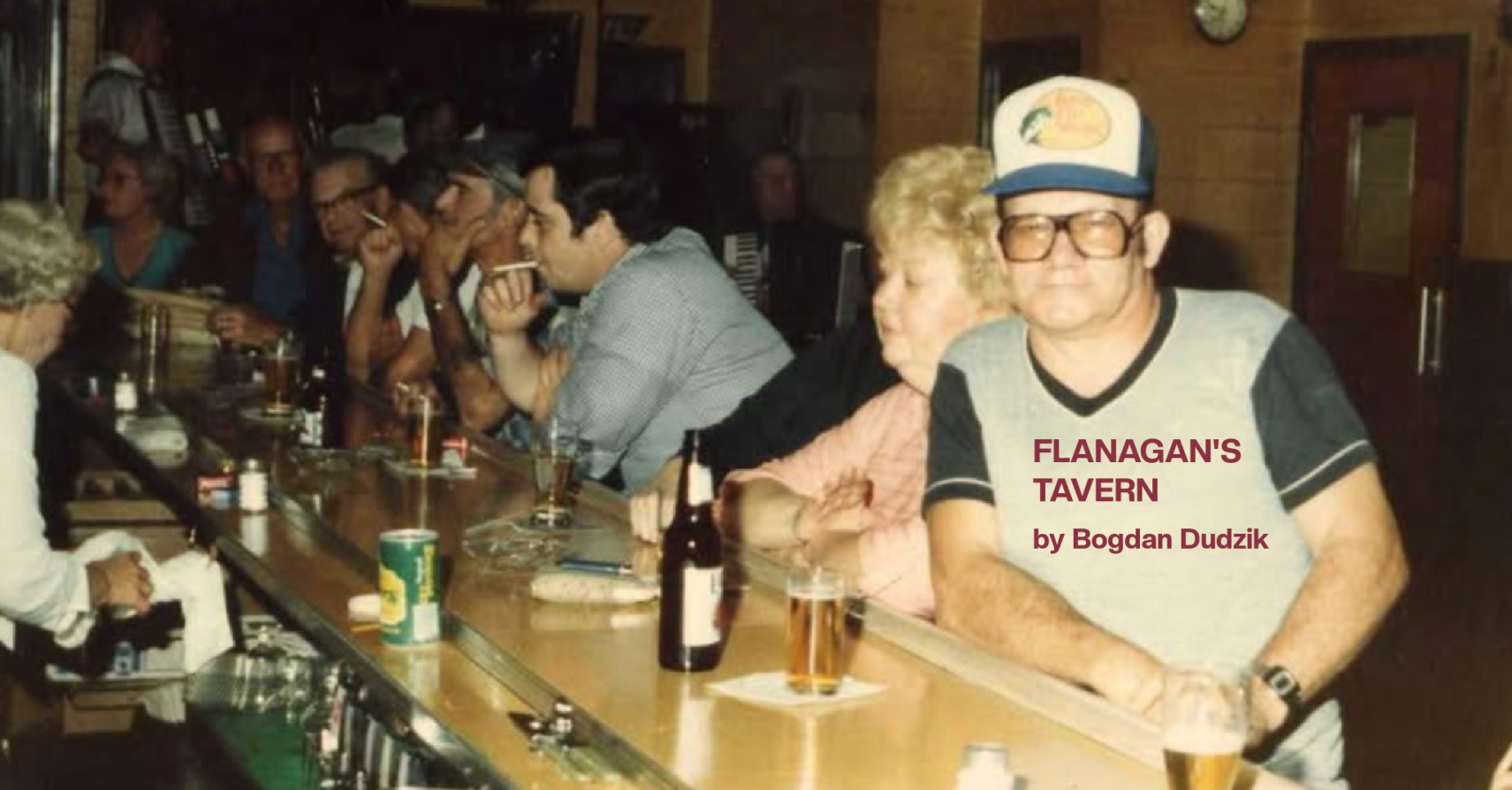
The barmaid at Flanagan’s saw George come in and headed to meet him at his regular table.
“How was your day, George?” she asked.
“It was good, thank you. How was yours, Tammy?”
“Mine too. You remember me mentioning my son having his heart set on being a baseball player despite being small and not terribly athletic?”
“Yes?”
“He told me he was the only one in his class to solve an algebra problem.”
“Good for him,” George said.
“Then he said, I kinda like algebra. He said this as if he was embarrassed to admit it, like telling me he liked a girl in his class. The first time he’s said anything positive about school.”
“That’s great news,” George said.
“I had to restrain myself from hugging him. You know how kids are. If a parent strongly praises something, they’ll start questioning their feelings about it.”
“You’re a wise parent.”
“I don’t know about that. You do what you think is right and hope for the best.”
“The usual?”
“Yes, please.”
The same crowd was at the bar, the old-timers and the newer regulars, all having a good time interacting. He had been coming to Flanagan’s for over a year but had never struck up a conversation with anyone except Tammy. He’d never been able to make friends easily.
When he was very young, his nanny would take him to a playground. She would sit down on a bench, open a book, and tell him, Now go play with the other children. All the other children readily mixed, while he, acutely self conscious, stood on the fringes or circled. He always felt that something basic and instinctive was missing or defective in him
George noticed a new person at a corner table and wondered whether his mind was playing tricks on him: why would his brother-in-law be in Ann Arbor?
Laura, his wife, tried to reassure him. My brother is always reserved with people he doesn’t know well, she said. In time, he’ll warm up to you. But he never did.
The man stood up and advanced toward him. His expression was menacing and George was seized with fear.
“What is it about me you find so fascinating?” the man said.
George realized that the man was not his brother-in-law.
“Sorry, didn’t mean to stare. You look so much like my brother-in-law.”
“Your brother-in-law?”
“Yes, on my cell phone, I have a picture he’s in.”
He found the photograph and passed the phone to the man.
“I see why you thought I was him.
“Mind?” the man said as he pulled out a chair.
“Please.”
He continued to study the photograph.
“I guess with eight billion people in the world, there’s bound to be someone that looks like you.”
“Yes,” George said.
“Is that woman standing next to you your wife?”
“My late wife,” George said.
“I’m sorry to hear that.”
“Thank you.”
“How long ago?”
“Two years next month.”
“She was lovely. You must miss her greatly.”
“Yes, terribly.”
He handed back the cell phone, reluctantly it seemed to George.
“This is a nice tavern,” the man said. “You come here regularly?”
“Several times a week. I like it because it’s near the Amtrak station.”
“I can relate. I lived several blocks from a Greyhound station when I was a kid. Every time I passed it, I would imagine getting on one of those buses. Never had a clear destination in mind. Just wanted to get out. A week after turning fifteen, I got the money to do it.
“My stepfather would go the bathroom before going to the racetrack. Most of the time he’d come out in a few moments without flushing the toilet, so I guessed that’s where he stashed his money. I found it in a cigar box under some removable boards in the vanity. $241. Figured he owed me that. I had to work at his garage the entire summer. Never got anything for it.
“I suppose the Amtrak station has a different sentimental attachment for you.”
“I’d take the train to Chicago from here to spend the weekend with Laura—that was my wife’s name. She was a student at the University of Chicago and I was a student here at U Mich.”
“High school sweethearts?”
“No. A friend of my college roommate’s girlfriend. Came over one weekend on a visit. I was invited to go out to dinner with them. We had a nice conversation at dinner, but I didn’t think anything would come of it. Out of my league. To my great surprise, she called a few days later.
“We got married right after graduation.
“The medical report said she died of a brain aneurysm.
“She suffered from headaches. I told her to see a doctor, but she brushed it off. My grandmother suffered from headaches all her life. She lived to be ninety three, she’d say. I should have been more insistent, but she seemed in excellent health otherwise. An avid runner.
“The night she died, I could tell it was especially bad. I kept checking on her every fifteen minutes or so. But then I got absorbed in my work. A math paper.
“If I had kept checking on her regularly, she might have been saved.”
“You can always think that if I did this or didn’t do that, something awful could have been prevented,” the man said. “My mother had a friend who gave her grandson her car because she was worried about him walking home from work at night in a dangerous neighborhood. He was killed by a driver running a red light. She kept blaming herself. ”
The man motioned to Tammy.
“Another gin and tonic, please.” Then, turning to George, he said, “What’s your poison?”
“I think I’ll have the same.”
George tried to pay, but the man waved him off.
“You’ve lived in Ann Arbor since your student days?” the man asked.
“Yes, except for one semester when I was a visiting professor in France. Laura was fluent in French and really enjoyed it. We’d often go on vacation there.
“You’re not from here?”
“No. Can’t really say I’m from any place. My job involves constant travel. One year, I kept an apartment in Atlanta. Thought you needed some place to return to or you’d lose your bearings. Nice place, pleasant neighborhood, but I ended up spending eighteen days total there that year. I didn’t renew the lease.”
“I don’t know how I’d feel waking up in a strange place every day,” George said.
“You get used to it, as with anything in life. And there’s an upside. You’re not tied down.”
“Don’t you get lonely?”
“You can always find company, even if you have to pay for it. But, yeah, sometimes when I see a couple who appear genuinely in love. Then I remind myself how every couple I’d known, whether they started off in love or not, ended up being miserable together.
“I think certain people are incapable of being in a long-term happy relationship. Maybe they’re missing some gene or maybe they never had a role model to learn what it takes.”
“You were never in love?” George said, then regretted asking a stranger such a personal question.
“Hard to say. There was a girl a couple houses down from me that I cared for. Maybe more like a sister than a romantic partner. We were in the same boat. Alternately abused and neglected. I told her about my plan to leave. She begged me to take her along. I told her that wasn’t possible, but I’d come back for her when I got settled. I meant it when I promised her that. But then I kept pushing back the time, telling myself I’d wait until I got a better paying job, saved up more money, had a decent place to live. Of all the things I did in my life, not keeping that promise was the one thing I feel bad about. Realistically, I wouldn’t have been able to provide her with the life she deserved.”
He ordered another round of drinks.
“You never get tired of all that travel?”
“Sometimes. The funny thing is that when I’m at one place for more than a few days, I get restless. But the reality is, I won’t be able to do it much longer. It’s not a job for old men.”
“You plan to change careers?” George said.
“No, the skills I’ve developed don’t carry over to other lines of work and I’m too old a dog to learn new tricks.”
“So you’re thinking about retiring?”
“Up to this year, I’ve never thought about it, to tell you the truth. Didn’t see how it applied to me. Lately, I’ve been thinking it might be a real possibility.”
“Any particular place you’re thinking of retiring to?” George said.
“Some place warm. Greece or Spain, where you don’t need to dress for the seasons. Where the locals are friendly, but know when you want to be left alone. Where everything you need is within walking distance.
“There would be a restaurant where I’d become a regular. Be on friendly terms with the owner and staff. Maybe get to know some of the locals, enough to have dinner with once in a while—
He stopped himself there as if he were embarrassed to go on.
“Sounds nice,” George said.
“Who knows? I might grow bored to death in a few weeks.
“What about you?”
“I have no plans other than what I’m doing now,” George said.
“You’re still young. You should get back on the saddle.”
“I can’t see myself going through the dating thing at this point of my life, not that I was ever good at it.”
“You managed to get Laura. You had to be doing something right.”
“That was a fluke.”
“You’re selling yourself short. Take the barmaid. You’ve obviously charmed her.”
“She’s friendly with everyone,” George said.
“Not in the same way.”
The man must have received a message, because, in mid-sentence, he took out his cell phone from his jacket pocket. There seemed to be a sudden change in his expression, but he reverted back to form so quickly that George wondered whether he had imagined it.
“You’re a mathematician, you said?”
“Yes,” George said.
“Is that what you’ve always wanted to be?”
“When I was young,” George said, “I would have preferred to be good at something like sports.
“My parents signed me up for tennis and soccer lessons, expecting me to follow in their footsteps, both being athletic, winning trophies at their country club tournaments. But I was always the worst one in my group. I’d see the embarrassment.”
“My father was the captain of his high school baseball team,” the man said. “Led it to the state championship. My mother was the head cheerleader. The two were probably the most envied students in their school. Prom king and queen. But that was the high point in their lives. Didn’t have what it takes to get to the next step.
“Maybe if they didn’t have that brush with glory, they would have been content with an ordinary life with its little pleasures and comforts.”
“There’s little glory in being a mathematician,” George said. “I don’t think more than one in a hundred persons could name a notable living mathematician. And many people have had bad experiences with mathematics. Once, on a plane, when I told a woman I was a mathematician, she lit into me as if I were to blame for her not getting into a college because of a low calculus grade.”
“So what made you decide on mathematics?”
“In high school, I was actually more interested in political science. I was idealistic and had big ideas about making the world better, or so I thought.”
“What changed your mind?“
“Whenever I expressed an idea in class, it was dismissed or ridiculed. Some of those ideas were naive and not well thought out and I would have accepted the criticism. But I was never attacked for flaws in my reasoning. It was always personal. I was told if I wasn’t happy with how things were in America, I should live in the Soviet Union.
“I thought college would be different. There the students would be more liberal minded than in my affluent, conservative community. But things weren’t much better. In some ways, worse. I wasn’t attacked for my political views, which were basically the same as my classmates’. I was just ignored. When I expressed an idea, there was no reaction. And then when someone with a more dynamic personality essentially repeated what I had said minutes before, he’d be praised for his insight. I realized that to be successful in political science and most academic fields you had to be a showman. Since academics were the only thing I was good with, I found a field where you didn’t need to be charismatic.”
“My stepfather had what people called a big personality,” the man said. “He also took credit for what others did.
“In his garage, there was an ace mechanic who could find what was wrong with a car that stumped other master mechanics. Most of the time he’d determine what the problem was just by listening to the engine.
“After the car was repaired, my stepfather would repeat to the customer what the mechanics had said was the problem, making it seem he was the one that figured it out. On his own, my he could barely fix a flat tire. By the time I left home, I knew more about cars than he did.”
As they continued to talk, George noticed that the man seemed increasingly distracted. There were abrupt breaks in his sentences and his thoughts trailed off. This was most evident when a person came into the tavern. George wondered whether the man was expecting to meet someone, but if
so, it was not someone familiar, as he kept scrutinizing the new person for some time. Sometimes his eye repeatedly returned to a particular person.
The man took out his cell phone, Again his expression suddenly changed. Annoyance? Concern? George could not tell.
“Sorry, I have to go,” the man said. “Business.”
“I understand.”
“I didn’t catch your name.”
“George.”
“I’m Jack. It was nice talking to you, George.”
“It was nice talking to you, Jack.”
Instead of directly leaving, Jack went to the restroom.
George hoped that Jack would be able to enjoy that retirement he described. He pictured him ambling down a narrow, winding street, a gait starkly different from the one he had observed, pausing to chat with locals. At the restaurant he frequented, the waitress headed to his regular table when she saw him enter, just as Tammy did with George. The owner would emerge from the kitchen for a friendly chat. Later, a local woman would join Jack at his table.
Jack emerged from the restroom and walked out of the bar. George was disappointed that Jack had not turned to him with a nod or small wave, the way Tammy did every time he left Flanagan’s, but then decided Jack was in a hurry,
George stopped at the restroom on his way out. He was relieved that nobody was there as he felt self-conscious and could not pee when someone was present. To make sure he was really alone, he glanced under the stall door.
He spotted a man’s shoes. He instantly knew something was wrong, because the shoes were not flat on the floor, but pointed up with the soles exposed.
“Is everything all right?” he said, standing a few feet from the stall.
There was no answer.
“Do you need help?”
Again, no answer.
George gingerly opened the unlatched stall door.
The man was propped on the toilet seat, his arms dangling from his sides, his neck bent at an odd angle.
George moved closer and determined that the man was not breathing.
He was the man whom Jack seemed most interested in.
George left the restroom and went directly home.
As he often did, especially before falling asleep, George had an imaginary conversation with Laura.
I don’t believe Jack’s a bad person. It could have been a setup, an ambush. Whatever Jack did in the restroom, I think he felt he had no other choice. It could be like that time he took the money in the cigar box. It was a desperate escape, but the law would deem it theft.
If I were to show the police that photograph in which Jack could be your brother’s identical twin and revealed other information, it could have led to his apprehension. He’d likely spend the rest of his life in prison while people who do much more harm live openly in luxury. But maybe I’m romanticizing him, just like country folk romanticized Jesse James. Do you think I did the right thing by not informing the police?
You have a good heart, George, he heard Laura’s voice tell him. You have to trust it to lead you to the right decision. As you have often said, Life is not black and white like mathematics.
Bogdan Dudzik was born in a displaced persons camp in Germany and then spent most of his childhood in metro Detroit. He worked at auto plants while attending college. Before he retired, he was the manager of the Slavic Languages Department at Mathematical Reviews in Ann Arbor, Michigan.