
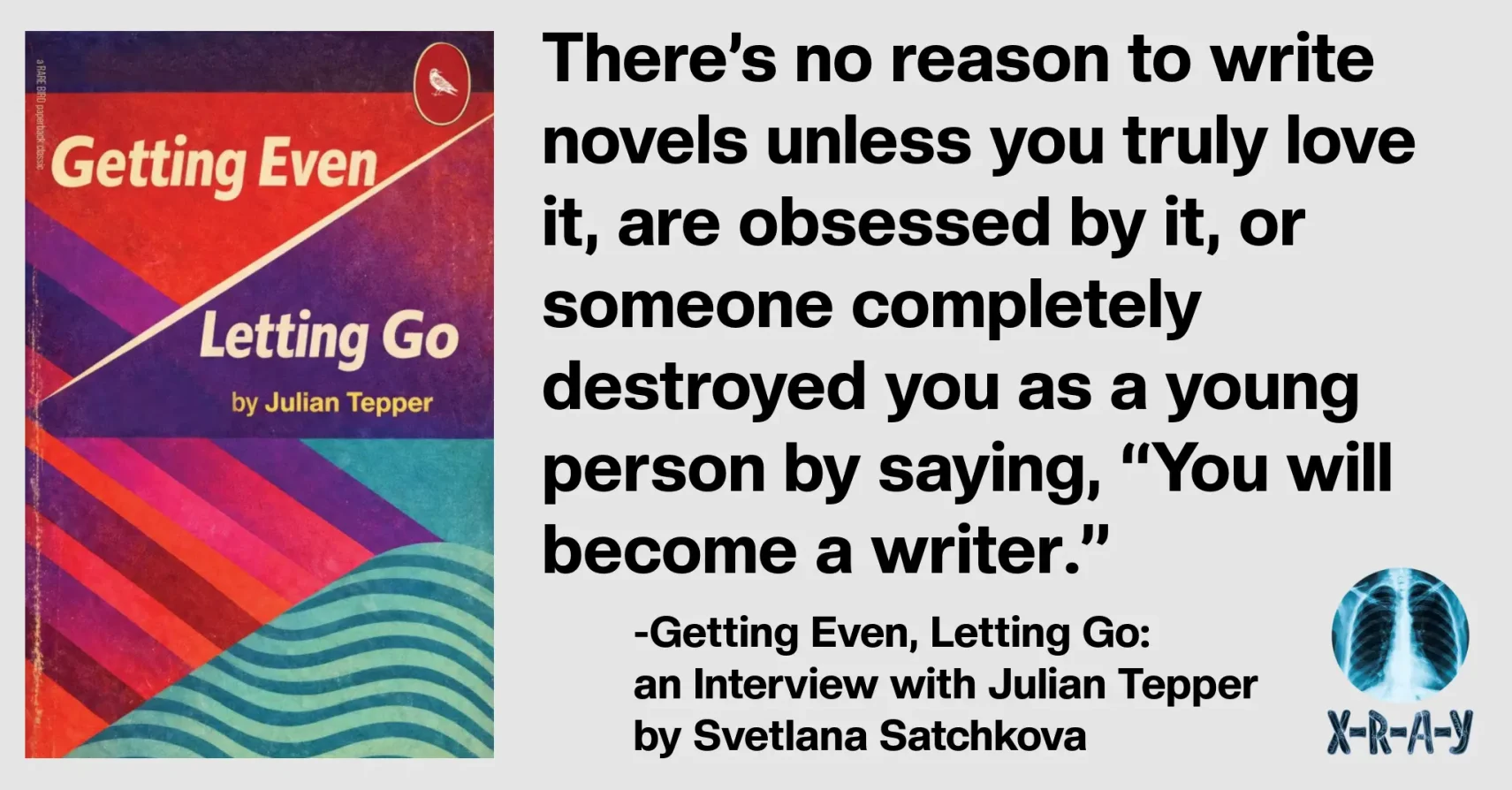
Julian Tepper’s fifth novel, Getting Even, Letting Go (Rare Bird, 2026), takes place over a single day in New York. We experience it with Gene Mills, a broke writer whose ex-wife has become a famous painter. Years after their marriage ended, Gene still has some forty paintings his ex-wife left behind. Among them are two portraits of a man she had an affair with while they were together. In need of money and still nursing the wounds of the marriage, he decides to sell the portraits at auction, hoping both for a financial windfall and, perhaps, a way of finally letting go. To coincide with the new novel, Tepper’s publisher, Rare Bird, has reissued his four earlier books with striking retro covers that turn the five novels into something resembling a single series—objects from another publishing era. Tepper has found his own way of bringing the five novels together, creating a map for each one and plotting more than a hundred New York locations across the books.
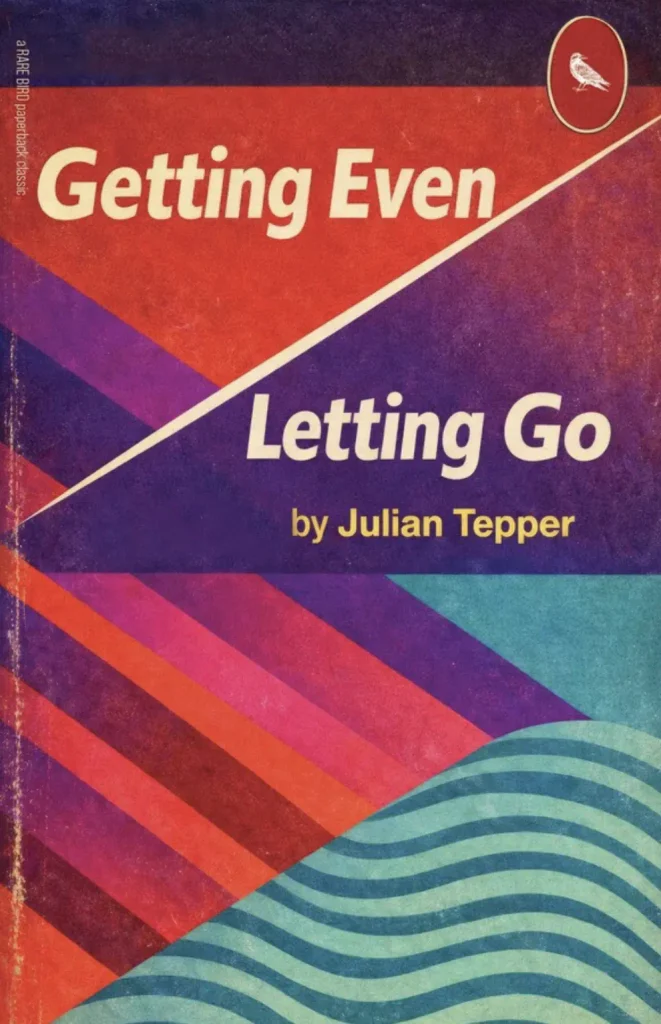
Svetlana Satchkova: I love the new covers. They have this great retro look, and seeing all five books together, they really feel like a series. Where did the idea for the covers come from? How involved were you in the design?
Julian Tepper: Thank you so much, Svetlana. I appreciate it. As the story goes, directly following an event for Cooler Heads at North Figueroa in the Highland Park neighborhood of Los Angeles, I was walking down the street with Rare Bird’s founder and publisher, Tyson Cornell, someone I owe a great deal, and he broached the subject of doing the reissues. Of course, I was keen. Then around the time I came to Rare Bird with the manuscript for Getting Even/Letting Go, Tyson brought it up again and said that we should move forward with the plan. A good day in the writer’s life, for sure. As for the designs, I had the idea that we reference those great covers used for psychology books from the 1960s. I sent some images along to Rare Bird and they ran with it. I could not be happier.
SS: And then there are the maps. What made you want to map the locations in all five novels? When you finally saw them laid out together, did you notice anything about your work that you hadn’t noticed before?
JT: My mother loves maps, and I’ve inherited that love from her. Growing up, we had so many framed maps on the walls or leaning against them, and even now my mother has old maps of New York City hanging in her apartment. So my own interest in maps certainly starts there, with her. As for mapping the locations from all five novels, the idea came to me and took hold. I wanted to see it for myself. So I went novel by novel, mapping out all the places in each one on five separate maps. And then I put all the locations on one map, color-coding them by novel. I don’t know if it necessarily changed how I think about New York or why I write about a particular location in my novels, but visually I find it very pleasing.
SS: What struck me looking at the maps is how many of these places have to do with making art—studios, rehearsal rooms, galleries, museums, clubs. Why have you kept coming back to that particular New York?
JT: For me, there is this generational relationship to the city and how art lives in it. My mother was a jewelry designer, my father a musician, and my mother’s father was a painter, all based in New York. It’s just part of the language of the city that was handed down to me. My older son, Silas, is fifteen. His mother is a painter based in New York, and with his author-father being New York born-and-raised, he already has an even greater fluency than I did at his age as far as art and the city.
SS: Can you give me some examples of places you used to frequent with your parents as a child or teenager—and maybe places Silas goes now?
JT: We lived in the museums—the Met, the Whitney, the Guggenheim, MOMA, the Natural History, the Museum of the City of New York, the Frick. My mother was always taking me. Now my own kids spend their weekends and summers growing up in these institutions, too. It’s amazing—you can walk into a single room in any of these museums and think, “Just one of these works would be an event if it turned up almost anywhere in the world.” It’s incredibly fortunate to have that kind of access.
SS: I came to New York from Russia and learned the city as an adult; you grew up here. What was it like to have New York as your hometown?
JT: I believe New York is the best place to grow up, but mostly because of the freedom to walk out your door and just go. That’s not the case in most places. Most kids need their parents to get them from point A to point B and then back again to point A. In New York, you can just walk out your door—and so begins the journey. That’s so much of it. But in my early twenties, after college, I went through a brief spell when I wasn’t happy here. At that point in life, you’re searching for your identity, and in doing so you may want to re-identify yourself and be someone else, and that’s difficult because you’re back where you began.
SS: As someone who wasn’t born here, I’ve always been fascinated by how quickly you start feeling that certain places belong to you—a particular bar or block becomes your place. Your characters seem to do that constantly. Is that how you experience the city? Can you name a few places that feel like yours, or that belong to your characters?
JT: Like most anyone who spends time in New York, I fall in love with the places. For me, I want to express that feeling—or any range of feelings about a place—on the page. I certainly have my places. You get to know them well, and they have their own lives within your life. Once a place grabs hold of my imagination, I usually want to write about it. Examples are always piling up in my head. Yes, the list keeps growing. In Getting Even/Letting Go, the Central Park Carousel is very important. I’ve been going there my whole life. I’ve taken both of my children there so many times. It’s a part of me. There’s also a lot of mythology around the carousel—Salinger uses it in Catcher, so there’s a major nod there in Getting Even/Letting Go—and as a device a carousel offers a lot to a writer.
SS: You seem to like hotels, too.
JT: I do. Don’t we all? My mother was a jewelry designer and she would have jewelry shows at the Plaza Hotel when I was a kid. Her company, M & J Savitt, would get these honeymoon suites and the shows would last about ten days, and I would spend a week in a honeymoon suite at the Plaza, like some kind of fucking Eloise. The Plaza has lost its identity in the city now. I don’t think anyone really knows what it is anymore. But it used to be a central hub of life, whether it was the Oak Room, which was a great place to have a drink, or the lobby. It had such a history. I wrote about this death knell on the Plaza for The New York Review of Architecture. But yes, I do love a great New York hotel. Always a nice place to have a drink and disappear.
SS: The maps also made me think about how differently people inhabit the same New York. An artist, a financial analyst, a lawyer, a child can walk down the same block and essentially be living in different cities. When you create a character, do you also create that character’s New York?
JT: A lot of the characters in my books are based on people in my life, and I probably have an idea about their New York. Oftentimes that view point has had a long gestation period. My mother’s mother’s mother was born on the Lower East Side, for instance. If I’m writing about people like her, Frieda Gunzberg (who does have a cameo in Ark, though she takes another name), I have a sense of her New York based on time spent with her and conversations with other family members. As for Getting Even/Letting Go, something else is happening. In New York, so many people can be found in a particular room because they want something from someone. Usually money or professional success. And that’s what we have in Getting Even/Letting Go. Each character’s New York—whether I made them up, drew them from a composite, or pulled them right out of my own life—they’ve sprung from the New York of greed, and the desire for more, more, more.
SS: Getting Even/Letting Go begins with food, and food places show up in your novels almost as often as art spaces—Balthazar, Barney Greengrass, Chinatown Supermarket of Manhattan on East Broadway, B&H Dairy. What place does food occupy in your fictional universe?
JT: Well, people have to eat. And food is very important to New Yorkers. One of the great privileges of living here is that we’re surrounded by every culture and so much great food. It’s a reason to leave your home and get together with people, and the great places are truly special. They’re also portals. Whether it’s a Barney Greengrass, the Chinatown Supermarket of Manhattan, B&H Dairy, or a thousand other places, the food allows you to leave one life and access another. And there’s also something aspirational about food in New York. People spend money on it to gain entry to a certain experience or the feeling that maybe they’re a little more special. At the beginning of the novel, the protagonist is hosting a party and spending his last dollars on this extravagant charcuterie spread. I would bet there are a couple thousand people in the city right now spending their last dollars putting together a spread for some occasion this evening…
SS: Why does Gene, your protagonist, spend his last money on those particular foods instead of serving something cheaper? Is the food a way of demonstrating status?
JT: Exactly. It’s a posture toward being something you’re not—representing yourself as wealthier, as having more access, or as having more knowledge. People love to talk about food as if they’re connoisseurs of certain things, as if they belong to a universe where people know about rare things. Someone uses a tone as if he were talking about Schopenhauer, but he’s just talking about charcuterie. So yes, demonstrating status through food is certainly part of it.
SS: How did you come up with the premise of Getting Even/Letting Go? Were you inspired by events in your own life, as you have been with some of your other novels?
JT: Some ideas are taken from my own life, but as much as I write about my own life, in my experience plenty needs to be fictionalized for the sentences themselves to come alive. I hesitate to say I write autofiction. It’s one thing to be inspired by your own life and another to put that life down on the page in the kind of fine detail that autofiction, at its best, is after. This book takes a lot from my life, but it’s heavily fictionalized.
SS: The novel takes place over a single day, and we always know where Gene is and what time it is. Why was it important to bind the story so precisely to New York’s geography and to this one day? Did you try other approaches, or was that always the structure?
JT: This book came faster than any other book I’ve ever written, which was great. Part of that was finding the structure you just described fairly quickly. With each novel, I start without knowing what I’m going to make, or even what the book is about. I don’t plan these things in advance. As I was writing a scene or two that would eventually become the book, I thought: Let me see if I can put this into a single day. Then: Let me see if each chapter should have the time and the place marked as a heading at the top. It was trial and error, and it worked out.
There’s so much to think about when you’re writing a novel. Trying to hold everything in your mind is an ongoing battle. The single-day structure, with the ticking clock toward the auction and the results of these paintings, was a gift. It resolved time while adding stakes.
SS: The novel is also a critique—a satire—of the art world. What interests you about that world, and what are you satirizing?
JT: My dad is a musician, and for a while my brother and I followed in those footsteps. That experience became part of my novel Between the Records. I learned a lot about the music industry in that time. The mother of my older son is a painter, and through her I got to see the art world up close. And after publishing novels for about fifteen years, I’ve gotten to know the publishing world pretty well, too. The art world is the most ridiculous of the three. It mostly comes down to the fact that there’s just too much fucking money. We know what paintings can go for now—hundreds of millions of dollars for a single painting. Once the money gets that ludicrous, there’s no hope. I’m not diminishing great artists or their contributions, but they have to contend with this particular insanity, and its impact on the work itself.
With novels, money isn’t much of a factor. There’s no reason to write novels unless you truly love it, are obsessed by it, or someone completely destroyed you as a young person by saying, “You will become a writer.” It’s not a great means to an end, unless the end goal is writing a book.
SS: Sometimes you see someone pay $100 million for a painting, and you look at it and think, What the heck is this? My child could’ve done it. Is there something about the art world that allows for that in a way literature or music doesn’t?
JT: The question of skill, yes. To write even a terrible book, you have to overcome obstacles of composition and organization. Music has shown us that you can make a lot of noise, and that can be attractive, but usually something wonderful—the human spirit—is coming through. Hopefully that’s also what’s happening in paintings that appear to be on the level of what a seven-year-old could make. Maybe the artist is asking something about the human spirit—more often form—and neither should be dismissed. But there is still something to be said for asking: What is the level of ability here? In visual art, you can hide behind conceits—enough to fill a dictionary—in a way that you cannot if writing a novel, even a mediocre one.
SS: People keep asking me if I’m ever going to write a novel that takes place outside Russia. So I’ll ask you the New York version: Would you be interested in writing a book that takes place outside New York?
JT: I’m writing a new novel, and it’s also based in New York. But I have left New York in other books. Cooler Heads goes to Poland for a while. About a quarter of that book is set outside Kraków, and I was really excited by that section. Between the Records hits the road in the United States, and Ark goes to Los Angeles. I dabble. You do have to know a place well to write it well. There are few things worse in the writing process than turning up somewhere and realizing, I can’t really feel this place. I’m out of my depth here. I don’t really know it. That’s not good. But yes, I’ll leave New York. I’m sure it’ll happen. And if it doesn’t, that’s okay, too.
Svetlana Satchkova is a Russian-born journalist and novelist who immigrated to the United States in 2016. She covers culture and politics, with bylines in Literary Hub, The Rumpus, Newsweek, LARB, the Independent, and others. Svetlana has published three novels in Russian; her first novel in English, The Undead: A Novel of Modern Russia, came out in 2026 from Melville House. She lives in Brooklyn.
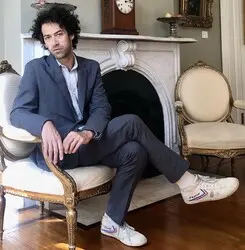
Julian Tepper is the author of five novels. His writing has appeared in The Paris Review, Playboy, Brooklyn Rail, Zyzzyva, Daily Beast, Bomb, Tablet Magazine, The New York Review of Architecture, and elsewhere. His essay, “Locking Down with the Family You’ve Just Eviscerated in a Novel” was a “Notable Essay of 2022” in Best American Essays 2022. He was born and raised in New York City.