
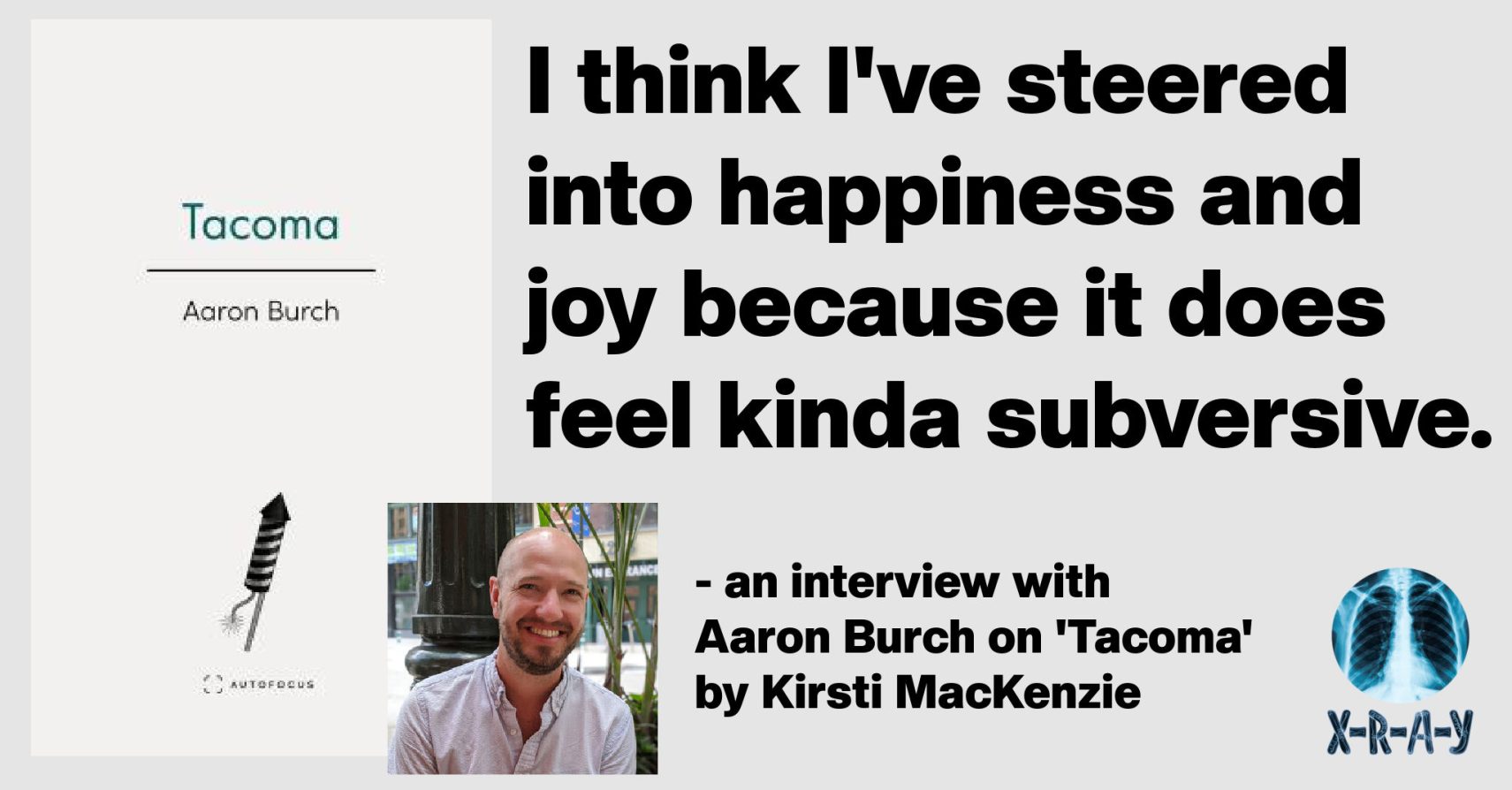
 Part of the fun of being a writer, and learning from other writers, is seeing what others leave of themselves on the page. To follow their work and discover their signature—the intangible that makes someone’s writing so intensely theirs that there is no mistaking it for being anyone else. There’s no mistaking Aaron Burch on the page. Tacoma (out with Autofocus Books) has all the hallmarks of a Burch book—nostalgia, magic, fun, optimism, friendship, and more heart than almost any other writer doing it today.
As writers, we’re often taught that characters should grow through hardship, conflict, and struggle. Tacoma explodes that instruction. Burch leans unapologetically into lightness, a gentle argument that characters—and authors themselves—can grow just as much in the meditative moments where you pause to notice the good and the gifts in life, especially when the world is heavy. It’s a joy to read, and Aaron is a joy to interview. Read on if you could use a little more of it.
I love that Tacoma starts with a bit of a mission statement—this isn’t going to be a story about a house, or a summer, or a story where everything goes wrong. Instead, you’re telling a story about “magic, beauty, and wonder”. It feels almost subversive in literary fiction to tell straight up happy stories—were you aiming consciously for that subversion?
It’s funny, I think everyone I’ve talked to so far has drawn attention to that line. Which I say not to be like, “ugh, everyone is asking that, Kirsti! *eyeroll*” but that it’s been cool to hear how much it is hitting for people!
I don’t think that I was aiming for subversion… but I like that it kinda is? (And I feel like that is part of why readers have been so responding to it?)
I recently published a story by Anna Vangala Jones, a story in nine parts / “lives,” and my initial editing… not even suggestion, so much as question, was wondering if we should shuffle the order, moving the first piece, the “happiest” love story to the end. Anna was hesitant, and we ended up not doing that, and rightfully so, but talking through it was interesting and beneficial to the final draft of the story. And when we were discussing it, Anna mentioned that, in the pro column to that idea, was, “I do think a happy ending can be sort of subversive now.”
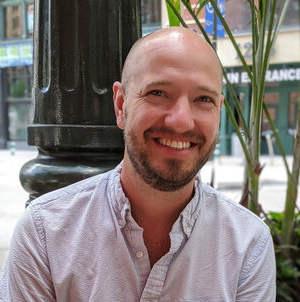 When I talk about myself as a writer, and especially one of my primary themes, joy, I often say I’m generally a pretty happy-go-lucky dork. Which is true, and I do think the more I’ve embraced that, the better my writing has gotten, but I also think I’ve steered into happiness and joy because it does feel kinda subversive. It feels like it is one of the things that sets my writing apart from a lot of others? It feels kinda punk rock to write about joy, and happy stories, and magic and beauty and wonder.
At the risk of adding on to an already too-long answer… I also just finished Perfection by Vincenzo Lorenzo. Which I loved! And is unrelated to this answer, but it reminded me that my working title for a long time for my first story collection, Backswing, was “Perfect.” I thought it was funny to call a book “perfect”… but I was alone in that, and got talked out of it. But in addition to thinking it was funny, the idea came from noticing one of my writing tics at the time was characters using that word a lot. A striving for wanting something to be perfect, a falling short of being perfect, a wondering what something being perfect might even mean, etc. And, having noticed the repetitiveness of it, I thought one idea was to lean in and actually call attention to it? Somewhat similarly, before Tacoma was what it became, when it started as a handful of individual stories, I was often describing things as magical, beautiful, full of wonder. So I wrote that line ending the first chapter to kinda acknowledge that and, rather than shy away from the repetitiveness, instead make it something of a mission statement.
You’ve spoken in other interviews about the road trip you took back from Tacoma to Michigan, where you first got the idea to string the stories together into a manuscript. Tell me a bit about the road trip, and about when the moment the idea for Tacoma first popped into your head.
Oh man. The road trip was the best!
So, similar to in the book, Amber and I spent a couple summer months out in Tacoma. And because we were going to be out there for so long, we really needed a car, and also I love road trips. Amber loves them… less, and also couldn’t, or didn’t really want to, take off so much time from work for the drive. So she flew out and I drove, and I asked a couple of my childhood best friends if they might be interested in doing the drive with me.
On the drive out there, from Michigan to Washington, I did the drive with my buddy, Wes. We listened to a lot of music, and just chatted, and one of our driving activities was that I was ~90% done with a novel manuscript that I was trying to get back into after a little time away, and also trying to figure out an ending for, and also curious if anyone else would find interesting… so I read it aloud to him in chunks while he drove. Which doesn’t really have anything to do with Tacoma, but was just a cool, great experience, and maybe primed the summer for being in that writing space?
Then, two months later, at the end of summer, I made the drive back east, Washington back to Michigan, with Wes again and our other buddy Brad. They’re my two best friends, and we’ve all known each other since basically elementary school. We went to Mount Rushmore and the Badlands, a rodeo in Wyoming and a minor league baseball game in Madison. It was amazing. Just an all-timer life experience. It isn’t represented at all in the book, but you asked me to tell you about it (lol), and also, thinking about it now, the whole summer in Tacoma was just really special, but then it got capped off with this, well… kinda magical, beautiful wonderful road trip across the country with friends. I started thinking about Tacoma as a project and a book on that drive, and I think the joy of my life in that moment probably all ended up getting filtered into the writing of the book, too.
Speaking of magic, I love the speculative or magical elements of the book—wormholes and magic maps and secret portals and forest pirates and a fireworks stash. Were the magical elements always something you wanted to include, or did they just sort of show up after you started screwing around with a whole manuscript?
They were always there.
You know how it goes, trying to retroactively talk about a piece of writing is part trying to make up smart ways to explain things that mostly happened subconsciously at the time and part not being able to remember the order of what led to what, or vice versa, etc. etc. But I’m going to try to ramble my way through this!
I think my writing has always bounced around between the speculative and more realist. My first collection of stories was probably something like half and half. But my novel is pretty straightforward realism, and my current story collection manuscript is all in that realism mode, and then I’ve been writing a bunch of essays in the last few years. So, on the one hand, swinging back into a narrative that had these magical elements felt new and different and was part of the appeal.
Also, as I think about all this, it kinda seems like the longer my prose gets, the more it leans realism. With short fiction, it can kinda go either way, and my short shorts are often more speculative. Tacoma started as a handful of individual, standalone short-shorts, and they pretty much all included some element of the magical, and so when I had the idea of combining them and building the story out, I think playing with those elements were a big part of what felt exciting about the book.
Who was more excited to be included in Tacoma—Kevin or D.T.?
I’ll zag, and the most true answer is probably Amber! I think both Kevin and D.T. think it’s cool, but are also kinda “whatever” about it (maybe in part because it is coming on the heels of, and really an outgrowth of, us writing Kettlebell together, with all three of us being characters). I don’t think either has actually even read it yet. Assholes! (They’ve read pieces, when they were just individual stories, and were pretty encouraging and enthusiastic about them, but they’ve been real dicks about not reading the book yet and giving me the compliments and praise that they know I’m needy for.) Amber, though, is really excited to be a character in it, in ways that is really cute and endearing and rewarding.
You write really warmly and lovingly about Amber, in a way that reminds me of how Mike Nagel writes about his wife, J. How much input did she have while you were drafting, if any? I’d love to know if she had influence on dialogue or narrative shaping or any nerdy old author thing.
Oh, I’m glad you think so! I think in the first draft, I was a little worried about that. Not that I didn’t think I wrote warmly and lovingly about her, but she was a little less present on the page. Less so than she ended up being in the book as it is now, but also maybe just “seemingly less present” than Kevin and D.T., who are so outsized (in, I think, fun ways) that it can maybe feel weird or hard to compete with on the page?
She didn’t have any input, but did read it before it was printed. I kinda thought there might be something (though I didn’t have anything specific in mind for this) where she might be like “I wouldn’t do/say that” or “that isn’t really what happened,” though of course she knows it is fiction and none of it is ever “really” what happened, but she didn’t really have any comments other than that she loved it. Or at least she said she did, because she loves me.
Quick—one fav track each on Seeds, Sleep Well Beast, and Heavy Pendulum?
Oh man. This should be a quick, lightning round answer, but Seeds I listened to all summer in Tacoma but pretty much always just as a full album, on repeat; and I maybe never actually listened to Heavy Pendulum in Tacoma though have listened to it a ton in general, but also mostly always as a full album; and, as much as I’m a big The National guy, I’ve never really listened to Sleep Well Beast.
In an attempt to answer though, I’ll say… the song that pops to mind from Seeds is “Trouble” (though “Happy Idiot” is maybe the Burchier pick), and from Heavy Pendulum let’s go with the title track, and for Sleep Well Beast let’s call it “The System Only Dreams in Total Darkness” (which I cheated and am picking because I googled and found the setlist from the last time I saw them and this was the only SWB song they played at that show).
You write so keenly about nostalgia and I think what Tacoma captures really well is how it feels to live the liminality of time and memory—to simultaneously be in one place and another, as with the scene where you’re at the Spencer’s Gifts and also in your childhood bedroom. Did the process of writing Tacoma as a full manuscript feel a bit like that—present or future Aarons coexisting with West Coast Aaron?
First, thank you!
I think the process of writing it actually felt not at all nostalgic and instead very much an embracing of current me. Though there is something interesting about “West Coast Aaron” — which feels like a real phenomenon, and which the book is partly me trying to wrestle with and figure out — where I do just feel different when out there. Which is part nostalgia; part the feeling of being on vacation; part liminality; part the joy of, and what it means, being around best friends and family; part that feeling of, as someone who grew up there but has now been in the Midwest for 20 years, just being around mountains and water and the weather; and also just part weird, mysterious, undefinable alchemy of it all?
What would the Stand By Me deer rate Tacoma on GoodReads?
4 stars. He’d say it was great, but I maybe over-relied on some of my evergreen themes and moves, but also that’s what was part of what he loved about it, but he couldn’t give it 5 stars because he knows I have a whole weird thing about “perfection” and he wants me to keep striving.
Early on, you contrast that need to write the Great American Novel (that everyone will love!) with your “dumb, fun stories.” Possibly (probably!) I’m overthinking this, but I wonder if there’s a case to be made that in not writing the GAN, Tacoma became the Great Aaron Burch Novel—something so intensely, individually you that it couldn’t be mistaken for anyone else, and that it’s a better work for being so personal. I’d argue that writing dumb, fun stories is maybe a necessary exercise on the way to writing your take on the GAN—do you think there’s room for overlap?
Oh, I definitely think there’s overlap! I too wonder and think “can’t it be both?” I agree part of what makes Tacoma what it is (“great”? the Great Aaron Burch Novel (GABN)?!) is its very un-Great American Novel-ness.
I think the very idea of a “Great American Novel” is kinda dumb. In the parlance of Tacoma, or of Kevin via Tacoma, I kinda think Great American Novels “aren’t real.” That said, I have an ego. I have ambitions. I’m mostly a happy-go-lucky dork doofusing his way through life and writing, but I also want to have as many readers as possible, I want people to think highly of my writing, I want to be someone’s (many someone’s, ideally!) favorite writer, I want people to think the writing is “great.” I don’t normally wrestle with those contradictions that much irl, but I think it often then ends up on the page.
Of course, seemingly counterintuitively, I think the less I give a shit about those hopes or ambitions or wanting to write something “great,” and the more fun I have on the page and in the process of doing it, the more “great” it ends up being.
If that magical map of Tacoma actually exists, please send a picture 🙂
It doesn’t. It is kinda funny, I got into drawing the last few years, really urged during those quarantine days, and I took a bunch of art material stuff with me out to Tacoma for the summer, but never used any of it. Maybe that’s part of why a drawing made it into the writing?
That detail though, of mapping something out to keep track of it, is borrowed from a Mike Megginis story, “Navigators,” which I published in Hobart a bunch of years ago. (Note to Kirsti, but also to anyone reading this: you should read that story, if you haven’t! I’m biased because I published it, but it’s truly one of my faves of the century.)
A cool thing that happened with that story was someone actually made Nintendo-like screenshot art for the (fictional) video game in the story. I got really excited to use this opportunity to show it off… but I think maybe it was only shared once-upon-a-time on the Hobart Twitter and/or Tumblr, both of which have since been deleted. 🙁
There’s a moment in the Portland chapter where your character is experiencing a derby day with Kevin, and you stop and consider “maybe this is the meaning of life?” and then promptly forget what it was that inspired the thought. Sometimes it feels like all of writing is chasing that meaning, trying to control it on the page, and then letting it slip past us. Maybe this is a trite thing to ask, but what was the most important meaning, or thing you learned, in the writing of Tacoma?
I love that you love that moment! What’s better than hearing from a reader a favorite moment in something you wrote?!
Tying a handful of these threads together, the most important meaning or thing I learned from Tacoma might be the power of joy, and having fun (on the page, but also probably just in general?). This was probably more a remembering than a learning, but that’s what sticks with me. I think the best parts of the books are the stuff I wrote borne out of “What would be the funniest or most interesting thing to happen here? What would make my friends laugh? What if I included the idea that I at first disregarded as seeming too silly or dumb or nonsensical but that makes me smile?”