I have complained that Australians are “small, something we insist on for ourselves and for each other.” But some of us want something bigger.
Who are the New Oz Cunts, heralds of the Ausnaissance?
Brothers Sini, Smith, Niccolai, Cuthbertson, Norman and Walter have each given some comments. Some of us even got together and podded about it. Here are some further observations of my own:
- The name is crude – blame Justin Isis! In Australia, the term is no less vulgar but far less offensive than elsewhere in the Anglosphere, and can even be a term of affection similar to ‘mate’. On my street recently, I overheard an elderly couple commenting on the newly replaced parking meters; the man said to his wife “every now and then they have to retire the old cunts off.”
- We love Australia, and for that reason we are ready to criticise it.
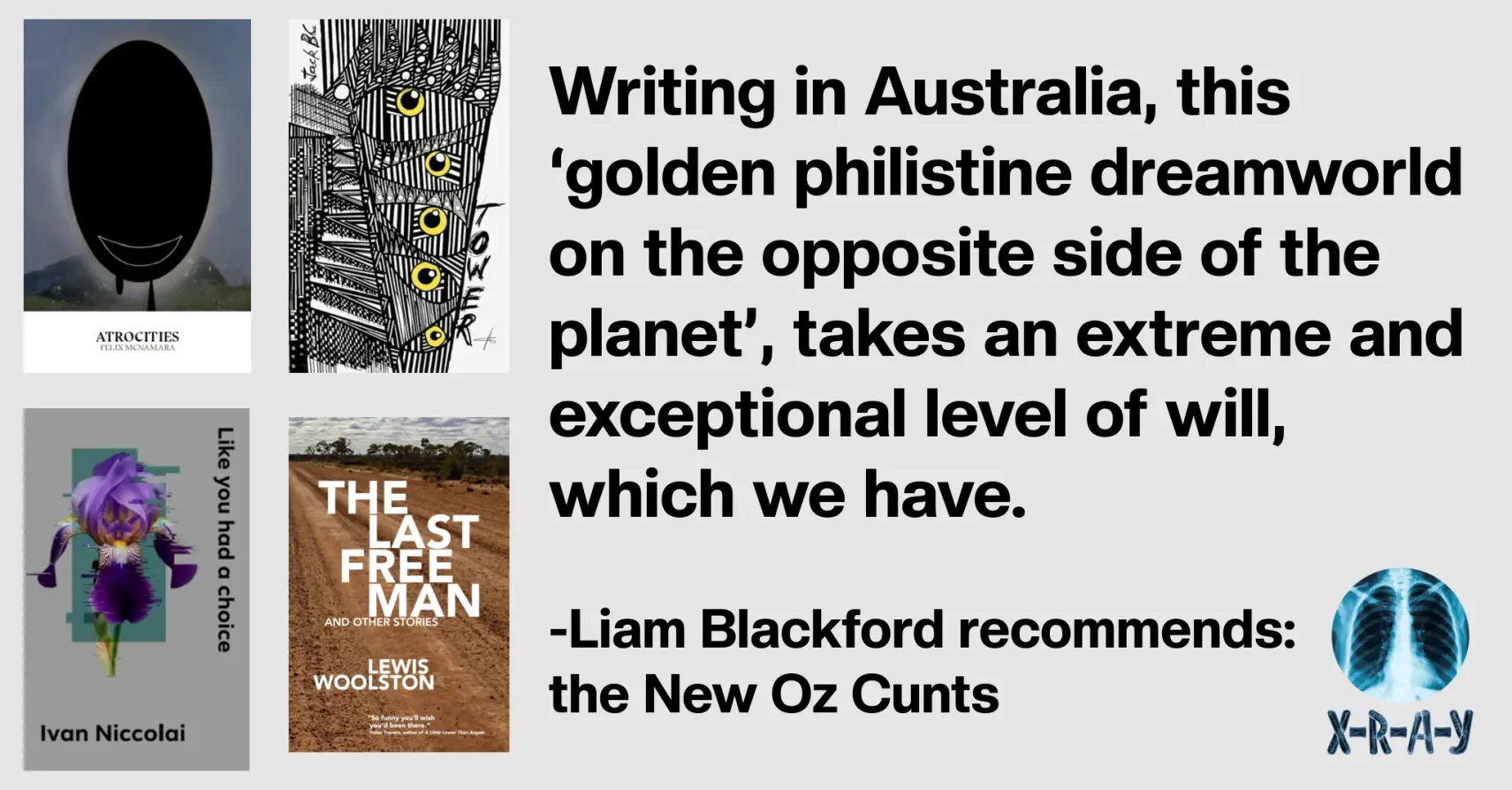
- Writing in Australia, this “golden philistine dreamworld on the opposite side of the planet”, takes an extreme and exceptional level of will, which we have.
- Australian literature is capable of the sublime, but these days too rarely achieves it. With our work, we hope to do so. None of us are masters today, but we aspire to be.
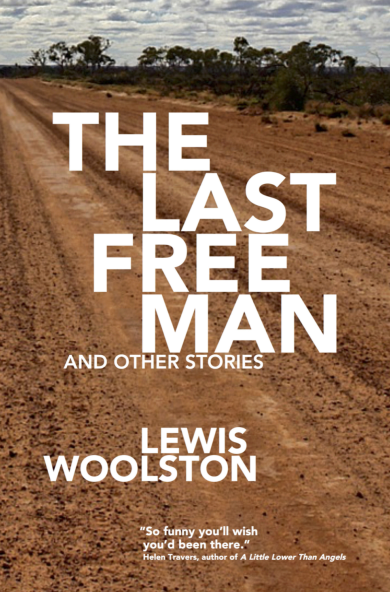
Lewis Woolston – The Last Free Man and Other Stories (Truth Serum Press, 2019)
‘I legit thought that having a steady job, a missus and kids, paying off your mortgage and saving for retirement was the way to go. Then I saw what the system really was. Us poor cunts that got called up to be nashos, we were just toys and tools for the system to use, then when we got back we were expected to be good little workers again like nothing had happened.’
Australia domesticates its young early, yoking them with debt, working them into a stupor and neutralising any and all instincts to break the mould. It is a great country for suburbanites and backyard barbecue conversations about home renovations (my non-Australian mother always complains that Australians are “always talking about whitegoods”).
The Last Free Man is a collection of stories about people who have refused this life and instead chosen to disappear to the Nullarbor, one of the world’s most vast, flat, dry and empty regions. It’s a life that’s not for everyone, and being up for it does say something about you. Woolston himself disappeared in this manner for 5 years, working at remote roadhouses in what is already very remote country. He has also previously been a prison guard, an army trainee, a member of a religious cult, and a drug addict. Woolston writes plain-spoken, honest stories about these experiences and other aspects of Australia that many Australians would prefer stayed out of mind. The Last Free Man is one of three short story collections Woolston has to date written (the others are Remembering the Dead (2022) and The Everlasting (2025)); all are commendable, but The Last Free Man is essential.
Jack Norman – Sleep Capricorn (Bonfire Books, 2025)
‘Don’t startle when you cease to dream. It’s true she has contained you. That’s called sacrifice, only you never knew you’d want to so bad, which is why you think you’re guilty of something. Ah who cares! I’ve finally won mine. And it is so good to be at home.’
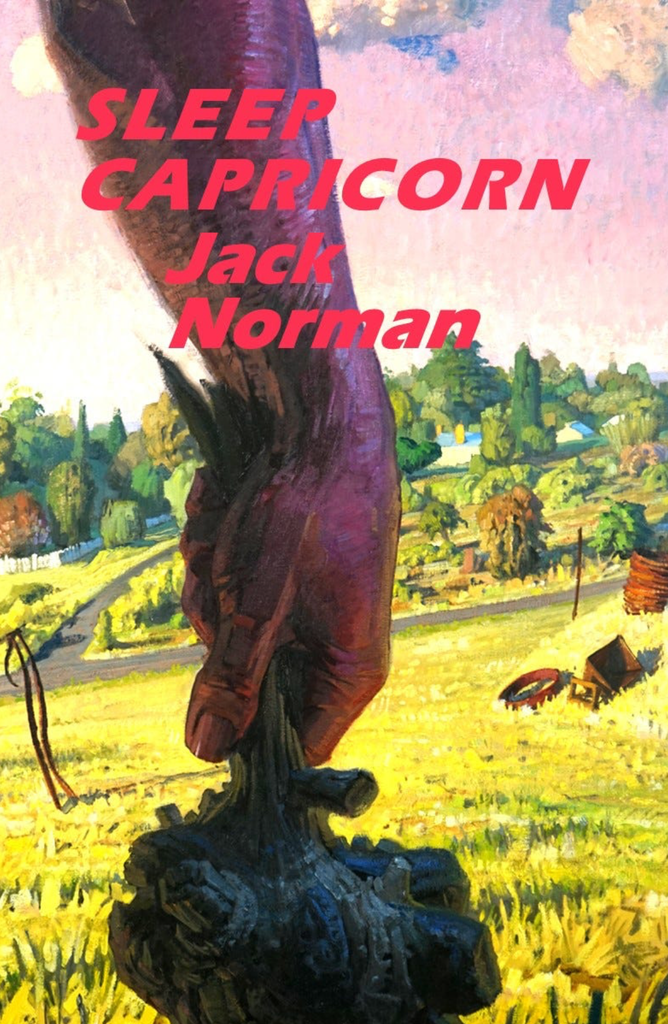
If The Last Free Man is about refusing domesticity, Sleep Capricorn is about accepting it. A collection of eight short stories mostly set in Far North Queensland, it opens with and is anchored by the resplendent “Beg Love, Beg Boredom”, in which a son eulogises his emotionally impotent father and the wounds he haplessly left both son and wife. But my personal favourite is “Happy Wife, Happy Life!”, a breezy, psychedelic love letter from a young husband not to his wife but to marriage per se, addressing in turns the end of youth and the honour of responsibility.
I said above that none of the New Oz Cunts are today masters. This is true, but Norman is the closest. When admiring other writers, there are those where I hope that “I could one day write like that” (Flaubert), and those where I lament that “I could never write like that” (Proust). For me, Norman belongs with Proust in the latter category. His style, sweltering with Queensland tropicalia, is singular and rich, as much a son of Melville as of 4chan. He tackles with great sensitivity both the mundane and the profound and sometimes both at once, as with the terrible subject of indigenous Australian misery in “Moonlight Upon Our Given Fates”.
Lucas Smith – Spare Us Yet (Wiseblood Books, 2025)
‘It was only later we heard the stories of people boiled alive in their dams, noses burnt off, or trapped in cars on roads blocked by flaming trees. Kangaroos on fire bounding through towns. One man saw out the fire in a creek next to a lyrebird that had jumped in beside him. All the boundaries of life dissolved.’
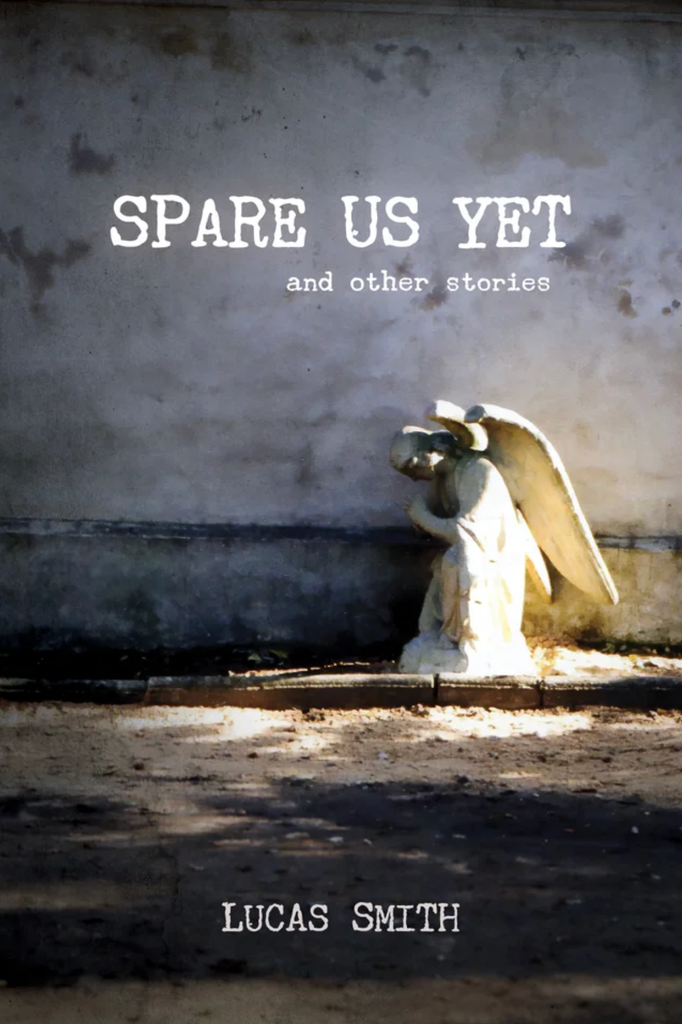
The surface-level themes of Spare Us Yet are Victoria’s covid-era restrictions and Catholicism. Kate Hodgson observed that “[if] Catholicism of a sort is the infrastructure in the worlds of many of Smith’s characters, its trestles and bridges, there are a lot of people sleeping in the rough under them, just trying to survive. Religion in these stories is less a foundation and more of a chaotic scaffolding that is not necessarily up to building code.” I would go further: in Spare Us Yet, religion is not a scaffolding but a ruin, and so is everything that has replaced it. History is forgotten and dogmas invented yesterday are revered. We the modern people live in the accumulating ruins, and nothing holds us together.
Unique and yet exemplary in the collection is “Matthew of Ours”, set in a future some generations after a rapid and severe loss of technology. Elderly Matthew is alone in remembering electricity and air travel, and records on paper what he can remember of the Gospels to share it with the occasional neighbour who shows interest. All his other neighbours (for whom the words “DANGER HIGH VOLTAGE” have been received as a divine message and are repeated as a prayer) either mock him, resent him, or want him gone.
Lucas is currently working on a novel about another type of man keeping the faith: men who look for evidence that the Tasmanian Tiger (aka the thylacine), long declared extinct, still lives. We might say they are insane; they might say we are not paying close enough attention. Blessed are they who have not seen and yet believe!
Felix McNamara – Atrocities (Hyperidean Press, 2026)
Time endures through dead history …
The homogenous and empty,
Is for the anti-hero’s lone
Conquest, but not anti-hero,
Rather, non-hero, yes, not like,
The modern anti-hero, no,
More like him, Orenthal Simpson.
Not a man but a vessel for,
All of dead history’s debris,
Its garbage feelings, its clutter,
Its surficial hopes and assumptions,
Its boring hatreds, absent joy.
Godfather to the anti-Christ!
Harsh words, yes, all are Anti-Christ …
Our King conquers the Anti-Christ!
And the car chase happened cause, well,
Eyes were on it, atrocities …
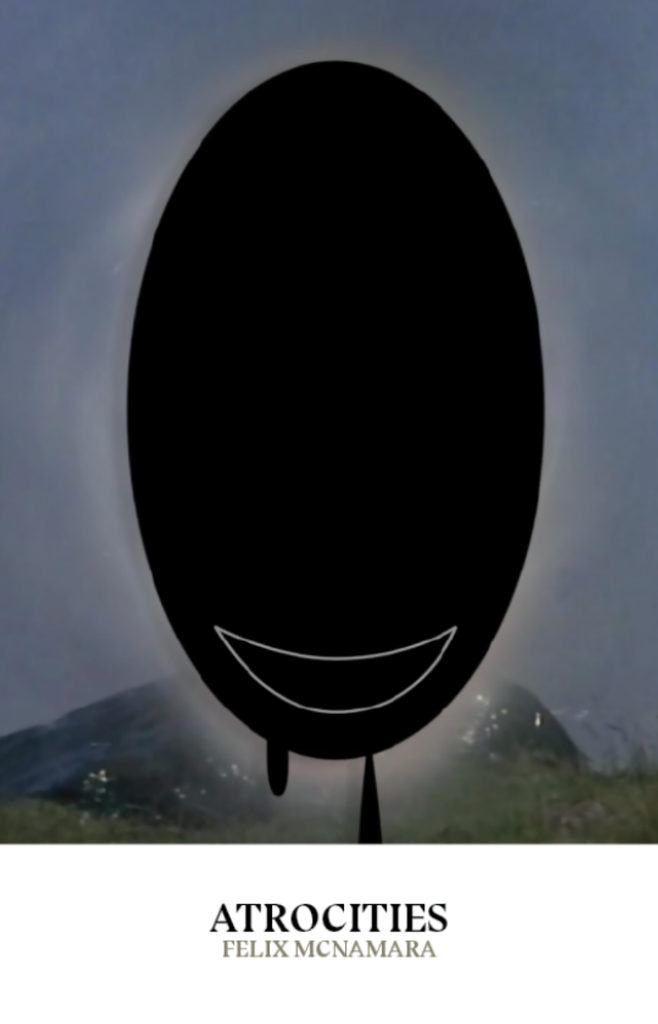
Contra Spare Us Yet where history has been forgotten, in Atrocities all of history exists at once. Here is no place for a sufficient analysis of McNamara’s epic poem (Justin Isis, Zane Perdue and Robert Charbonneau have already offered theirs) but I commend him on two counts. Firstly, more than a century after The Waste Land, McNamara has created a successful epic poem in an era totally hostile to epic poetry. Secondly, he has created something that is nothing but an epic poem. It is not prose, though it does contain characters (Jeffrey Epstein, Ted Kaczynski, Timothy McVeigh), narrative and dialogue (including Tucker Carlson interviewing William Blake). Its lines are not lyrics and could hardly be put to music, though when McNamara performs them in public he chants them like a goblin priest. Interlaid with images and unreadable on a phone, Atrocities begets study in the manner of a medieval codex.
Predictably, Atrocities is a garish disaster of language and meaning; less predictably, it is very funny. The feral wit that McNamara applies to theory (also on brilliant display in his collaborative essays with Tara Heffernan) makes Atrocities a descendant of Anti-Oedipus (1972), The Sublime Object of Ideology (1992) and Meltdown (1994). And why shouldn’t we laugh? It may be the end of history, but it’s not the end of the world!
Jack Cuthbertson – Tower (2023) (as Jack BC)
‘The souls of the repeatedly objectified are strange things. Malleable in the beginning, softening with each objectification, until a point is reached and then they harden, wrought into whatever shape The Tower needs. If plates had souls, would they look like that of my patient? But only human plates have souls. My patient smiled softly; I’m not sure if he recognised me. He made me uncomfortable, so I covered his face with a bread roll.’
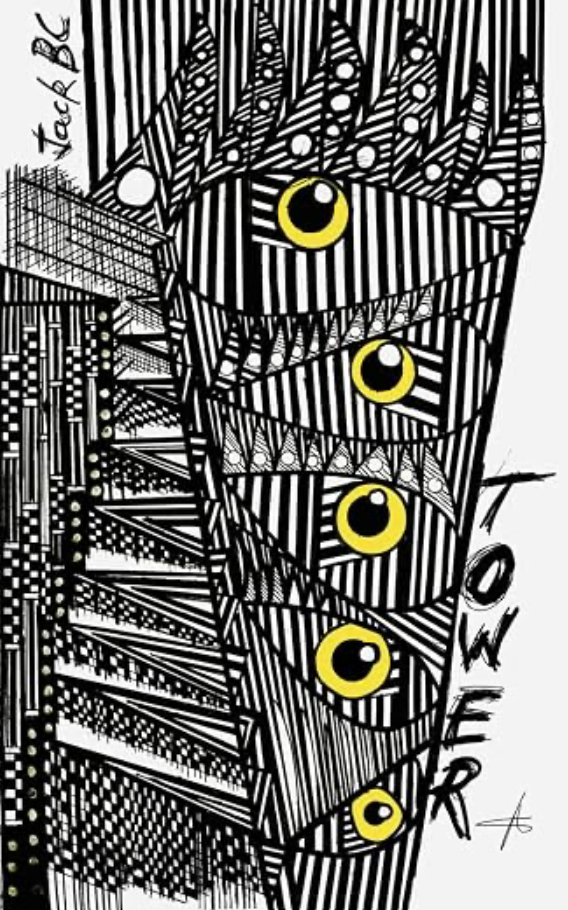
Tower is a story about personified objects and objectified persons. The titular tower is the monumental form taken by the company, ‘our company’, of which everyone is an employee. Employees become objects of various kinds (benches, lampposts, pavement) and many of these objects accrue onto the tower’s surface, constantly expanding its scale. The tower is in fact one of the novel’s characters, as is a hat (Hat) and a briefcase (Briefcase); all three of these are persons but not humans. The protagonist, a doctor who studies and treats souls, has discovered something that makes him a threat; to squash and neutralise him, the company deploys its vast army of loyal employees, including its CEO, to whom the protagonist happens to be married.
Tower joins a tradition of consummate weirdness in Australian literature, which include landmarks Voss (1957), Picnic at Hanging Rock (1967) and much of Murnane. It is comic like Flann O’Brien (who wrote a comparable story of an objectified person) and terrifying like Kafka (who also wrote a story about a person turning into something, but who more importantly wrote about the plight of persons trapped inside labyrinths). It showcases Cuthbertson’s ability to get carried away, a quality I consider essential in a writer.
Ivan Niccolai – Like You Have a Choice (self-published, 2025)
‘He began to form the fixation that the west’s ambivalence towards the future was rooted in a sense of guilt, a guilt which had lodged itself within its cultural psyche and paralysed it. He would inflict upon them the revenge their contemporary masochism longed for. He would do it with a gift. An unwanted gift, a city within their city they hadn’t consented to, that they would react violently to. He would give them his idiosyncratic and disorienting vision of an architecture of the future, a five billion dollar private joke.’
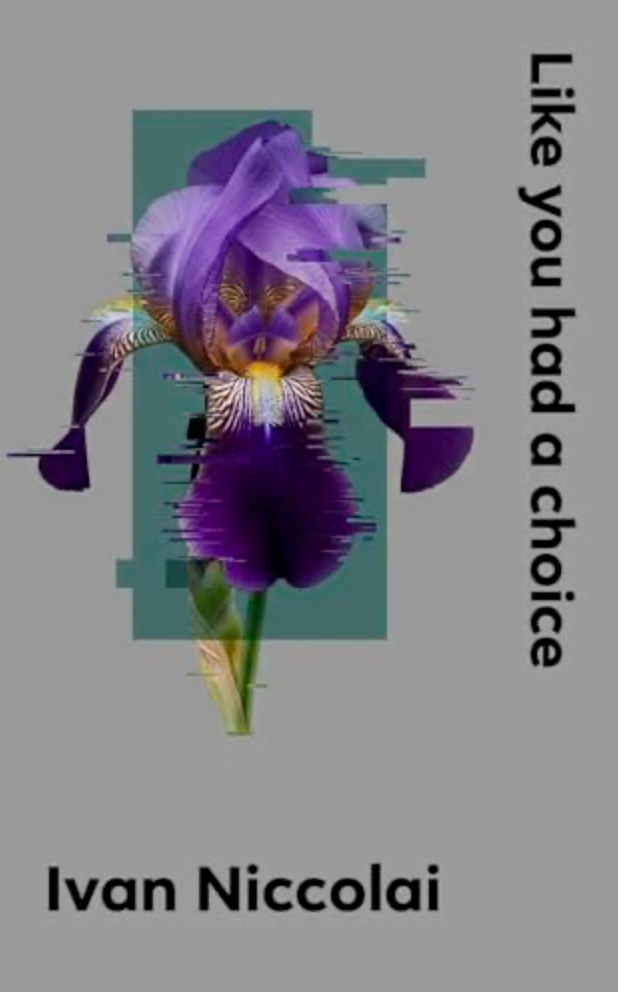
If Cuthbertson is the Ausnaissance son of Kafka, Ivan Niccolai is the Ausnaissance son of Ballard. Notably, Niccolai is by nationality not Australian nor anything in particular, but rather a ‘third culture kid’ whose mother dragged him kicking and screaming through 21 countries before the age of 21. In adulthood he fled the Eurocracy of the continent for the Anglocracy of the antipodes, using his outsider’s perspective to become an astute observer of Australian decadence. Like You Have a Choice is a short story collection with one subject: Melbourne, Australia’s fabulous showpiece city, the best place in the country to flaneur and rot, where the economy is always tepid, the real estate is always red hot, and what you say is always more important than what you do.
Can you love Narrm but hate Narrmgroids? Perhaps Niccolai does, and I submit as evidence The Gift, in which a three-kilometre square (taking in the smart inner-north districts of Princess Hill, Carlton, Carlton North, Fitzroy, Fitzroy North and Collingwood) are razed by a visionary Angolan oil scion-cum-architect and replaced with eight gigantic concrete skyscrapers. In Narrm, like everywhere in so-called Australia, it’s always just another day in the colony.
What’s next for the New Oz Cunts?
So far, we have all put work out in various forms: novels, short stories, poems, essays, video essays and podcasts (which, as we all know, are the new literary salons). However, in a curious case of convergent evolution, we are now all (save for McNamara) working on novels. This includes Sini and Walter, who don’t have novels out yet that I can recommend here. Our latest: Bonfire Books dropped Cuthbertson’s latest novel Audience Capture just a few days ago, and Verdurin will publish my novel The Stud next week. Our power is growing – look alive!
Liam Blackford is a West Australian writer and poet living and working on Whadjuk Noongar country in Perth, and previously in Shanghai and Hong Kong. His work has appeared in Overland, Asian Cha, Apocalypse Confidential, No More Poetry, Spectra, and Neo-Passéism. His first poetry collection A Gateway Has Opened was a finalist for the Proverse Prize 2020 and was published in 2021 by Proverse Hong Kong. His second poetry collection No Freedom Too Total was a finalist for the Proverse Prize 2023 and was published in 2024 by Private Reality. His first novel The Stud will be published by Verdurin in November 2026. Find him at liamblackford.com or on Substack.