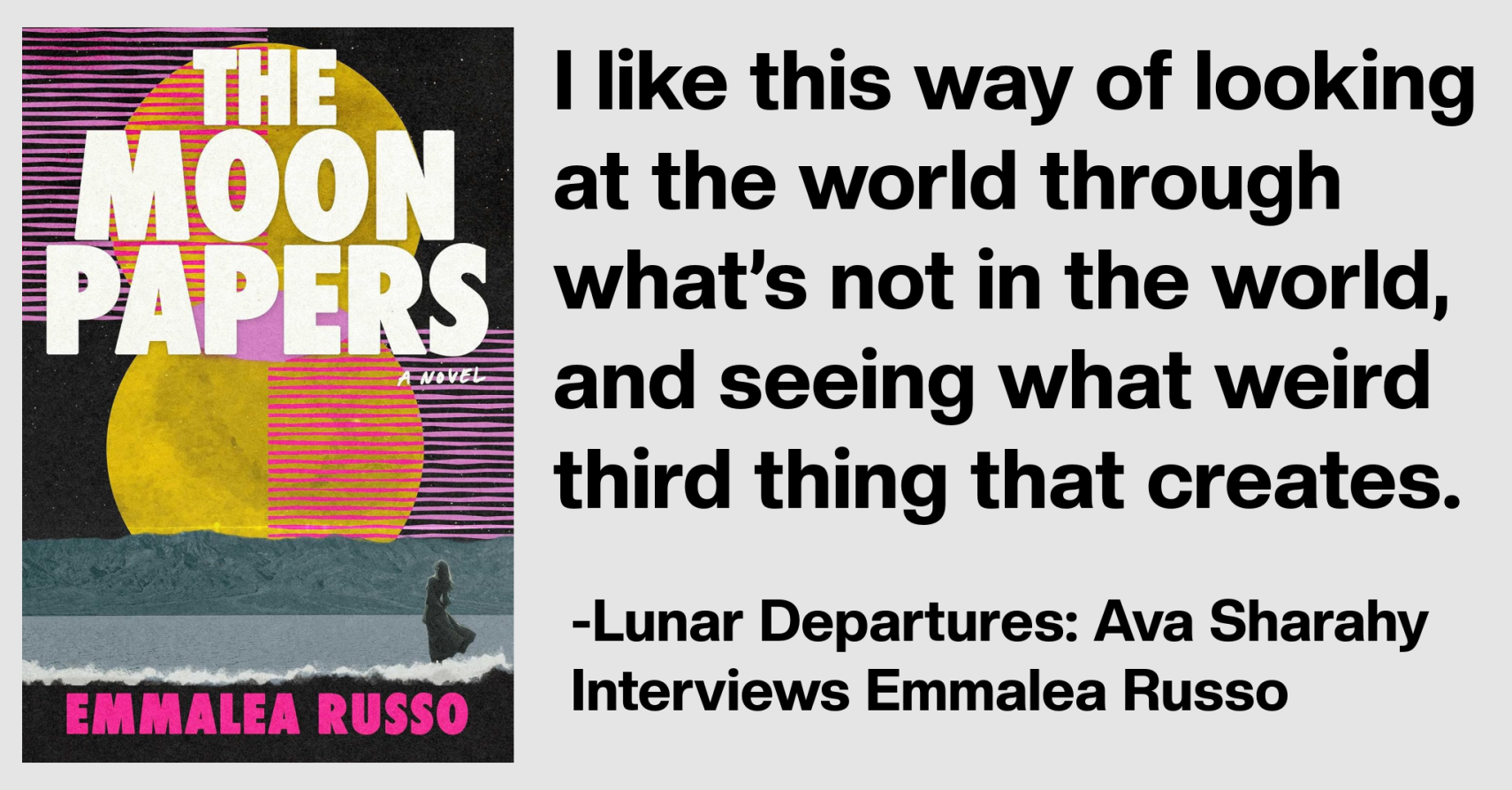
An arts collective sets out to launch a second moon, dubbed “Moon2”, into the Earth’s atmosphere, an act in which even the group itself is unsure of the full consequences. What follows is The Moon Papers (Arcade Publishing, 2026), a masterclass in genre hybridity, balancing sci-fi sensibility with a literary lyricism.
Following its cast of characters – from a bat expert, to the daughter of an art dynasty carrying on an Internet affair with a member of the collective, to the daughter’s gallery owner conspiracy theorist husband – The Moon Papers examines the art world, escapism, and the intersection of origin and memory with humanity.
I spoke with Russo to discuss the definition of “soft sci-fi”, the relationship between the moon and femininity, and the limits that come with marketing, both as it shows up in The Moon Papers and with her own work.
Ava Sharahy: I want to get started by asking about some of the genres. The Moon Papers was pitched to me initially as Jurassic Park meets The Bell Jar, which drew me in, and I think that’s an apt description. What I loved, as someone who reads both literary and genre fiction, is how well it balanced the literary element with the sci-fi setting. I wanted to ask what it was like to balance two very different genres in one work, especially since lit fic and genre fiction like sci-fi are often seen as separate entities.
Emmalea Russo: The second moon, Moon2, is the sci-fi element of it. The anticipation of the moon and the look of the moon and the kind of image that the collective is painting of the moon. But really, I think of it as post sci-fi, or someone recently said like “soft sci-fi”. It’s not really focused on the technological realities. It’s not speculative in that way. It’s mostly focused on the characters’ inner lives in relation to this new object or entity, and they’re projecting many of their feelings onto it.
I was interested in how these characters, some of whom are new and some of whom are carried over from my first novel, Vivienne, react to this thing whose origin and workings no one really knows. I wasn’t thinking about how to balance these genres, or even that it would be part sci-fi and part literary fiction. I was: what’s up with these characters and this bizarre, possibly art project that is a second moon, possibly government conspiracy?
AS: What I really liked about it was that it does what a lot of modern horror does well: the speculative elements are secondary to their impact on the characters. So I like that it was these little character studies first, then world-building second, and I thought it was really cool that it was implemented in speculative genres beyond horror, like sci-fi. In that area, what were some of your inspirations when writing The Moon Papers? What were some of the things you were reading, or works of media that inspired it?
ER: In the book, there’re a lot of descriptions of houses – interiors of houses, exteriors, objects within the house, or interior design. So, I was looking at a lot of houses – especially from the moon landing era, like late 60s. That kind of mid-century modern design, and the strange futuristic slash retro objects, I was really focused on that. For Vivienne, my first novel, I looked at a lot of fashion and clothing, and I was still doing that, but I switched to home interiors. I would go on Zillow and cruise the insides of houses.
In terms of books, often when I’m in the throes of writing a book, I don’t read that much because I feel like it’s a bit dangerous. But certainly poetry. There’s a book of poetry by Mina Loy, early 1900s, called The Lost Lunar Baedeker. It’s bizarre, and you need a dictionary. She drops a lot of strange words, and it’s musical, surreal, kind of psychedelic, and futuristic.
And also pictures of the moon landing. I looked at a lot of those because that’s one of the last historical events that was lunar, like The Moon Papers, which is super moon-focused. So I was looking at those images and also reading conspiracies – did the moon landing happen? Did it not happen? Was it a distraction? What’s the deal with these pictures? So a lot of strange websites like that. And of course, I did a lot of research on bats, because bats figure heavily.
AS: From what I researched, you do have an extensive history with lit fic. Did you read any sci-fi in preparation for writing The Moon Papers? Do you have a history of reading sci-fi, or where did the sci-fi angle come from?
ER: I’m a bad sci-fi reader. I don’t read much proper sci-fi. A bit of an inspiration for my previous novel that carried over into The Moon Papers was Cormac McCarthy’s final two books, Stella Maris and The Passenger, which I feel are sci-fi-esque-ish. And Blade Runner. I was thinking a little bit of the replicants when I was writing the character of Dean, who is kind of maybe human, maybe not.
He doesn’t really remember his past or his origins, so there’s a question mark around him. So certainly Blade Runner, which is one of my favorite movies. I love that kind of glittering image – images of sci-fi films, like the opening moments of Blade Runner where these things lodge in the brain that are disturbing and impossible.
AS: The 60s influence is really cool to hear. While I was reading it, it read like what someone in the 60s would write about something happening today. I don’t know if you’ve seen the movie The Love Witch, but I like that it’s a modern movie that replicates and pays homage to the 1960s era of filmmaking in its style, so the book had a similar essence.
ER: That makes me so happy! I’m curious to hear more about what you think, because it’s early days. It [the book] doesn’t come out for over a month. So I haven’t talked to that many people.
AS: I’m going to be honest: I’m not much of a sci-fi reader myself. The speculative stuff I read is primarily horror, and I read a lot of the classic weird girl lit fic canon.
ER: Like Wuthering Heights?
AS: My weird girl lit fic canon is anything Moshfegh, Mona Awad, at least in the modern realm. I feel like Wuthering Heights is classic weird girl stuff. But The Moon Papers made me like sci-fi a little bit more. It’s a good book for people who are like me, in that I don’t read much sci-fi.
ER: Oh, good, I’m really glad. That makes sense because it’s kind of a trick to pitch it as sci-fi. Sylvia Plath meets Jurassic Park – that was also my husband. He was originally like, “oh, you should describe it as this,” and I was like, “oh, brilliant, I’ll tell them that.”
I think it’s because I have poet brain. I have mostly written books of poetry, so I’m interested in how these sci-fi premises or ideas would make a mind happen to work differently, what new and unexpected language would come out of this new era, or what ways of speaking would come out of this new change of life for everyone.
AS: What I find interesting about meshing sci-fi with weird girl lit fic is that there’s one quote on page 43 about Binky being put in this sleep state to give birth…
Their worlds, their lives have become unmanageable. So they started to go away. Binky Stratford wanted to grow new life inside her body while she slept.
Specifically that one:
Like someone who simply wanted to sleep for a very long time.
It reminded me of the ethos of My Year of Rest and Relaxation.
In general, like genre fiction, it’s about wanting that escapism. And I hate saying the word “weird girl lit fic” or “female rage” – it boils down good books to these marketing terms, to simplify them into buzzwords – but they allow a lot of female readers to step into the shoes of a woman who may act in ways that are less societally acceptable, so there’s an escapism in that as well. Was this theme of escapism something you were intending? How do you think an idea like that manifests in your work, or a work like The Moon Papers?
ER: That’s a great question – these wild experiments where women are used as vessels for children of the future, as they call it, in the desert facilities. Binky Stratford, in the book, is an artist who willingly goes to the CCC, this wild collective that’s launching Moon2, in order to “rest” and grow someone else’s child. So it’s a surrogacy program that they see as an art project. That’s another incredibly sci-fi element of the book.
But escapism is a huge, huge theme, and kind of only in retrospect. I didn’t set out to write about escapism, but as I was going, I started to realize that it was one thing I was talking about. Vesta, of course, is trying to escape her life in some way. I think we could see a lot of forms of reading or art-making as a kind of escapism, and possibly we come back and look at the world differently. So I think there is an element of escapism in creation. And the book is partly about that, the making of humans, the making of art. So there’s this element of wanting to escape or get outside the self. In Lars, there’s a mystical impulse to forget the self or leave the self behind, escape the self, escape identity in order to join with something greater.
In the entity of Moon2, and the focus on it, there’s some level of, for better or worse, escapism. This looking away from the earth, or looking up. In researching the moon landing, a theme that came up was going out of this world to explore other arenas and gain scientific knowledge, or something more existential.
AS: Or this idea of there being Moon1 and Moon2, there’s then and there is now, going from one era to another. It’s interesting because in our modern pop culture landscape there is also a desire for escapism because of all the turmoil going on. But that manifests as a tendency to look to the past, to be referential rather than to develop something new. So it’s interesting to see how this escapism in the book is evolving into a move toward the future, rather than being stuck in the past.
ER: That’s a great point. I think of Elon Musk, or that Brian Johnson guy.
AS: We’re living in a world where we have billionaires, corporations, and governments trying to flex their power through space travel, so I found it interesting that you chose not to include any of these entities, but rather an art collective whose one desire is rooted in space travel. In the book, there is also this conspiracy that they’re being backed by the government. How did real-life cases, whether it’s the space trip with Katy Perry or the Mars colony or any of these modern space power trips, influence how you had the CCC approach their project? Do you think it makes a difference, in terms of intent, whether it is a billionaire versus an art collective?
ER: This is a question that the book has about origins, where something comes from. How important is that? There are a lot of different theories, as the book talks about. I thought it would be interesting for this arts collective to launch a moon they didn’t know anything about. Their job is to present marketing lingo and to present the image of the moon, and they’re interested in it as a concept. And they talk and talk and talk. They have two meetings a day, and are isolated on this desert compound – originless, you know? So Dean, the main collective member that the book explores and goes inside the mind of, is questioning his origins and who he is because of his conversations with Vesta, this outsider who’s also an artist. One question the book raises is: how much of our knowledge of our own origins and our memories makes us human? How much does that matter? How do we figure that out? What sort of relations or relationships are possible if we don’t know that?
I don’t know if I have a huge take on it. I wasn’t trying to spread a message, but I think the book leaves that open. I’m curious about your take on whether the collective is backed by the Voortelle Corporation, which is a government branch. There are conspiracy chatrooms that are anti-Moon2, so there are these ideologically correct people who are like: let’s move forward, this is a great advancement; the arts collective is doing something great, of course they’re not backed by the government. Then there’s this more fringe subset who’s like: wait a minute, let’s think about where this is really coming from, what the motives are. Is it a surveillance balloon? Is it gonna disrupt bodily cycles with this artificial light? So it’s ambiguous. I don’t feel like I had something that I wanted to convey in a super strict way. I wanted to raise the questions, but I was also thinking a little bit about China’s plans to launch a second moon for artificial illumination. I don’t know where they’re at with that or if that’s happening.
AS: This is my first time hearing that. What?
ER: I’ve deleted all of this from my moon-and-sun research brain, but there was talk of blotting out the sun or blocking some of it to help with global warming or something. But in the book, with Moon2, it’s like: oh, we’re going to position it so it sometimes blocks the sun. There are all these apparently beneficial things that the moon will do, but it remains to be seen whether it happens, or if it’s even a good thing to have the sun blotted out.
AS: For me, I approach the questions you posed in The Moon Papers as if I were watching a David Lynch movie. There are a lot of questions, but art doesn’t have to be good by answering everything. Sometimes you have to be presented with a world and then take it as it is. But I also wonder: the CCC is technically an art collective, but you say in the book that Dean considers them less artists and more like angels. They’re the ones bringing about works, rather than self-creation. So in the book, is Moon2 less like an art project and more something that is an inevitability for this universe?
ER: It does feel like it’s an inevitability for this universe. I like that you brought up David Lynch, because I get so bored when I feel that a novel is telling me what to think or trying to convey an ideology or prove that it’s on the right side of history. And I love questions. I love strange endings that leave questions hanging and open up another door, as opposed to tightly wrapping the whole thing up.
This world of Moon2 slash The Moon Papers was born from the last few pages of my novel Vivienne, which was published two years ago. In those pages, we are suddenly transported to the desert with this collective. Vesta is there having this meeting with Dean, and it’s 10 years prior to the opening of The Moon Papers. But that was a very sudden ending, and people were like: oh, this is great, this is the best part of the book. And a lot of people were like: what the fuck, this makes no sense, what is she doing? It was a divisive ending. But for me, I needed the ending to open a door. I didn’t know there was going to be a sequel, but I needed it to create more questions than answers.
AS: In your debut, Vivienne, I was surprised but also intrigued to learn it was about Vivienne, Vesta’s grandmother, and Velour’s mom. How long did you spend between finishing Vivienne and starting The Moon Papers?
ER: The idea for Moon2 came in the very first novel I wrote, which was before Vivienne, and which I scrapped. I was like, this is shit, but I’m interested in the second moon idea that is part of this universe. So I put that on the back burner, and then The Moon Papers emerged from the ending of Vivienne.
There were a few things that came together to make The Moon Papers spark, and make me think, oh, this is a worthwhile book. I had a few bats in my attic. I met several, essentially, bat experts, and I was so interested in the way that they were speaking about bats. I just thought I want there to be a character who’s obsessed with these lunar creatures, because bats, we think of them alongside the moon.
My husband and I were looking for a house a few years ago in Pennsylvania, where I originally grew up. I saw the interior of a house, and I was like, I feel like I’m supposed to live here. We didn’t end up moving there, and I was like, oh wait, I think I’m supposed to write about this house. That became the interior of Vesta and Lars’ house. And I became interested in the guy across the street from them, Ziggy – his house was also inspired by one of these houses that I had seen the interior of. So I think those three things made it possible for me to write the novel.
AS: With Vivienne and The Moon Papers, since it’s its own little pocket universe, is that a world you will continue to develop or write about in future works, or are you looking to expand beyond that?
ER: I feel like I’m not done with these characters, or maybe the characters aren’t done with me. I like this notion of staying inside a world for as long as it will let you. Maybe it’s time, maybe they’re kicking me out, I don’t know, but I feel like maybe I will.
AS: One of the aspects of The Moon Papers that interested me the most was how women are portrayed, which is as vessels, as projections, as these vestibules, whether that’s literally carrying children, or being the recipients of people’s thoughts and feelings, or even in general, being projected upon by the men in their lives. Especially with the way that, in relation to how the moon is also feminized historically, and how female characters like Vesta and the moon are these central things that everyone talks about and projects everything onto, particularly their fears and anxieties, but we never get to know much about them in general.
What was your intention in exploring specifically womanhood, but gender in general, in The Moon Papers, especially through the relationship between the moon and femininity?
ER: The moon, since the ancients first talked about it in myth, has been the feminine entity, and it’s associated with change and flux and cycles, and the sun is associated with eternity. So the moon is associated with life on Earth, is really like our earthly timekeeper, and we can look directly at it. And in a weird ghost way, it’s this fossil. It’s also a screen in the way that the desert is a screen in the book. It’s this empty space that is not empty at all, and it’s filled with history and reality and story.
I was thinking about the moon as a historically feminine entity, and also mother-daughter relationships, in terms of Velour and Vesta. This question of origins and home, which is also another very feminized notion. We all come from a woman, obviously, but the moon as origin or as an uncanny home. There’s a theory that states the moon birthed the Earth, so it has this ancientness projected onto it, like the night is older than the day or seems more mysterious or womanly in some way.
I was playing with these tropes or archetypes, and thinking about origins, because we do see Vesta’s origin. We see the house she grew up in, where Velour still lives. Dean sees it on screen, and Dean is wondering where he came from. So all these questions – and where the hell does Moon2 come from – I was thinking about. Also in terms of the uncanny, or the doubling, because the uncanny essentially has to do with something that is familiar and foreign at the same time. So you feel like you’re at home, but it’s not quite home. I was trying to capture that feeling of home, that “maternal source,” but slightly off, something not quite adding up, which is very David Lynch, I guess.
AS: I think the word “Lynchian” is overused, but I will say The Moon Papers is quite Lynchian in nature.
ER: That’s a huge compliment.
AS: Of course! So I did see, both on the back blurb and from what you described, that similar to Vesta, you’re also from Pennsylvania, and I’m assuming a similar area, rural. How did your experience growing up in that environment inform the setting for the book? What was it like writing about these very different locations, between the Mojave Desert and suburban, borderline rural Pennsylvania? What was it like having this dichotomy between East and West, community versus isolation? How did you balance between these two environments, and where did you get the inspiration for the California desert setting as well?
ER: The area I grew up in, in Pennsylvania, is maybe about two hours, an hour and a half from New York. So it feels very rural – although it’s getting more built up now – but there’s access to this whole other place that’s not too far away. When I was writing it [the book], I was thinking about that, going between the center of American culture and this rural, off-grid, quiet, insular village that they all live in in Pennsylvania. Being far away, yet close to art, informed my childhood and the book. It’s also just quite beautiful, sort of strange, and sad. There’s something about that I feel nostalgic about. I felt like I needed to explore it in writing.
I wanted this feeling of two-ness, like Moon1 and Moon2, the doubling of that to be present in every aspect of the book. So, there are two sections in the book, and the first section goes back and forth between the East and the West. I was also interested in this oscillation, back and forth, back and forth, cause this is what Vesta is doing in her mind and heart. She’s going back and forth between obscurity and visibility, between these two men who she’s intrigued by, maybe in love with, maybe just wants to be seen by; it’s kind of unclear. So I wanted to have that formal effect.
And I mean, I just love the desert. I love the romance of the desert. I love movies that are set in the desert. I love the myths about the desert. I love everything we project onto it. It really feels like the OG cinema or screen. I was thinking about the desert as a kind of moon or lunar landscape. There’s this book, actually – this was one of the inspirations that I left out – but it’s called America by Jean Baudrillard. He’s a philosopher. He came to America from France, went on a road trip, and wrote about his experience. There’s this section called “Desert Forever” where he talks poetically about driving through the desert, how different it is from Europe, and how it feels so cut off from the source, the past, and history.
I was thinking about these tropes, like the East Coast is this kind of older America, or what we think of as America. I also lived in Southern California for a little bit, and I definitely wanted to escape my East Coast roots. Going back and forth between East and West was a way to explore those ideas and to paint Dean’s and Vesta’s realities and the ways in which they merge via their video calls. That was another challenge I set for myself: how to have them communicate via video call, but make it interesting.
AS: Since you mentioned you have two parts to The Moon Papers, did you have different intentions or ideas going into each part, in terms of keeping them separate yet cohesive?
ER: The first section is called “The Smell of Bats Was Heavy on the Wind.” When I realized that would be the title, I was like, bats and the removal of them, and Velour dealing with them, will be the backdrop of this first section, and something that will get teased out while Dean and Vesta are having these video calls.
Then the second section is called “Extraordinary Beings Have Extraordinary Departures,” which is the line Lars first said in a chat in one of the conspiracy chat rooms. Dean reads it, then repeats it to Vesta, and Vesta says it back to Lars. It’s this line that gets fragmented, chopped up, and used as a vehicle. And Lars is like, wait, that sounds familiar, where did you hear that? Then there is a departure at the end of that section, so it is dealing with that whisper down the alley, surveillance, being connected via technology, and intimacy. Also, there are reverberations of section one and section two, and vice versa.
AS: On page 64, when they were initially discussing the chat rooms, they were like, let’s just write another press release to address these very, I think, valid concerns. It read to me as a parodic aspect of the book, and specifically of the art world. The art world was something that you explored in Vivienne as well. What’s your history with the art world, and how is it something that you implement in your writing?
ER: It’s funny, because when I was writing Vivienne and when I was writing The Moon Papers, never once did I think that I was writing a satire of the art world. Then, as soon as people started reviewing it [Vivienne], they were like, “This is a scathing satire of the art world.” I was like… Really? I did set out to make it funny and entertaining in some capacity, but also these worlds, it’s impossible not to mock them.
I am on some level interested in the life of an artist, or what it is to make art, and being part of an art world. Or showing one’s art or promoting it, and how these things might ruin each other or be dependent upon each other.
In this particular book, the art world is parodied with the Moon2 situation. In another way, it’s exploring the marketing lingo, like in a press release for a book, or how you have to describe it. It’s so hard, and it often feels like bullshit even trying to describe what you’re trying to do. Because it’s often a mystery even to the person who did it.
AS: In general, as artists, it’s demoralizing to boil down your work to what people would be most attracted to in a one-sentence pitch. So it is interesting to see that kind of exploration of how marketing is portrayed in The Moon Papers, because it’s like, how can you boil down something like a second moon into a press release? How can you boil down people’s work, since we can have complicated and complex feelings about our own writing, other people’s writing, into the most palatable pitch?
ER: In a way, it’s a catch-22, because it erases something of the work, but then it is a vehicle. The words you use are a vehicle to help people connect with them, which is what you want, so it is necessary in this way as well.
But yeah, I was in the poetry world in New York for a while, and then also I used to write art reviews. I would review art shows and go around to galleries, so that’s my experience in the art world. All the money and the glitz – it’s an intriguing place.
AS: Speaking of your other work, I saw that you also have a Substack on the intersection of the humanities, like philosophy and literature, with the cosmos, which I thought was fitting for The Moon Papers. As you said, your first novel [unpublished] that you wrote was also about this idea of a Moon2. How did you become interested in that intersection of the astro world with literature and writing? What keeps you going back to it?
ER: It’s partly this alchemical or astrological principle, which is “as above, so below”. This is looking at what’s going on above in the cosmos, or in viewing something that’s above us in some way. Even a dream, it could be many things. Connecting it to daily life feels interesting to me and at the heart of poetry, writing, meaning-making, whatever. I like this way of looking at the world through what’s not in the world, and seeing what weird third thing that creates. The throughline in so many of my works – the novels, the poetry, and even the teaching I do – is bringing these disparate things together, and seeing what weird thing happens when you do that.
Ava Sharahy is a writer based in New York City. A recent graduate from Columbia’s journalism program, they write about local news and arts and culture happenings, especially in the bookish realm. Their work has also appeared in publications such as Write or Die, Full Stop, and IMPULSE. You can find them on Instagram, where they go by @r_ava_lations.
Emmalea Russo‘s first novel, Vivienne, was published by Arcade in September 2024. Her second novel, The Moon Papers, is out now. Her books of poetry are G, Wave Archive, Confetti, and Magenta. Recent writings have appeared in Artforum, BOMB, Spike Art Magazine, Compact, Granta, and Los Angeles Review of Books. She has a private astrology practice and lives in Bucks County, Pennsylvania and at the Jersey shore.