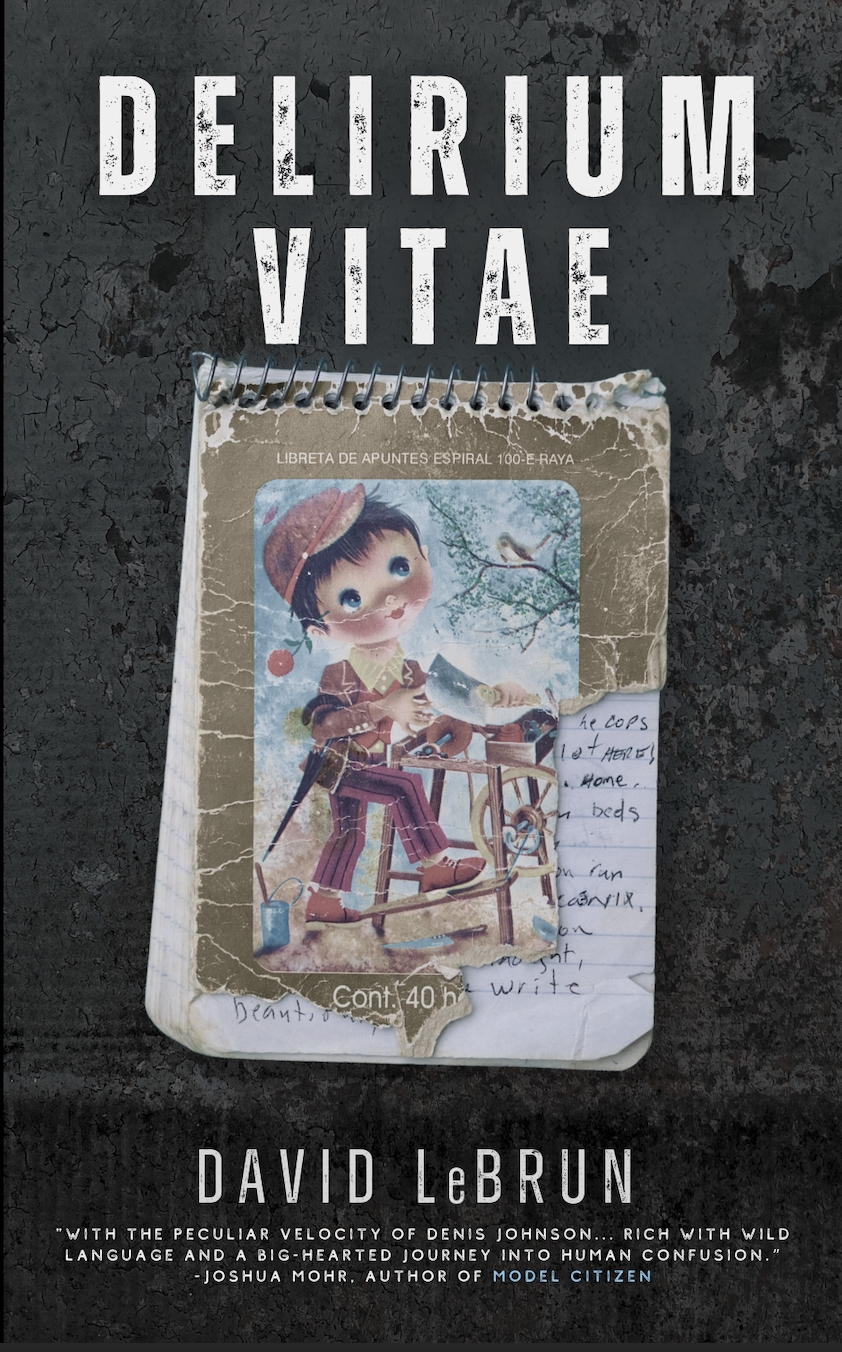
 My debut memoir, Delirium Vitae (Tortoise Books, 2025), recounts five months of hitchhiking and street busking I did from Costa Rica to Phoenix Arizona, in 2001, when I was broke and struggling with addiction and mental health issues.
In 2020, I was halfway through editing my memoir, when the pandemic left me happily unemployed. I read Joshua Mohr’s Sirens and discovered he offered editorial service through his Decant Editorial. We worked hard on my manuscript for three months, but what stuck with me most was his encouragement and certainty that the book would find a publisher. Four years later, when I was done tinkering, Delirium Vitae found a home with Tortoise Books and Joshua Mohr’s generous blurb landed on the cover.
Josh and I recently talked about my long road to finishing the memoir. What followed was a conversation about grief, spiritual blind spots, voice, benefits and hazards of beta readers, and our characters’ moral mud.
Joshua Mohr: Of the many things I love about your book, it’s the quest/road trip angle that makes the work feel so utterly alive. Can you walk us through how you calibrated the book’s kinetic energy to speak to the main character’s arc?
David LeBrun: It’s an interesting question because it started the other way around—where I first had to calibrate the character’s arc to speak to the kinetic energy. Some of my early readers sensed something missing in my character’s emotional arc—something to justify his behaviour. To dig deeper, I saw a therapist, attended a trauma workshop, even ate a hero-dose of mushrooms with a shaman. Eventually, I understood I had been carrying some unspoken grief for most of my life, and it was that silence around loss that had propelled my character into chaos and self-destruction. With that realization, it was easy to keep the pace moving—to know what mattered to the story and what didn’t, as I shaped the book’s emotional pacing around a character who thinks he’s running toward something, but gradually awakens to see he’s running from something.
JM: Ah yes, the ol’ “hero-dose of mushrooms with a shaman.” I’ve been there! What you’re describing—the unspoken grief—is such a potent driver for the book. I’m curious about how you calibrated that balancing act between what your character knows about this grief and what exists in a kind of spiritual blind spot. Did it take a couple drafts to get that “yin yang” properly aligned?
DL: I worked on the book for eight years, so there were countless drafts. At some point, I decided I didn’t want to drag the reader through another fifty pages for the sake of chronologically. Instead, I folded some post-journey realizations—and other scenes—back into the road narrative. I shuffled those into every possible configuration, wanting to embed them in places where they’d feel natural and rewarding for the reader (to sense the character’s blind spots before he does) but also emotionally true for me—moments when memories would have been triggered, where the unconscious would have come knocking.
JM: I super dig that! It makes the juxtapositions between past and present so dynamic on the page. You’re also telling this story with such a strong voice, an evocative cadence. Did the “sound” change much as you wrote across all those drafts? If so, how?
DL: Thanks for the compliment. I started writing this version of Delirium Vitae in 2016 and I found myself writing with different authors’ voices. But I didn’t want to write something derivative. I wanted to record the sound of the voice in my head—that lifelong inner monologue. In the middle drafts, I leaned on critique partners, and some of them were great at pointing out when I strayed from that voice. Once a solid draft was finished, I read the manuscript out loud many times, and relentlessly combed through it, like rewatching a movie. I mean, if someone told me I’ve read through my book two hundred times, I’d believe them. So, I’d say I came to that voice thanks to obsessive compulsion.
JM: I sure feel that! I must’ve read my memoir MODEL CITIZEN aloud hundreds of times, too. There is no better way to dial in cadence and time signature than hearing the sonic potential. Your answer is making me wonder about the other ways your beta readers helped you get closer to your book’s intentions. Are there other ways that they helped you zero in on the project? Or maybe the other way, as well? Did they make any suggestions that you had to disregard in order to write the book you felt called to create?
DL: I learned to spot and pull away from those who would try to steer me toward a safe, cookie-cutter story. But, sometimes, those folks would give me a reaction so pointed that I just had to play with it.
There’s a scene early in Delirium Vitae where my boss reprimands me for an inappropriate conversation with his daughter. A beta reader commented, “This scene doesn’t reflect well on you.” And I thought, Of course not, that’s the point! I’m showing the protagonist’s flaw here! That reader’s comment stuck with me, and their specific concern would improve the scene’s tension when I gave my boss the line: “That conversation (with my daughter) does not reflect well on you.”
So, in my quest to make sense of myself and my character, the resistance often helped me anticipate: I know what you’re thinking—here’s why it still stands.
JM: “This scene doesn’t reflect well on you” is basically my whole career on the page! LOL. I love writing characters who have no idea how to get out of their own way. Since I’ve written a lot of autofiction, I know what you mean by “myself” and “my character” in your answer. Every author will approach those two “identities” differently. How did you balance that? And are there any solid examples of when “you” the character surprised You the author?
DL: I guess I sometimes refer to my character as someone separate from me, because I no longer identify with who I was at 25. I know I couldn’t have written as openly if I’d imposed my maturity onto him. That split gave me permission to lean into his flaws and needs. It helped that I was working from notes and recordings I’d made back then, and from a very rough draft I’d written at 26.
As I gained distance from that period of my life, I’d have moments of objectivity where I was shocked that the lifestyle and situations the younger me had put himself through—eating very little, hitchhiking over 5500 kilometers (3400 miles), refusing to call someone for help, sleeping on the streets—somehow, felt safer than going home. It still amazes me how the pain we choose is sometimes so much worse than the pain we’re hoping to avoid.
JM: Pain! I love that you’re answering this through the mud of suffering. I often tell my grad students that characters need to exist in the moral mud, as that’s where true, nude, human complexity lives. What are you able to see now, through the perch of remove, about that suffering that you admire/appreciate, and which aspects of that ache are you glad to leave in the past?
DL: I admire the young me for his hunger—for thriving in chaos. While I wouldn’t stomach it now, I’m grateful he did, because all that raw chasing of experience left behind a lot of material.
But I’ve outgrown the type of suffering that hinges on self-destruction. Back then, I thought there was meaning in throwing everything and everyone away. Now I don’t romanticize that anymore. When I think of how many artists drank themselves to death, I’m glad to have left it behind.
JM: Does that relief mean that you’re ready to turn your attention to the next book? What’s been kicking around your imagination?
DL: Stepping away from Delirium Vitae was too easy ’cause that book really took a lot out of me. I’m nearing the obsessive read-through stage of a novel based on some… turbulent relationships I had in my late-twenties and early-thirties while I worked overnight at a ketchup factory and later the film industry. I’m also finishing up three feature screenplays and have another on the backburner. So, I’m kicking tires on some agents now, ’cause I’ve got more stories than time.