
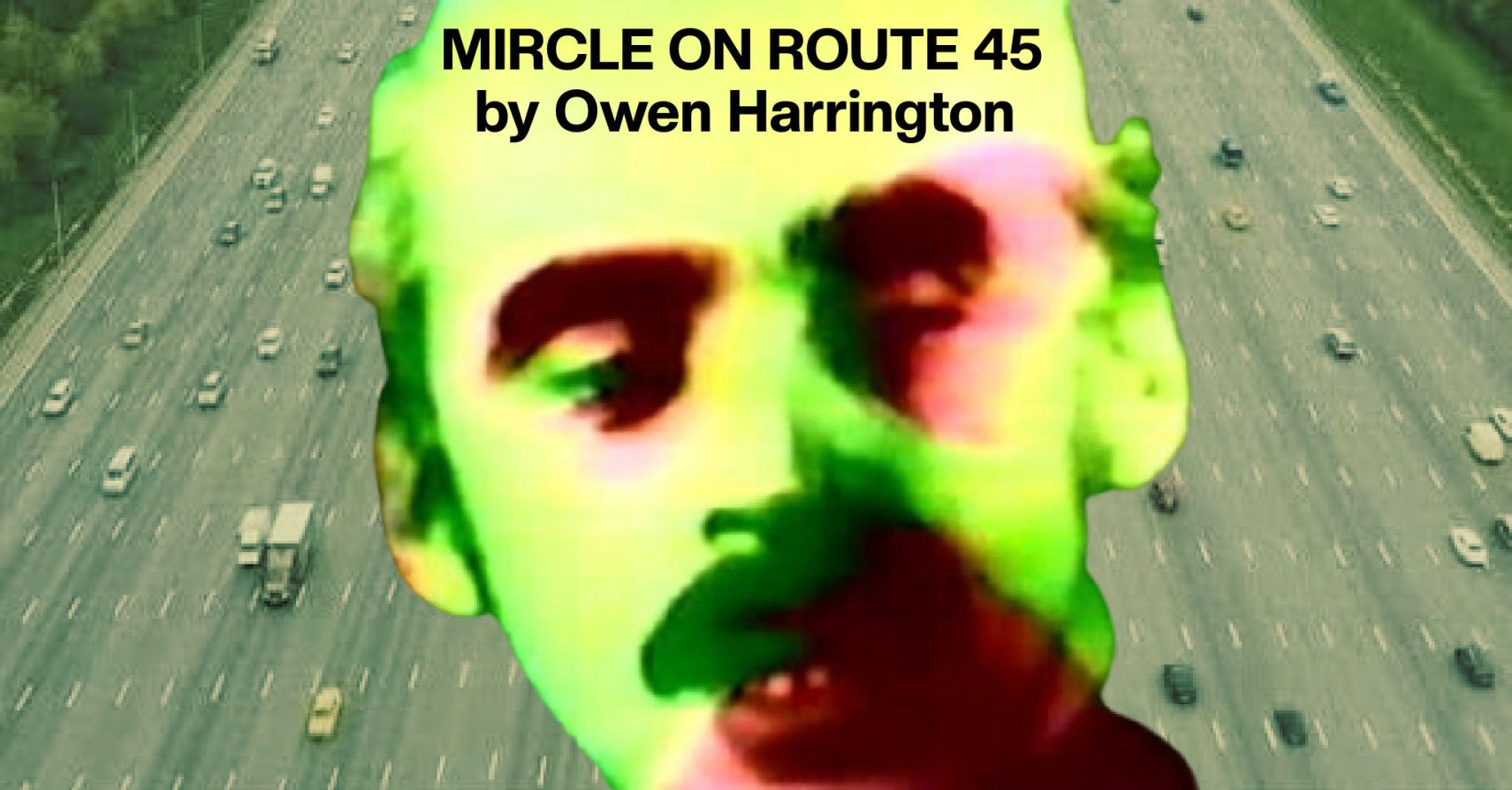
There was only one way things could end. I was trying to find something else to think about and he emerged, covered in red clay mud like the first or last man, right onto state route 45. The ride back to State College was just long enough to fixate on something, but not long enough to work up the nerve to turn around. It strung together Mifflinburg, Harleton, and Milheim like the dim lights of a dying civilization in the heart of darkest Amish country, and had few features to catch the wandering eye. But just past Mifflinburg, a man parted the curtain of sorghum-like grasses between the soybeans and the road and hauled himself up the five-foot embankment onto the narrow shoulder.
He was without a doubt neither Amish nor Mennonite. While the local Anabaptists usually wore black slacks, plain colored button up shirts, straw hats, and black shoes, he wore next to nothing. Not even shoes. All he had on was a pair of purple basketball shorts with a black vertical stripe down the thigh. The waist band was long gone: the shorts seemed held up by the weight of his large gut hanging over them, pinning them to his waist, while his nearly concave ass offered little support. He clambered out onto the asphalt, then stood up and began jogging lightly eastward.
I saw it all. I couldn’t believe my eyes–where had he come from? What was he doing? As I passed him I searched his sparsely-bearded face for some spark of human recognition, some acknowledgment of strangeness. His eyes stared back straight through me before I watched him fade to nothing in my rearview mirror. I lingered on the point where he vanished into the horizon.
A black alien assemblage–flashing legs, spoked wheels turning, and the glint of the evening sun on heavy panes of antique glass–appeared at the edge of my consciousness and then became my whole field of vision, tearing my eyes back to the road. A horse and buggy. Gripping the wheel hard, I closed my eyes and swerved. It was like I passed straight through it. When I opened my eyes, though I was in the left lane, I was by some miracle still driving along through the rowcrops, and the horse-and-buggy had slowed down in my rearview. To my surprise, it had no driver, just a panicked Belgian draft horse in the reins, slowing to a halt and kicking up dust.
For the space of about five or six miles after all this, there was silence. The image of the horse and buggy rapidly filling my entire windshield was quickly substituted piece by piece in my mind’s eye with the mud-stained man in the purple shorts. Something about his eyes.
When I was on the threshold of my adolescence, I went on vacation with my father in Northern Vermont. At the halfway point of a day hike we stepped out onto an outcropping and looked down at a waterfall on the Missisquoi river. On another rocky ledge across the river there was a similarly hulking man in a purple shirt, standing at the edge of a vale of hemlocks, staring deep into the forest. He didn’t once turn around while we ate our sandwiches and he was still there when we left. I never saw his eyes, but it was like his stare had passed through those woods and slowly circled the globe like a military satellite, finally making its way back to me after all these years through the tall roadside grass.
Just the sight of the man in the purple shirt had cast a shadow over the rest of the trip with my father. His inauspicious presence sapped me of good cheer. My father chastised me for my sullen demeanor that night over dinner in our cabin. That he had been entirely unaffected by the apparition made me mistrust him, and this must have shown. Over the following months, our relationship, once very close, began to sour. My patience with him became exceptionally short and I avoided sharing anything about my life with him. I developed nasty habits. He said I was becoming a conniving thief and he began to accuse me of lying daily. He blamed me when anything had gone missing, for no matter how short a duration. He was “the professor”– a pillar of the community– and I was a hostile little rat. I was thrilled to move out when I turned eighteen, bringing an end to years of open hostilities.
And now, after all these intervening years, I suspected I was once again in the presence of the man from the falls, or at least his eyes. I felt a breathy heat seep out from my brain stem to the back of my ears, like a varicella virus reemerging from dormancy years after a childhood malady. Whispering, it urged me to follow. I had said I’d be in State College by six, but my timely presence there seemed less and less important, not that it had ever held much attraction.
I needed to know. No one was coming the other way, so just before Woodward I slammed on the brakes, then cut the wheel hard for a U-turn. My truck’s turning radius was poor so I went off the road a bit, my tires shaving a crescent in someone’s lawn. I didn’t see the horse and buggy anywhere– evidently it had turned down one of the long driveways leading back to a gaunt Amish farm house. The ridges, rising straight up out of the valley bottom to the west, blocked out the sun behind me like a screen. I felt eyes watching me from behind the hills.
His endurance was impeccable. When I finally tracked him down he was already inside the borough limits, where the houses were laid out in a grid bisected by route 45. He was still jogging. It was almost 6 PM, so I expected to see Mifflinburg’s usual semblance of a “rush hour.” However, the town was deserted. I meticulously snaked down one parallel street after another, through rows of Victorian houses surrounded by piles of their chipped paint, my head on a swivel for his purple shorts. I silenced my ceaselessly buzzing phone. Like a flash, I saw him for a moment before he disappeared around a corner.
I started to cut through the next alley, but a black Lincoln Towncar pulled in at the other end, blocking my pursuit. I rolled my window open– Get the fuck out of the way! What the fuck are you doing? I need to get through, I need to get through! The car did not move. Bastard. A man dressed in black formalwear got out and quickly walked away, leaving the car in my path. I cursed him, got out of my car and ran the rest of the way down the alley. The Lincoln driver was nowhere to be seen, but the man in the purple shorts was again visible at the end of the road, jogging machine-like, shorts poised to fall at any moment. He ran up to the side door of a white building, set apart on a corner where the road stopped at a graveyard set on a sloping hill, pulled it open, and disappeared. I went after him at a jog.
The last storefront on the block froze me for a moment. In the display window, bathed in the glow of string lights, a 4-foot-tall tin Santa Claus, rotating back and forth in 120 degree arcs, waving his arm stiffly at the elbow. At the extreme of its rotations, its eyes fell on me with a mocking paternal gaze, as if to say only coal this year. It was flanked on either side by a small metal monkey on a bicycle and a music box in the shape of a clamshell topped with an ivory mermaid. A Pierrot sat off to the side on a benevolent crescent moon, strumming his little tin lute. One long ostrich feather lay on the ground at the back of the display, forgotten. When Santa’s eyes turned back to me, Pierrot’s hand suddenly flicked on its wire strings and he jerked his head, making me jolt.
The display was backdropped by a heavy curtain, making it difficult to see whether the store was open. A dim light peeked underneath, emanating from somewhere far in the back of the building. I could faintly hear the whirring gears of the automata through the window glass, like a hive of metal wasps buzzing, which persisted even as I rubbed my ears. The light under the curtain flickered. I turned to the front door, landed three blows on the wood and waited. No response. There was an angel rendered in cracking paint on the door where my fist had struck, hands clasped in prayer. What would an angel pray to? Stung with shame, I turned and ran. I could feel metal eyes following me.
I entered the white building at the end of the block, which from the exterior seemed to be some sort of municipal annex building. Inside, I felt entirely cut off from the surrounding world. The lengthening rays of evening light were completely blocked out by curtains and replaced with candles arrayed around the walls at even intervals and stuck into a chandelier hanging from the high ceiling.
Evidently, it had been a protestant church sometime in the last century: there were several rows of pews on the ground level, sparsely occupied by elderly people, and a second level (with no recognizable entrance) which looked down on us from all sides. I suspected there was someone up there, but it was too dark to tell. The area surrounding what had been the altar was transformed into a stage, with a long bolt of delicate paper suspended between two posts standing up at the back.
Several sets of eyes turned towards me when I entered, and almost immediately, a childish looking old man (or an ancient child) appeared out of the semi-darkness, and with a delicate touch to my shoulder, gestured for me to sit. I unquestioningly obeyed. Nowhere in the pews did I see my quarry. Either he was somewhere above me or behind the brocade curtain, which had been set up behind the stage and covered the furthest corner of the room.
I waited in transfixed silence. My duties in State college gnawed only dimly at my conscience. My sister could easily speak in my place. What would I even say? I hadn’t spoken to my father in years.
Mostly I dwelled on the beastly man I was following. What drove him? What was the source of that ancient light behind his eyes? He wanted me to see him. He had been waiting in that field, for years even, covering himself in mud and manure to keep cool in the late summer sun. He’d waited until he saw my silver Tacoma approach in the lengthening light before disinterring himself and clawing his way up onto the roadway. Though he ran tirelessly as if being hunted, I knew he wasn’t running from anything. That was the lot of God’s lower creatures. He was conveying some more obscure but noble purpose through his flight here. I felt lucky to be bearing witness, even creaturely as I was.
The lights flickered and, seemingly taking this as a cue, the door attendant sat down. Voices murmured in the darkness above. Somewhere, a sickly harmonium began to cough out a waltzing melody in a minor key, pierced by chords on the 2 and 3. To my surprise, the screen at the back of the stage began to move: the two poles holding it up rotated in counterpoint and fed it from one to the other with the same vespid whine as the automata in the shop window.
A landscape scrolled by, slowly transitioning from a hilltop dotted with warped trees to a tropical island scene, before passing to an ocean storm. The whole vista was done in watercolor on diaphanous paper, lit from behind to give it an oneiric glow. A group of school-aged children filed out from behind the curtain in a funereal procession, costumed in feathered masks and black capes. Some of them held sticks supporting antique depictions of heavenly bodies in papier-maché. There was no order to their ersatz firmament, like the heavens had been shaken loose onto a card table by the shock of an earthquake.
Then I saw him again, just as before, parting the curtain, first with his eyes then with his filthy hands. He had, moreover, not changed his outfit, nor even washed off any of the rusty mud. He emerged, and with a delicacy that had been absent from his jog along route 45, he tip-toed into center stage, never taking his gaze off the shadows of the upper balcony. He paused for a moment while the sound of a clarinet materialized alongside the harmonium, playing crescendoing long tones.
Then he started to dance. It began in his feet, which stabbed blows into the ground, while his arms hung at his sides. Then, to match the dynamics of the clarinet, he slowly swung his arms, at first a little, then more and more freely, front to back. He added in a familiar series of repeated 120-degree rotations along an axis running from the top of his head, straight down to the floor.
I shuddered.
The ensemble of partial moments gave way to a full body whirlwind: the man in the purple shorts spun and jerked as if prodded from all sides by a red hot iron. The reedy instrumental duo wailed while the children rotated around him as if drawn by a gravitational pull around a center somewhere else, high above. It was as if his will was not his own and his movements were epiphenomena to the more profound oscillations of a larger body.
My vision, or perhaps my memory, was subjected to a strobe effect for the remainder of his performance. I experienced, or remembered, his motions as a sequence of discontinuous poses. The passage of his limbs from one position to the next was imperceptible. One moment he was balanced on his right foot, legs spread wide, arms in a “T.” Next he was crouched, holding himself in a ball. Then a series of violent contortions mid-thrash. Instead of a body he became a series of discrete parts: one moment a set of flashing teeth, next swinging arms, sharp flicks of his wrists. The scrolling panorama in the background flew madly from desert wastes to alpine passes, as if whole geological ages were passing before my eyes. His eyes had a new wildness in them. Suddenly, a single hand poised to strike.
The music ceased. The muddy body and the purple shorts were again still. Then he slowly sank to his knees and collapsed in a heap. My mouth hung open, and no breath came out.
For a moment I didn’t recognize myself, unable to reflect my thoughts back onto themselves in any symmetrical way. Every concept I tentatively reached out for, to touch the reality of what I’d just seen, returned to me warped and ill-fitting, as if in the course of their transit they had passed through the mind of an idiot. I could not think without thinking the thoughts of another, experiencing my own recollections like the grit of unexpected sand in food. Only gradually did a relatively intelligible, if somewhat distended, version of myself begin to re-emerge out of the confused vortex of sensations the performance had dissolved reality into. I was left with the lingering sensation of having attained a slightly higher degree of perfection, and a restless stutter in my breath.
The moment demanded some sort of reaction. But which was most appropriate? One of the audience members in the row behind me answered with a tepid clap. She was joined, slowly, by the five of six other people in the room. I followed suit, stunned and teary-eyed, louder than the rest.
Then, just as unceremoniously as the whole performance had begun, so it dissipated. The audience quickly filed out. The children returned behind the curtain, senselessly chattering amongst themselves. Where were their parents? I was not ready to leave, still watching the star of the show, my object of fascination, sitting on the stage, exhausted. The doorman had brought him a glass of water and laid a hand on his shoulder. Seeing me staring at them slack jawed, he smiled, then leaned over and whispered to the dancing man, before waving me over. I once again obeyed. With kind eyes the door attendant stated, matter-of-factly, “I understand you have a question for our star.” Though receiving no recognition from the exhausted dancer, I affirmed this, and asked him: “Could I buy you a drink?”
We walked out of the annex building in silence. It was still a weird twilight. Evidently the performance had not been nearly as long as it had felt and the curtains on the windows had not allowed me to accurately gauge the passage of time.
I struggled to keep pace with him. He didn’t jog as before, but his walk was a compact, mechanical stride. We turned onto the main street and then into the windowless storefront of an Eagles lodge. Inside it smelled of years of accumulated cigar smoke, acrid though not entirely unpleasant, which had seeped into the wood-paneled walls. A long bar ran down the right side of the room, behind which a bartender in surprisingly formal attire cleaned glasses. We took two seats close to the back of the otherwise empty room, near to a door that held a sign reading “Private Event.” Muffled conversations and light, occasionally interrupted by shadows, peeked out from underneath the door.
My companion gestured to the bartender, who had already started filling up a glass with dark ale. Within seconds of the bartender setting the first glass down, the man in the shorts had drained it. The bartender was already filling a second one. I watched incredulously, having yet to take a sip before the man in the purple shorts was halfway through his second pint. He did finally slow down, pause, and lower the glass to the bar, before finally turning to look at me for the first time. His eyes were like charcoal underneath his crude bowl cut. I spoke first.
“I’m supposed to be at my father’s funeral right now,” I said. “He died three days ago, and he wanted to be buried in the evening, which is weird. I decided to follow you instead. I saw you running out on Route 45. Did you know that?”
My words seemed to only dimly register to him, but after a few seconds he gave me something like an affirmative nod, then made a quick circle gesture with the index and middle fingers of his right hand as if to say continue.
“The last time I saw him he called me a Quisling, for reasons I still don’t understand, and I scratched his face,” I said, “but they still wanted me to say a few words on his behalf. I wrote something, too, but it wasn’t very nice.” I paused to gauge his reaction. Not much. “Do you want to know why I followed you?” I didn’t pause this time. I launched into a full-scale reconstruction of my life over the past 20 years and my theories about his role. How I knew I had seen him once before in Vermont, the subsequent disintegration of my relationship with my father, moving east, working in jails and nursing homes, writing horrible poetry, committing countless petty thefts at gas stations, waiting out the years until my father died, all culminating in the man’s emergence from the sorghum-like grass. I told him how I knew he had a message for me. “I think you’re some kind of angel is what it comes down to. I can’t say I know what kind.”
His reaction was more muted than I’d hoped. He just kind of swirled his tongue around his gums and then finished his beer. There was another waiting for him already.
“I want you to tell me what it is you have to say,” I said, becoming more perturbed. “I followed you here, I saw your performance, which was fucking bizarre, by the way. My sister and mother have been calling me non-stop this whole time, and it’d all be worthwhile if you could just tell me what you were doing crawling out of that field.”
His look, now directed towards me instead of the counter, telegraphed a new valence of disgust.
“Don’t judge me,” I said. “Don’t fucking judge me. You fucking beast. You slob! You’re covered in reeking mud, in a place of business no less, and you can’t even fucking say why? I was wrong! You’re not an angel, you’re a fucking pig!”
He finished his beer with a somewhat pleased look, then turned back to me, gripped my chin with his mud-caked fingers, and finally spoke. “Out on the highway was the first time I’ve ever seen you in my life, and I’ve seen a lot of things. Burning stockyards, tombs for the living, a woman giving birth to half a sheep. October 8th, 2006. April 4th, 2011. June 23rd, 2017. Remember that? I’ve seen everything that’s ever appeared to you in a dream, and I’ve never even left this town. I’ve spent half my damn life underground. But I’ve decided I’ve had enough, I’m tired of living off of secondhand images and the sugary sap of cut roots. I love to dance too much to stay down there. You’ve been free for far too long, and you’ve never once earned your freedom. You came by at just the right time. I’m not going back, and you’re going to take my place. You’re already halfway there. Can’t you feel it?”
His words knocked the air out of me. I pawed at his chest with wild eyes, making hoarse animal sounds, but he kept his hand on my chin, staring at me, squeezing harder, repeating, “Can’t you feel it?”
As I struggled for my stammering breath, his face lost definition and his eyes dissolved, becoming a field of light and the sound of air sucking between my teeth.
My sister’s voice emerged out of that vortex, saying my name. Shapes precipitated out of my milky surroundings. Screens, faces, a clock on the wall, silhouettes of whole people, curtains, tubes. The random array of objects slowly congealed into a hospital room, a nurse, and a few family members.
Once I had worked back a little strength and mental acuity, I sat in my reclining bed. I sipped water as they filled in the details of the past three days. On Route 45, a mile or two east of Mifflinburg, I had crashed my truck into an Amish horse and buggy, seemingly by accident. Thankfully, they said, the driver had seen my vehicle swerving and leapt out in time. His horse had not been so lucky, and had perished. It was unclear if he’d press charges, as we were unsure he believed in “English Law.” My truck flipped over the berm and into the soybean fields, throwing me through the windshield.
That I had survived, though briefly in a coma, was a miracle only attributable to the soft red clay they found me half-buried in. There were no other witnesses. My sister noted in hushed tones that while they had no reason to believe I had been driving under the influence of any illegal substances, the police had found an empty blister pack of Benadryl and a similarly empty bottle of CBD oil in the wreckage. Had I taken them?
I had not yet regained the ability to speak, which made it very easy to lie convincingly. I smiled sweetly and shook my head no. Even if my mouth had been working properly it would have been difficult to explain the process of how I’d transformed those ingredients into vapeable form. Everyone had been calling me when I was late to the funeral, and had started to curse my name at the reception. When they got the call from the doctor in Mifflinburg they ate their words and rushed to my side. I was not a shirker, but a poor boy who’d gotten into a horrible accident while rushing to pay his final respects to his father, in spite of our troubled past. I smiled and patted their hands as they left the room to give me the chance to rest.
They could not have known that I had in fact chosen not to go. But the relationship between my pursuit of the man in the purple shorts and reality was foggy. The longer I was awake the hazier it became. And, as I sat in the room, features of the experience began to map onto elements of my hallucination. Certainly the many eyes I’d seen and felt had been the gazes of my doctors, nurses, and loved ones looking down on me. The sound of the whining machines by my side were a near perfect match for those of the automata I’d seen in the window. The wall-mounted television playing nature documentaries could easily have stood in for a mechanical panorama. The curtains surrounding my bed separating me from other patients were all backlit by warm bulbs, their light seeping out from beneath. There was really only one feature of my dream I couldn’t account for.
I laid in the hospital bed, with my head to one side, looking at the door through half-shut eyes, restless breath twitching in my lungs. A warm light somewhere down the hall spilled around the jamb into a puddle on the floor. At this moment, two muddy feet stepped into the pool of light. A shirtless man in a pair of purple shorts marched through the doorway with that same bestial look in his eyes. He made straight for me, his arm stiffly bent at the elbow, a hammer poised at shoulder height. This was the end of my freedom, even though I’d done nothing wrong.