
Some thoughts about two books worth reading:
“Gentleman Overboard” – Herbert Clyde Lewis
“The Coast of Everything” – Guillermo Stitch
One fine early morning, Henry Preston Standish (of the Mayflower Standishes!) decides to take a stroll along the railing of the Arabella, a freighter carrying him and a few other adventurous travelers from Hawaii to Panama. Standish, a New York investment banker, happily married father of two, member of the Weebonnik Golf Club etc. etc., has treated himself to a time out from his responsibilities in the form of a long journey around the world – and into himself. As he passes the service door of the galley, he slips on a grease spot, or maybe it’s a potato peel, and loses his footing. Instinctively he attempts to grab onto a bracket. In vain alas. Three days out at sea and eight more to Panama along a rarely frequented sea route, he plunges headlong into the Pacific Ocean. Splash! Gentleman overboard!
Where am I?, Henry Preston Standish asks himself – probably for the first time – when suddenly he finds himself, very alone, in the lukewarm waters of the Pacific as he watches the Arabella drift farther and farther away.
Initially, he can’t manage to call out for help. Helplessness is just not something a person of his station cares to make public. By the time he is finally prepared to communicate his plight, it is too late. His only remaining hope: someone will notice that he is nowhere to be found aboard, prompting the captain, if Standish is lucky, to change course and search for him on the surface of that sparkling sea.
At any rate, Mr. Standish happens to be a good swimmer, and that allows him fortunately – or perhaps unfortunately – to stay afloat. Then he begins shedding his clothing, shoes first, until he is little more than a speck of naked life in a vast ocean watching the Arabella fade off towards the distant horizon.
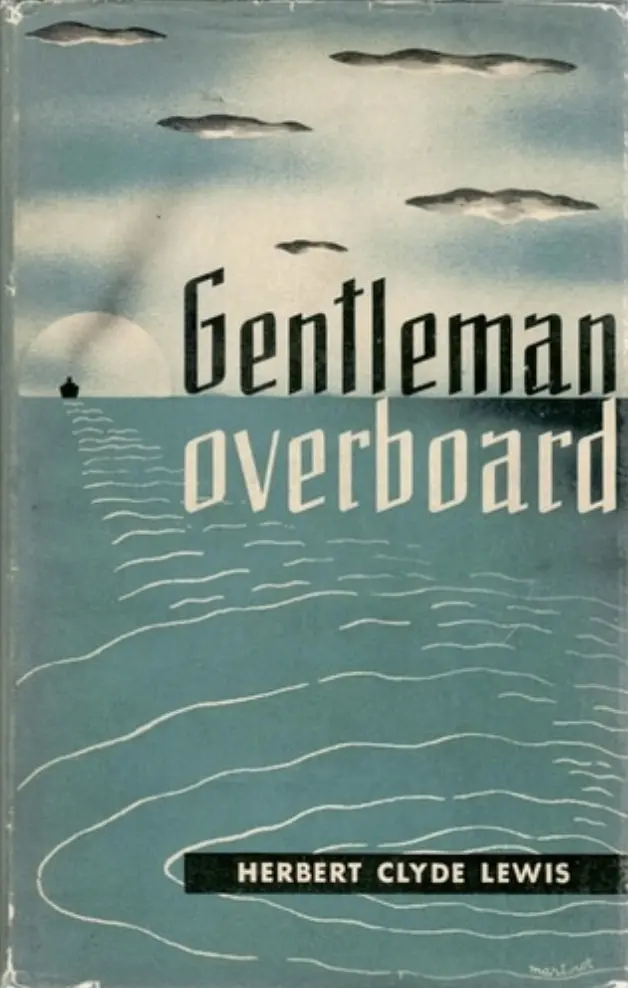
The chilling short novel I have been describing, appropriately titled Gentleman Overboard, was first published by Viking Press in 1937. The author, Herbert Clyde Lewis, then 28 years old and financially distressed, was no doubt hoping that his royalties from this page-turner would bring about a turn of fortune.
Well, that didn’t happen. The book did manage to get reviewed at the best addresses, but the arbiters of literary taste of his day gave it a reception as lukewarm as Lewis’s imagined Pacific. The New York Times described it as “entertaining”, “a flight of fancy”. The reviewer in The Saturday Review praised it faintly as “a good enough book of its kind”.
No need to continue this lackluster litany of days gone by. Contemporary interested readers can purchase their own copy of this neglected masterpiece, resurrected in 2021 by Boiler House Press in its series “Recovered Books”. Since then, Gentleman Overboard has finally taken its rightful place in the ranks of world literature.
No solace for Herbert Clyde Lewis. He died of a heart attack in 1950 at the age of 41, a derelict in a rundown hotel in Greenwich Village.
Moral of the story: writers always take chances when sending the results of their wondersome flights of imagination into the fickle world of tastes and prejudices, a world as perilous as any seemingly pacific Pacific a man named Mr. Standish who ostensibly had been dealt the best cards in the deck of life might find himself afloat in.
Maybe what I’m trying to say is that writing is no occupation for sissies. Or do I mean that about life in general? That wounded soul Franz Kafka, blessed (or cursed) with a sharply ironic perspective of the world around and within him, never once heard the term “Kafkaesque”. If it hadn’t been for his friend and literary executor Max Brod, we would know very little of what Kafka wrote. Deathly ill, Kafka asked Brod to burn his manuscripts once he died. Well Brod didn’t and began publishing Kafka’s books in 1925. By the late 1930s and early 1940s Kafka had been deemed a literary giant.
Or Fernando Pessoa, today one of the greats in Portuguese literature – and far beyond, died a troubled middle-aged alcoholic in 1935. And then his friends found a trove of manuscripts heaped in a trunk in his rented room. By the mid-1940s, Pessoa was a figure in world literature.
And let’s not forget Emily Dickinson.
No, the vicissitudes of renown is not my theme. Besides, what about those writers who in the course of their lives did make it and even received swell sendoffs attended by friends, family, fans and press. And then… Do people still read Norman Mailer? Are all those gooey and oozing sex juices dripping from the pages of Philip Roth novels still palatable? And on a more general level: who knows what books will still be read in fifty years?
Which brings me back to Mr. Standish, floating naked on the surface of the Pacific and faced with the bare facts of his existence. Gentleman Overboard is a wonderful book because it deals with the most fundamental level of human existence. Not politics, hot sex, depression, victimization etc. etc. In other words: Mr. Standish is no more than a metaphor for the human lot – our situation.
Where am I? That is the question Herbert Clyde Lewis is asking us to ask long before we fall into some Pacific Ocean.
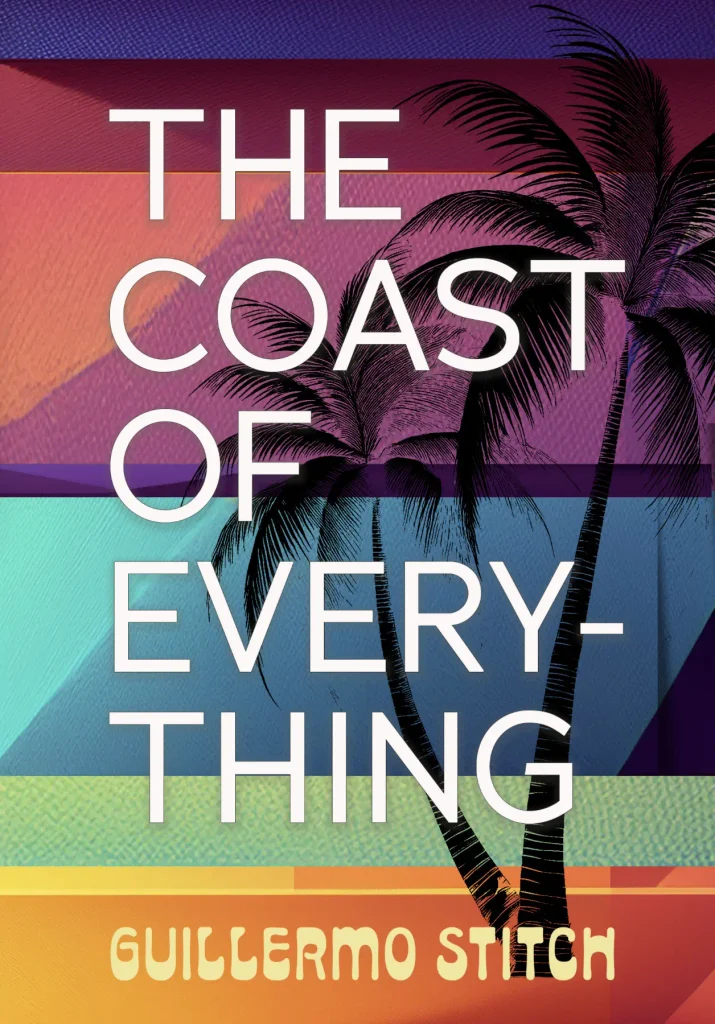
And now let’s turn to Guillermo Stitch’s new book, The Coast of Everything, published in June 2026 by Sagging Meniscus Press and like Lewis’s book a roadmap to a place where words go silent.
In contrast to Gentleman Overboard, Guillermo Stitch’s book weighs in at 760 pages. A complex page-turner that takes the reader on a journey through diverse worlds that fit into each other like a multidimensional atlas of the visible and invisible universe.
On its most basic level, it tells the story of a one-eyed paraplegic girl named Clara, who, while being carried up a mountain trail in a litter by two young men, one a dwarf, the other mute, to attend an event at the top of a mountain called Wahrberg, entertains them with stories, perhaps as a reward for their efforts or just to pass the time. Or maybe for some other reasons? What makes this book especially complex is the fact that certain characters in Clara’s stories themselves have stories to tell, long tales that evolve into a convoluted structure no less profound and mysterious than an ocean, an ocean, a deep ocean like one on which a Mr. Standish might be floating.
Clara’s stories introduce us to characters living in a variety of dystopic worlds, some seemingly futuristic, some frighteningly present but lastly as unsettling to the reader as Mr. Standish’s experiences on the surface of something deeper than words. Like Herbert Clyde Lewis, Guillermo Stitch wants his readers to ask that uncomfortable question: where am I?
His answer is obvious: You are on the coast of everything. And not to forget: the surface of an ocean is also somehow a coast, a thin covering dividing what is visible from what is not.
Where am I? That is the question that both these books, as disparate as they may seem on their respective surfaces, are asking. Clara, a seriously disabled person in this world, is asking this question and so are the myriad figures she invents in the course of her multidimensional narration; Mr. Standish, a man born with a silver spoon is also asking it, as he comes to understand his existential dilemma. And probably we too should be asking this question…daily.
Where am I? It’s the question that motivated Herbert Clyde Lewis and Guillermo Stich to write their fine books. As for the answer: Shh. Listen! Do you hear all those people floating on the surface of that great ocean bordering the coast of everything and trying to figure out why?

P.J. Blumenthal’s collection of stories Self Portraits is published by Sagging Meniscus Press in October 2026.
P.J. Blumenthal is an American writer living in Munich, Germany. He is the author of the novel Winston Hewlett’s Impotence (Sagging Meniscus, 2024), a nonfiction book on feral man, Kaspar Hausers Geschwister (Kaspar Hauser’s Siblings), as well as a German-language blog, “Der Sprachbloggeur.” Three volumes of his poetry have appeared in the USA so far: A Lusty Romance, Poems for Readers and Slow Train to Cincinnati.