Nicholas Montemarano, If the Sky Falls (Yellow Shoe Fiction, 2005)
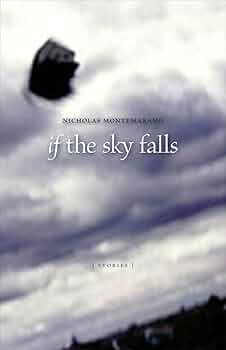
I was 24 years old when I first encountered Nicholas Montemarano. He was reading for a class I was TAing for, so I dutifully picked up his then-latest book, If the Sky Falls, a collection of short stories. You have to understand that this kind of thing happens a lot: reading the books of visiting writers is part and parcel of academia, and unfortunately the books are often at best easy to get through and at worst a chore. I was as a result not only pleasantly surprised but gobsmacked that within a few pages I was reading a book like nothing I’d ever read before and already knew I’d never forget.
If the Sky Falls came out in 2005 and isn’t quite a linked collection, but it’s also not not one either. Put it this way: if the protagonists of each story aren’t the same person, then they would trauma-bond immediately if they ever met at a party. We repeatedly hear of checked-out absentee fathers and anxious, overbearing mothers, as well as siblings who cling to each other in the face of such abuse and neglect. I’m making the book sound maudlin and it isn’t, though it’s difficult to pinpoint exactly what the magic of the prose is, how and why it so thoroughly sucks the reader in.
One way is that the characters don’t really know what to do with the trauma they’ve experienced, often avoid it, push it down, think about something else, such that each character isn’t so much suffering as shellshocked. So “The November Fifteen,” for instance, opens with graphic, extended torture scenes which are followed by the PTSD protagonist feeling nothing as a result, his family growing increasingly frustrated that he won’t communicate with them what happened to him. “Note to Future Self” opens with an urgent call between siblings as a sister asks for help after being beaten, but her brother struggles to face the gravity of the situation and counts time on the potato chips he’s eating on the bus ride to see her. In “The Worst Degree of Unforgivable,” children of a domineering mother recount her many, increasingly insane, directives in plaintive voices divorced from anything suggesting they’ve confronted their abuse. And, most directly, “The Beginning of Grief” finds a character quietly suffering in the wake of his secret fiancé’s death and who seeks solace by participating in performative pain (getting shot in the meat of his arm at a shooting range, going on a Holocaust reenactment tour).
Montemarano once spoke to me about the important difference between sentiment and sentimentality, and you can see that in his project here, you can see his impatience with artifice and surface-level Oprah-style touchy-feelies. He wants to cut to the bone, to the heart of human experience and in doing so finds emotional language contemptible. “For years I’ve been unforgiving with my students in this regard—sentimentality will be the death of you as a writer, I’ve told them,” he writes. “But now I want to be sentimental—I want to write all the terrible prose I’ve been telling my students not to write…I want to gush now that gushing is called for.” He navigates that gap again and again—in “Man Throws Dog Out Window,” a community grieves the titular dead dog but seems uninterested in the couple whose fight culminated in that act of violence. “I’m very sorry you feel the way you do,” is a repeated line in his writing, therapy-speak spoken most often by characters who do not seem to care at all about how others feel.
But his best stories are the ones where he pushes so far into the impatience with artifice that he breaks the artifice of the fourth wall itself. In many pieces, he exposes the mask that is fiction by throwing it off and going meta. In “Story,” he stops the setup of a man and his son playing at a playground midway to admit that he has no son, this scene isn’t real, and that he’s really an author at his desk trying to reckon with the many instances of racism he’s witnessed—and sometimes partaken in—throughout his life. In “The Other Man,” he writes, “This—what I am writing—is not a story. This is not a fiction…it should be called something else. My father’s name is Nicholas. My father and I share the same name. If you look at the cover of this book, you will see my name…”. In “To Fall Apart,” he quite literally tells us that the present action of the story is him writing the story and ends by asking whether he has, at long last, told it right.
There are two ways of handling metafiction, I tell my students. One is to push people away: you know, Ha ha, stupid reader! You got attached to these people? They’re just characters! But another way is the opposite, the way Montemarano does it: it pulls people in, offers a vulnerability on the part of the author, rewards readers for investing themselves. If you cared about these characters, it seems to say, then I’m glad, because they are not just characters, they’re real people with real stakes who live and breathe and hurt. Maybe what he is—and I am—getting at is the pursuit of what’s true, and the admission that reality and truth are not necessarily synonyms. Fiction can be a mask, sure, but it can also be a map directly into the emotional core, the discovery of what’s true, in a complicated situation.
I can’t count the number of times I’ve reread these stories over the years, or how often I reference them in conversation or just think of them as I live my day to day. I can’t count how many copies I’ve lent out and lost and bought again. The stories in If the Sky Falls act as something of a litmus test for me, now that I’m no longer the young student discovering the book for the first time, but am actually the teacher. Its craft elements aren’t as clearly outlined and dictated the way they are in, say, Tobias Wolf’s “Bullet in the Brain,” another staple of my syllabus. But invariably, the best writers in class immediately warm to these pieces (one of my all-time most talented students got a quote from it tattooed on her clavicle!). They’re deeply felt, and you don’t have to be embarrassed by that being the operative quality, since the book gives itself a built-in defense mechanism against that charge.
Anna Dickson James, Boys Buy Me Drinks to Watch Me Fall Down (Whiskey Tit, 2023)
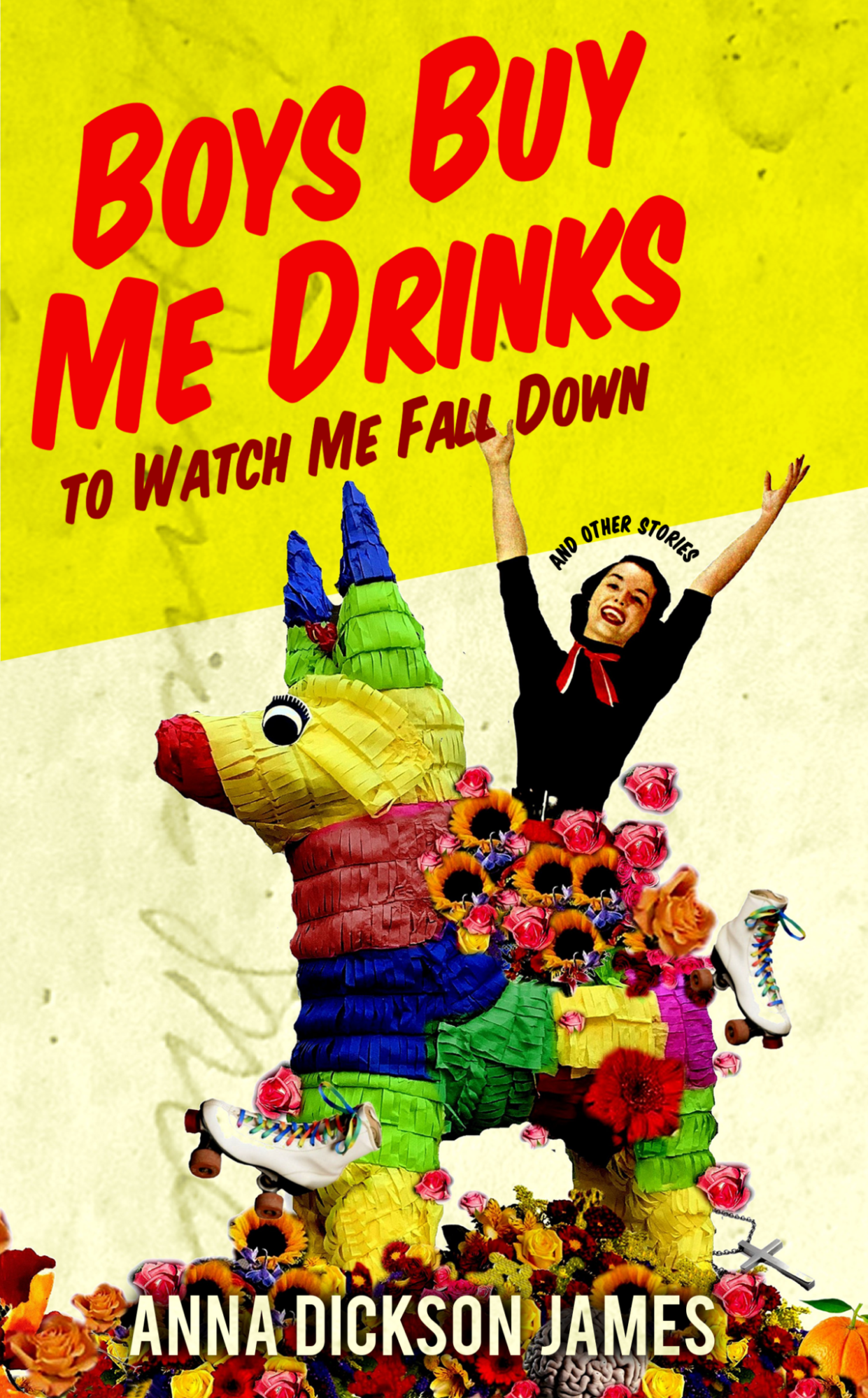
On the other hand, Anna Dickson James’ Boys Buy Me Drinks to Watch Me Fall Down interrogates the ache and hurt of its characters through a different lens: humor. Big time humor. Dark humor. Pitch-black humor. Irony. Shit that will make you embarrassed at how loud you laugh in whatever public space you’re reading it. James finds endlessly inventive ways to examine her characters’ plights, with a real Aimee Bender-ish magical realism to some. In one, a couple’s toxic dynamic is portrayed through cannibalism, as one lover (the man) eats the other (the woman), and she’s too in love, or too polite, to stop him. In “Goodbye, Ray Charles, Goodbye” a woman with breast cancer gets prosthetics and finds out how deeply in love with her natural body her boyfriend was—and how deeply in love with any other part of her he is not. In “Sommelier Mort Vivant,” a zombie (she prefers “second-lifer”) develops a taste for intelligent brains in the least likely place to find them—America. (“Without me,” she says of their zombie horde, “they’d still be eating politician brains. I know that joke is low-hanging fruit, but I have yet to eat a mayor’s brain as succulent as a high school English teacher’s. The world should know”).
The men and boys (they’re interchangeable, really) in James’ book are wisely not portrayed as cruel or villainous, twiddling cartoon mustaches as they prey on the women in each story. In fact, they’re portrayed most often as confused, checked-out, selfish-without-knowing-it, blunted by their own entitlement and emotional unintelligence. Likewise, the women aren’t victims passively navigating overwhelming relationships; instead, they’re often in the position of feeling sorry for the men they’ve found themselves involved with, inwardly and simultaneously rolling their eyes and clucking their tongues in the face of partners who are not their equals. It’s the kind of 21st century feminism that an increasingly complicated world demands, when communication seems all but futile in relationships in general and heteronormative ones in particular.
James has a gift for elevator pitches. When you do find yourself laughing out loud in front of strangers and they ask what you’re reading (I speak from experience here), it won’t be hard to sell them with a handy logline: “This story’s about a Baptist tradwife who joins Sex Addicts Anonymous” or “This one is about anthropomorphic furniture.” She also seems incapable of writing opening lines that are anything less than stellar. “Gretchen’s been dating a 24-year-old professional boat racer from Brazil named Andato,” she begins in “Proud to be a Shriner’s Wife.” “Rebound” opens with, “We had sex immediately in the club bathroom. We’d done it to break the ice, to get it out of the way.”
But most importantly, underneath the snappy writing, genre-bending, quips, and entertaining premises (and when was the last time you read a book that was both smart and entertaining?), the characters ache with real feeling. “The Art of Drowning” sees a mother so disaffected from her husband and infant that she’s convinced she is her own twin, not the actual wife and mom meant for this situation (when I saw the recent and awesome If I Had Legs I’d Kick You, the story kept coming back and haunting me). In the aforementioned zombie story, our central character misses her (still alive) husband throughout and does everything she can to push that memory away, before doing everything she can to embrace it. This is where the Bender comparison feels appropriate, the way James uses speculative premises to get at real-world emotions: who hasn’t felt so distanced from an ex they still love that they feel like they’re living as a different species, doing what they can to savor whatever memory of that former life they can still recall?
Maybe that’s what ultimately unites these two otherwise seemingly disparate collections, published twenty years apart by two very different authors who write very different stories in very different tones. At their core, they love their characters, they love the people behind those characters, and they do what any good story tries to do, which is to find out what makes these characters tick. “Don’t write about happy people,” I tell my students all the time. “Happy people don’t need you, they’re doing fine without you. Use your writing talent to tell the stories your characters are too vulnerable, or too shy, or too emotionally inarticulate, to tell.” Too often we define our protagonists by whether we’d want to have a beer with them. But what art does best is compel you to spend time with characters you wouldn’t normally interact with if you met them on the street, and recognize the human inside.
(postscript: I would happily have written about Kevin Maloney’s Horse Girl Fever, handily my favorite book of 2025, had it not already been written about on this very site; that said, I would have been remiss not to give it another plug, so here’s that plug. It’s hilarious. It’s fun. It sounds like the voice in my head. Order it!).