
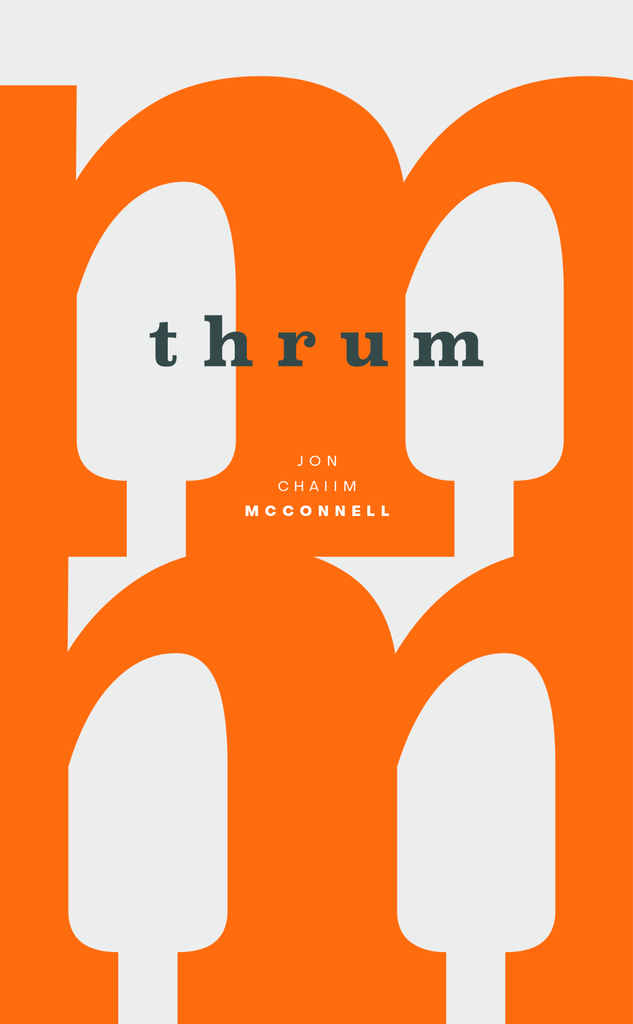
Jon Chaiim McConnell’s novella thrum (Malarkey Books, 2026) approaches from an obscured direction. A form of fluid electricity powers the world, and leaks through reality in unpredictable ways. The author presents an eerie exploration of a society facing failure, where the ethereal presence of this disordered power source creates mystery and distress in equal measure. I spoke to the author about this intangible book.
Rebecca Gransden: The man ushers in his daughter off her phone before the television, saying sit to watch the spire on the news. The greater spire, driven aluminum thirty-five stories above a midtown drainage park that they can already hear thrumming down the avenue.
The above is taken from the opening of the novella. In the world of thrum electrified power has adopted a liquid, fluid form. It is a familiar concept made alien, and creates some startling imagery. Do you recall how the idea came to you?
Jon Chaiim McConnell: The images would have come first actually, and then I reverse-engineered the story-logic out of them. The concept started as a short story called “Electricity” that was published in the sadly now-defunct journal Requited in 2013, and was my first accepted publication. I’m looking at it now to see if it jogs any memories and so much of the core imagery was already in place… the first being the image of the electricity beading as it runs over the surface of some crusted snow, which I then used in the middle of thrum. But I had seen a transformer blow during a lightning storm around that time and I had been specifically challenging myself to write stories that started with strange imagery and then seeing if I could write something good enough to justify using it, so the idea arose out of a purposeful exercise.
RG: The Merriam-Webster definition of ‘thrum’ is “to sound with a monotonous hum”, and secondly “to play or pluck a stringed instrument idly”. What led you to the decision to use this as the title?
JCM: Self-consciousness! Or a version of it. My favorite book, especially at the time I was writing this, is The Road. And I wouldn’t call it a “flaw” but there is one disappointment in the book for me (that now I don’t even remember the specifics of) but there’s a word that he uses earlier in the book that is so striking as part of an image and then you get all the way to the end and he uses that word again in a more banal way that retroactively saps away a lot of the power and novelty. At least in my opinion.
But from that idea I came up with using “thrum” over and over so that the repetition becomes part of the project of the book. Plus the background electrical noise of simply existing on the grid and having appliances plugged in. I like the idea that we live with this constant reminder of danger in the walls.
RG: For thrum you present a society in the process of various states of decay. Some characters are forced to go on the move, while others study the crisis. The novella unfolds in dual narrative. How did you settle on this structure?
JCM: Well that’s every disaster isn’t it? Who gets to leave and who has to stay? I wanted to depict the urge towards normalcy in both cases and how disaster cannot always be outrun.
RG: The next day is spent disoriented. Homebound by choice and suspicious, the man catalogues street leaks from the window, noting how the public basins drip and how it looks like scorch beneath the lampposts. Of course he blames it on the surge. It is the surge. If he listens at his walls he swears he can hear the current loose inside, swirling and lapping.
A theme of the book is unusual currents. What is the surge?
JCM: It’s the breakdown of the infrastructure used to contain the liquid electricity – too much current overloading the system. Old pipes starting to burst, more or less.
RG: The current possesses a curious quality, making it at once unnerving and magical. What was your intention when designing the physical properties of the phenomenon?
JCM: Beyond enjoying the language of trying to describe it, there was an aspect of wanting to lean on the dangers of electricity as a device for the story. We live with it but we don’t really respect it because of the way it’s relatively invisible and controlled for most people, similar to the first time you cook with an open fire vs an oven. A lot of the devices and procedures around utilizing the liquid electricity (hand-pumps, etc) are intentionally old fashioned so that I can have my characters interacting with it directly as much as possible.
RG: We follow a family who are displaced and also the character of Gwendy, who joins a team searching for answers. Their stories approach the situation from different perspectives. How did these characters make themselves known to you?
JCM: They were characters in search of a story — Gwendy, specifically, existed in various forms in other stories that I had been writing since my undergrad writing program, which will never see the light of day (simply because they aren’t worth reading). And the unnamed dad; well, I use various unnamed dads, he doesn’t exist much off the page. He’s not exactly a self-insert but he is a vehicle to hang my own imagined thoughts and reactions on. An opportunity for play-acting.
Honestly I consider character last, because I find it so difficult to do well. So I try to lean as heavily as I can on other aspects of my writing in hopes that will consequently prop the character work up. Then I can interpret them later.
There’s an interview somewhere with Hayao Miyazaki where he talks about how he thinks of his animated characters from film to film as real living actors appearing in different roles, and I twist that idea around a lot for my own purposes, to decouple from the pressure to create these distinctly glimmering literary characters every time I sit down to write.
RG: Then there’s the look. It always goes on for just a little longer than would be comfortable, because of the way they seem to size up not just Gwendy herself but her framing in the doorway, the official smell of whatever warehouse that wafts up off the envelope, the way the deadened hallway lighting falls across her bags.
In thrum, people are beholden to authorities. What part does bureaucracy play in the book?
JCM: A confounding but comforting one. I love a scrambling bureaucracy. I love a slapdash procedure. It reveals procedure-making as this currency, especially during grief or panic, which I find both heartwarming and a little silly. I don’t think I made too many of the bureaucratic workers explicitly bumbling or anything, that’s not the angle I was interested in, it’s more the work itself being obscure and ridiculous but carried out in earnest by people with little else to do. And my main characters find their comfort in navigating these otherwise ineffectual systems.
RG: A theme that stands out to me is that of control, or more precisely lack of control. Society is fragile, with many forced to move away from hazardous places. For the individual, power is held over them, by the phenomenon itself chiefly, then by the chaotic state of the world in which they find themselves. What role does control have in thrum?
JCM: It is very fatalistic, isn’t it?
It’s the procedures I mentioned, finding or creating something that can be controlled in an environment where so much can’t be. I’m that way personally, I like a task to stabilize a bad mood or situation, and so I wanted to represent that feeling in some way.
I agonized over exactly how to word the ending, which speaks directly to this point, and while I don’t know that I agree with the book’s grand fatalistic declaration (and even less so 5 years on), I am still fascinated by how this void of control can be an organizing force for people.
RG: The nature of the surge results in some evocative descriptions, many times using terms and imagery more frequently associated with water. The surge overspills and floods, and, like water, it is carried in currents. This creates an absorbing tension, as water being a conductor for electricity means that any mixing of the two creates the condition for shock, so there is a subtextual implication of danger throughout. What was your approach to language for thrum?
JCM: Rhythm, first and foremost, which I guess you can tell by the italicized sections where I really let the language take charge. More than any of the storytelling aspects of the book, I wanted thrum to feel aesthetically and sonically complete from a language perspective, and being able to tie that into the premise is what then made the water properties make sense for the story, or the repetitive actions, or sound-based events, etc.
RG: The surge is a classic example of a mysterious phenomenon. Are there any real life examples that fed into the book?
JCM: Not specifically, no, at least not consciously, but something I still think about was a day during A+ (computer tech) class in high school when the teacher was describing people he knew who had touched high voltage and been frozen in place by the electrical current, ways to safely help, etc. That was more the aim, to take explainable phenomena and use pieces of them to depict this unreal thing.
RG: Who are the Hands?
JCM: Regular people who saw the opportunity to take on these roles of authority and really leaned into it.
RG: The thrum abounds. There are many ways into the thrum.
Is there a religious or spiritual dimension to thrum?
JCM: Oh, I’m sure there is.
RG: In this direction from the town are some of the older constructions, since abandoned: a wind shelter, deep with weeds; some kind of root cellar, its roof collapsed; a three-walled structure raised onto a sturdy looking platform, very similar looking to their own outpost though half the size.
Locations visited in the book include desolate beaches, empty parking lots, woody scrublands, and lonely outposts — all environments that set the scene for ruin and societal breakdown. What draws you to these settings?
JCM: I’m not sure. I find a lot of familiarity and comfort in disrepair and think I just grew up around a lot of it, organizational efforts from the past that either came to nothing or reached the end of their usefulness. There are a lot of cracked sidewalks and toppled stone walls and overgrown trails in the woods on the east coast of the US. Old bridges left to rust. A lot of work is put towards things with short shelf lives, so I like implying that no matter how important things are to my characters in the moment that it’s all part of a cycle.
RG: Their lives have been set to the cycles of the thrum, to the rhythms of gathering and handling the current, of taking the care to animate their small wooden homes by hand, dipping and pouring and urging the rattle of machinery so beyond their expertise that they may as well be tending living creatures. The man sits and considers this. It’s been a long time since they last had to adjust to such a severe change.
The book explores how your characters live with, and adapt to, the thrum. For some, its absence can be as unnerving as its presence. How did you approach these tensions?
JCM: Through the depiction of banality, I think. I didn’t want to necessarily resolve the tensions, but I did want to use them as a canvas for the rest of the moments or imagery to exist on. So like if making toast is a little dangerous, or charging your phone, then the resting tension of daily life throughout the entire book is overall pretty high. The reader then hopefully agrees by accepting this as explanation for further escalation.
RG: Another theme of the book is government neglect, as characters experience the anxiety of a disappearing safety net. When writing thrum were there real world issues that influenced the focus of the narrative?
JCM: A *gestures towards everything* meme would be appropriate. This is the other side of the semi-romantic view on disrepair I mentioned earlier, and I think the distinction is around if the effect on peoples’ daily lives is benign vs otherwise. For example, I drive on a lot of potholed roads, past a lot of closed businesses, through a lot of neighborhoods where the need for certain investments that never come would be plain to anyone who looks.
And of course official disaster response has only degraded in the 5 years since the book initially came out.
I’ll wrestle sometimes with how explicitly political I should be in my work, but whenever I try to go that way my sentences feel artless and I quickly feel the limits of my knowledge.
So as a firm believer in the idea that all writing/art is inherently political, I’ve settled on trying to interrogate my creative decisions to the best of my ability and on the project of depicting how it feels to live in this political moment through the sequences of imagery I put together.
But, to answer your question very succinctly, the overall issue of where money is and where it isn’t was top of mind.
RG: A constant throughout the book is the threat the thrum holds. For your characters, there is the risk it presents to their survival, and yet its power is a way to sustain their lives. We witness the struggle to harness its properties, tame it and control its chaotic force. Every move they make is a calculation, and a balance between danger and utility. What part does instinct play in your writing?
JCM: The question makes me think of the italicized bits, and this is an idea that interested me more specifically after I’d finished thrum actually, but instinct as a capacity for harm. When my characters are up to something that is motivated by instinct, group instinct especially, my immediate reaction is to think about what potential harms are now on the horizon and how will they react to them.
RG: Later, once they’re bored of running through the contamination, the kids begin to chew it. They pluck small clutches of wildgrass into their mouths and breathe out curling flares between their teeth. It becomes a game. Smokestacks. They flicker out their nostrils.
How does the book deal with the idea of contamination?
JCM: I view contamination in this book as reclamation, nature’s tendency towards rewilding itself. The electricity slips out of containment because there was never going to be a way to perfect the infrastructure.
I remember while writing it that medical imagery was always front of mind, not just in the sense of the body rejecting foreign objects, but in the moving target of it all, historically. I wanted to capture how it feels to try and push back against entropy.
RG: thrum originally entered the world in 2021, published by the press Eye Cult Attic. How did the rerelease with Malarkey Books come about and what has been your experience of this process?
JCM: I have been lucky enough to be solicited for a short story once (thank you to Caroljean Gavin) which ended up in an anthology put out by Malarkey called What I Thought of Ain’t Funny in 2020. That was my introduction to the world of Malarkey, and I kept generally aware of the editor, Alan Good, and what he was up to. So when he posted a call for republishing out-of-print books after the original edition of thrum fizzled, I jumped on the chance.
The process itself has been great, not least of which because it coincided with the Delaware Arts Grant that I received at the beginning of this year, which stipulated that I needed to use it for exactly this kind of thing. So I was able to come to Alan with a revised manuscript and a little built-in budget for a book that he already knew and liked, so things fell into place rather nicely. Mainly I’m glad to now have entrée into the Malarkey club which is full of great writers.
RG: What is next for you?
JCM: I’m putting the finishing touches on a story collection right now, so I’d like to see if anyone would like to publish that, and have also finally made some actual inroads on a book #3, a novel, after years of false starts with it. Overall just continuing to write, it’s my favorite thing to do.
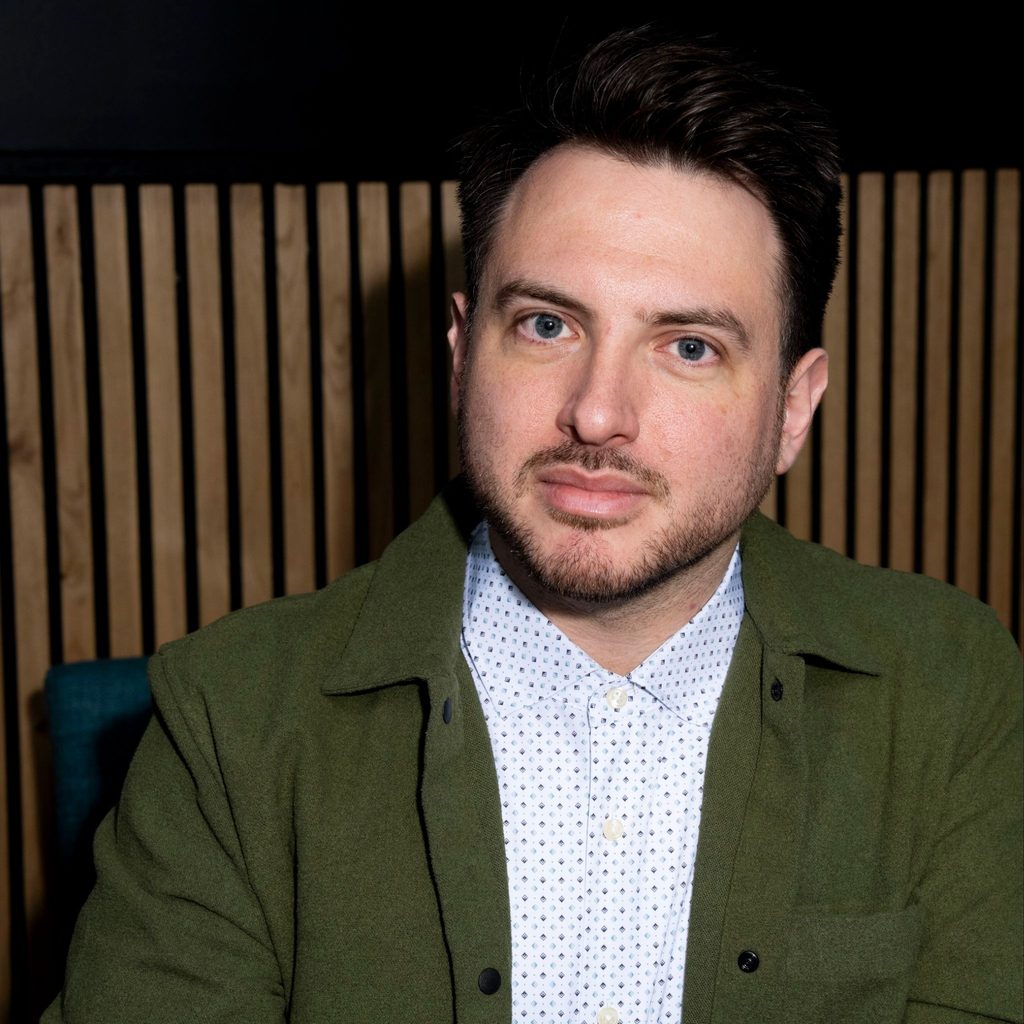
Jon Chaiim McConnell is a recipient of a 2026 Delaware Division of the Arts Fellowship for Literature. His short fiction has appeared in journals such as Blackbird, Heavy Feather Review, and Yemassee, among others. He is the former Fiction Editor of Split Lip Magazine, Redivider, and a former Associate Editor of Whole Beast Rag. He can be found online at www.jonmcconn.com. thrum is his debut novella.
Rebecca Gransden lives on an island. She is published at Burning House Press, Expat Press, Bruiser, Hawkeye, and BULL, among others. Her books include Figures Crossing the Field Towards the Group (Tangerine Press) and The Undead Shepherdess and Further Cavities with Sean Kilpatrick (Pig Roast Publishing).