
 Klaus Nakszynski was born in Germany in 1926, and within a few short decades became everything from Nazi conscript, to piss-drinking mental patient, to one of the most prolific and notorious stage-screen presences of the twentieth century. Despite everything he was as an actor, Kinski (excising sections of his name after returning to Germany from a Colchester POW camp) became better known for his psychopathic behaviours both at work and recreationally. He screamed at Werner Herzog for an hour and a half over a cold cup of coffee; he once stalked one of his psychiatric nurses for three days before attempting to strangle her in her apartment.
It is hard to know too much of the reality of Kinski’s story: Herzog, for instance, has accused him of fabricating many of the facts of his life. What is certainly true, however, is that Kinski was possessed of a rapacious desire to perform, appearing in hundreds of films and plays from the 1940s until his death in 1991. His most notorious works, if not his most famous, are those he devised himself, apparently against the better judgement of his various handlers, who attempted to warn him off what they saw as expensive follies. An unheeding Kinski forged ahead to produce over twenty spoken-word albums and several one-man shows, their bizarre contents often courting controversy. The apex of these oddities was surely 1971’s Jesus Christus Erlöser (Jesus Christ Redeemer), a play featuring only three elements: a stage, a spotlight, and a Christlike Kinski.
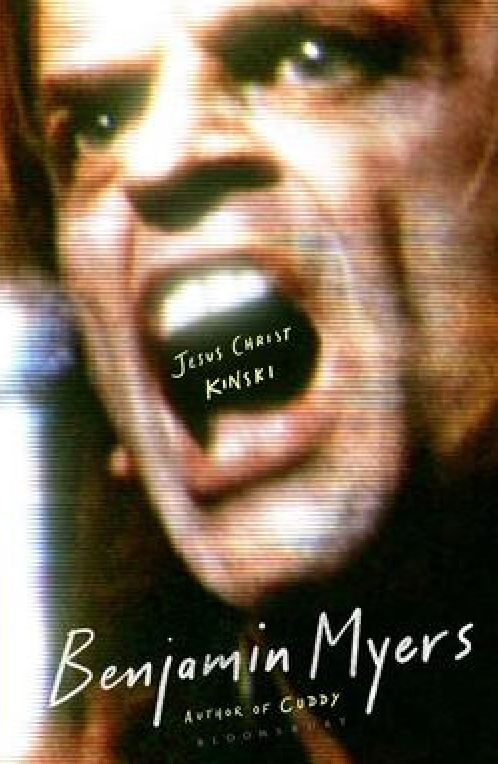
In keeping with this public imagination of the actor as veillard terrible, an eccentric despot, a violent force of nature, the first half of Benjamin Myers’s Jesus Christ Kinski is the rantings of a ventriloquised Klaus, as he curses whatever fate brought him to performing onstage as the Redeemer. Though Kinski spearheaded the project, when we first meet him in his dressing room he wishes to be anywhere else, for instance with a Vegas chorus girl who, he nostalgically recalls, ‘took it up the arse with such ease’; Myers’s Kinski would even rather be back on set with his despised collaborator, the ‘interminable skidmark’ Herzog. From the get-go Myers leans on reputation, giving us the Kinski we think we know.
We read from inside the mind of a self-observing Kinski as he takes the stage. He begins.
‘Wanted, you say. Jesus Christ. Charged with seduction, anarchistic tendencies, conspiracy against the authority of the state. Distinctive features: scars on hands and feet. Alleged profession: worker’.
Kinski doesn’t get far. The play, or Myers’s Kinski’s experience of it, is continually interrupted by irate audience members, seemingly a strange meeting of hippies and German Christians, and these intrusions are interpolated amid Kinski’s lines like violent marginalia, as are Kinski’s obsessive thoughts as he tries to proceed with his performance. The way the audience are subsumed into the playtext is fitting, given their eventual encroachment onto the stage. Myers’s neat trick here is simultaneity: within this transcript-of-play-performance-as-yet-another-playtext-and-its-own-performance, Kinski becomes, like Christ for Christians, centrum omnium rerum, an all-powerful centre of all things, experiencing his life as one continuous moment. All history flows now through Kinski, he is its fulcrum, its demented conductor.
And as a reader you find yourself asking why. Why Kinski, why now, why for Myers is he this sparking component in the great circuit of mankind? Then there’s a blank page, then one that simply reads INTERMISSION. Perhaps within this imposed caesura our questions are to be answered. Then a writer works in a storm, in England, 2021. He is Benjamin Myers, and the storm is the seemingly never-ending covid pandemic and its attendant political upheavals; and Myers writes about his decision to write about Kinski. But is it Myers? Another mirror trick here, a perspectival shift: the real, paratextual, flesh-and-blood Myers is writing about his experience of writing the very book we are reading, yet writing of himself in the third person, and so the identity of this Myers-writer is suddenly in doubt. Whoever they are, they try to justify the Myers-persona’s decision to write about Kinski now, when others seem only to be writing in order to ‘seek precedence or meaning in what was developing around them on a daily basis’. What right does this writer have, while they and everyone else are hanging on for dear life in an undammable torrent of events, everything that happens to everyone being of global importance, to write about something so irrelevant? The Myers-persona doesn’t have much of an answer, as it turns out. But it’s rather fitting in a way, for them to have found themselves writing about nothing to do with what’s going on: when life becomes only frightening tedium, one turns away. And in a moment when everyone’s sense of reality seems askew, so much so that we wonder how it will ever be righted, why not turn to a madman?
The self-writing section which makes up the ‘intermission’ becomes too self-consciously au courant in places — insistent discussion of political ‘cancellation’ as an assumed category is unfortunate and by now beyond cliché, and is rather an unwitting self-parody of writers of a certain age — and as a reader I feel much more compelled by my time spent with Myers-as-Kinski. But just as this section sags, the Myers-writer recalls our attention with beautiful descriptions of life spent walking alone during rolling lockdowns, and then, another blankness and: Act Two.
Myers’s Kinski attempts to restart the play after the audience will not stop interrupting, physically attacking him, grabbing at his microphone, attempting to proselytise, angry Christians speaking over this actor-Christ. And just as the play itself begins to fracture, so does the text, literally fragmenting on the page, as though the performance’s breakdown makes it unrenderable as writing. A tannoy announcement advises all disruptors to leave, and the performance halts. So too does any attempt at transcription, and the ventriloquised Kinski suddenly disappears. He has stopped being written. In his last moment as a fragment of this untenable transcription-as-playtext-as-performance, which folds in and further in on itself, Myers’s Kinski gasps: ‘you may applaud now’.
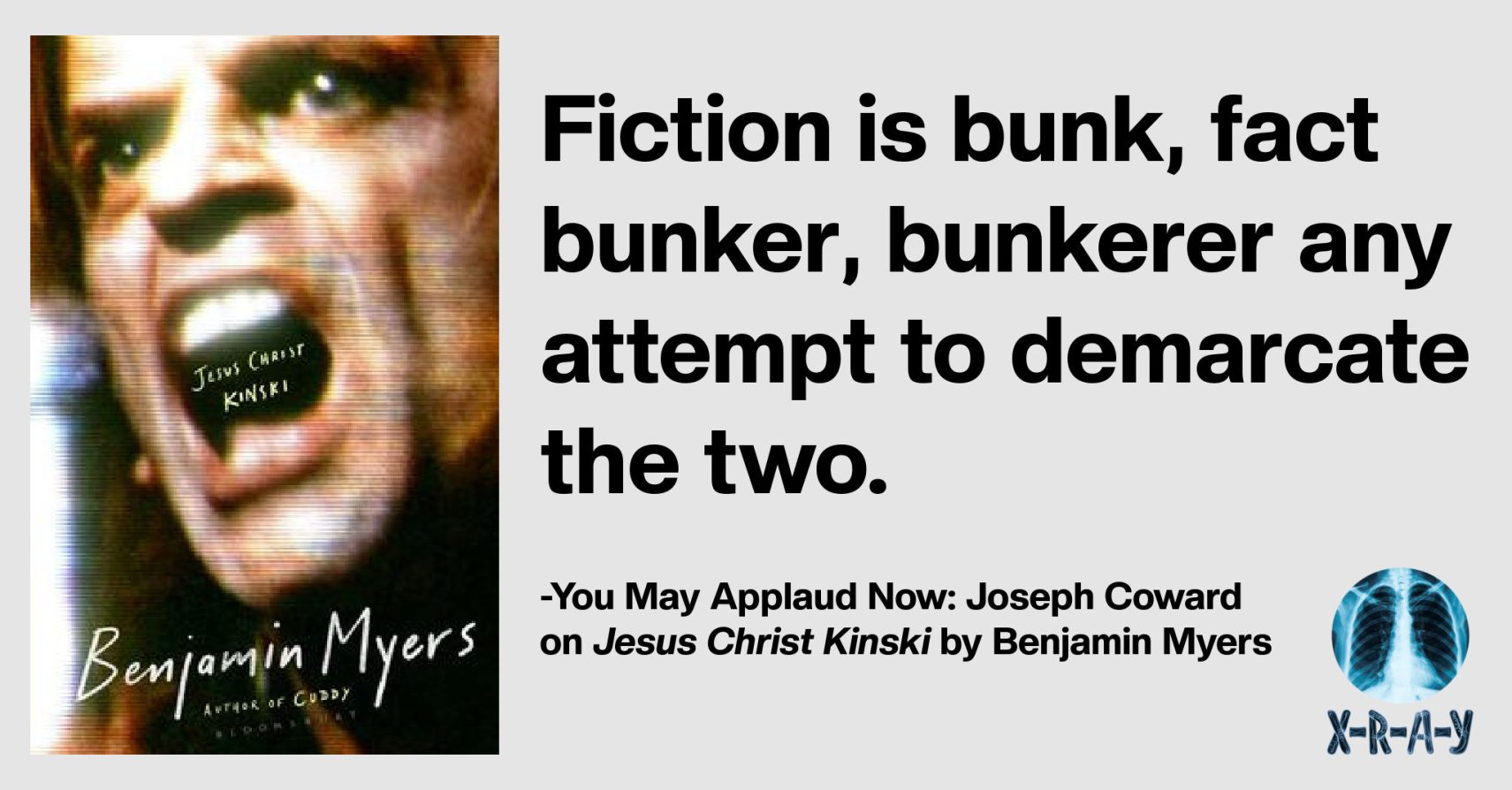
While the Myers-writer writes of the Myers-persona worrying about the viability of the text that he’s writing, and which we are reading, and claims that it is ‘neither novel, biography nor memoir’, this is exactly how any kind of life-writing should be done. Fiction is bunk, fact bunker, bunkerer any attempt to demarcate the two. And so this book achieves a certain verisimilitude of life experience precisely through its embrace of the subjective, towards which Myers continually moves. Despite its apparent intenebrations, not least the ventriloquising of Kinski, which the Myers-writer thinks of as ‘tampering with corpses’, the events of Jesus Christ Kinski seem real: in this extraordinary derangement of a book, disparate histories meet, and speak convincingly to one another.