
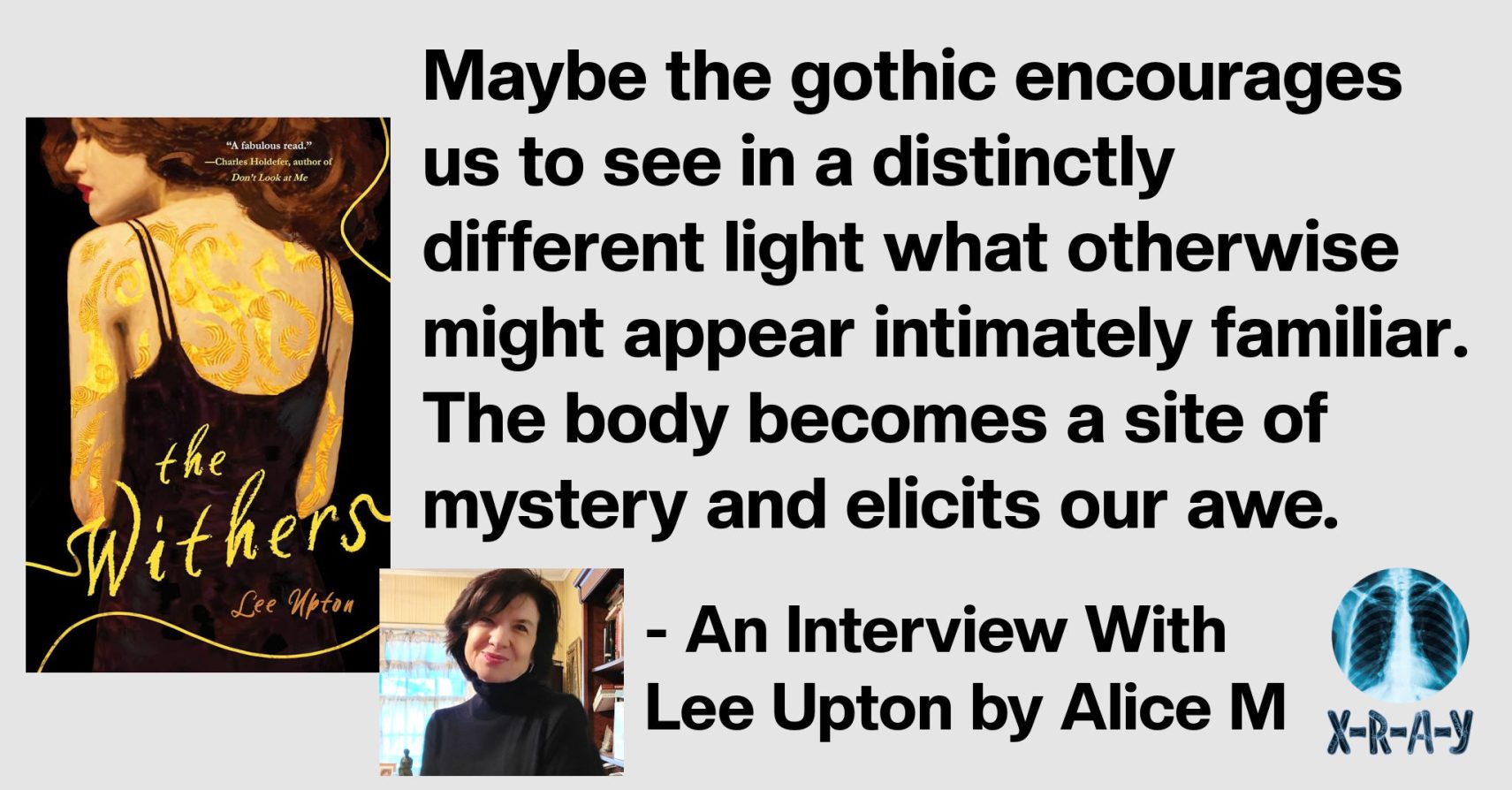
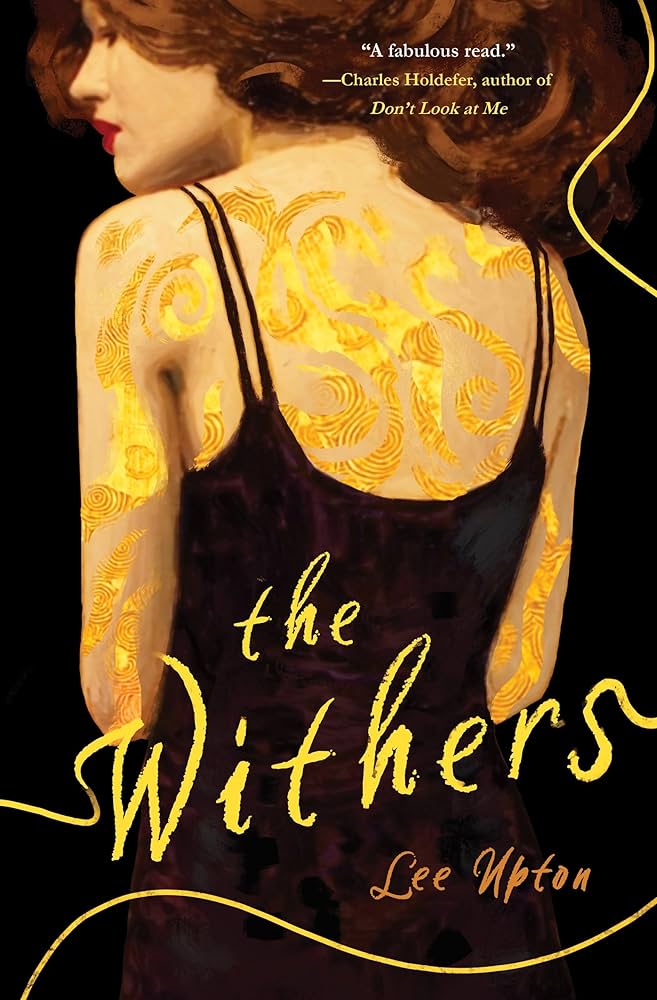
 Alice M: As I read The Withers I was struck by its genre. Even before the narrative mentioned Rebecca, I thought, ‘This is Lady’s Companion Gothic.’ I tumble thoughts in the back of my head as I read books, and at first I defined ‘Lady’s Companion Gothic’ to myself as a perversion of what used to be quite a common practice.
But that’s not exactly right, is it? The practice itself seems like a perversion, making it an inherently gothic idea. Even in cases where the employer’s intent is totally benign, the role of lady’s companion is a perversion of emotion, usually friendship. In Rebecca, every lady’s companion we see, both our unnamed narrator and Mrs. Danvers, experience some perversion of emotion in their roles as companions. In The Withers, Riatta is accompanied by a pervasive unease which comes from a distinct power differential between her benefactors and herself. She tries her best to even the scales, but it never feels like a balanced relationship.
I’m interested in what drew you to the lady’s companion as a topic. Was Rebecca the impetus? (I should admit I’ve watched the Hitchcock adaptation hundreds of times; I was obsessed with it as a teen.)
Lee Upton: This is such a marvelous question. Although Rebecca is referenced in the novel, I hadn’t realized—until your question—how thinking about Rebecca could open up perspectives on The Withers.
AM: How lovely to hear!
LU: Like you, I have been haunted by Rebecca. I read Daphne du Maurier’s novel as a teenager, and I’ve watched the Hitchcock adaptation multiple times, but until your question my brief citing in The Withers of the evil Mrs. Danvers seemed like only a glancing rather than a more significant reference. Now, thanks to you, it appears to me that the novel is very much within the gothic tradition of Rebecca: the atmosphere is haunted by an unseen presence and a pervasive sense of what you rightly call “unease.” The house where my main character Riatta is staying offers sanctuary and, at the same time, is clearly a site of surveillance—our contemporary form of threatening and pervasive doubling that renders experience uncanny.
As so often with characters in the gothic tradition, Riatta is an orphan. Her early experience of the loss of her mother, of rejection in multiple foster homes, of being marginalized and outcast—all reinforce her wish to be useful and loyal, to give to others what was missing from her own life. To be, in a sense, the best “companion” of sorts.
The economic realities of her situation mean that in some circumstances she cannot fully express her wishes. While she wants to be helpful to others who are apparently helping her, she also thinks it’s best to be “invisible.” Your phrase “perversion of emotion” is perfect. Riatta is dependent economically on the kindness of those who were, until recently, strangers. When the dynamics of power are so out of balance her anxiety is heightened and her self-trust is diminished.
AM: How was it crafting a story around a narrator who’s physically limited, creating tension through conversation and a flow of action through low-energy activity? I ask because I have an incurable chronic illness myself (MS), and appreciated a narrator who was engaging and had agency in a narrative which was realistic in terms of an exhausting illness.
 LU: I love Riatta—her persistence, her heroic attempts to enhance her life. I don’t want to give too much away, but I especially loved how she and her friend Diana used transgressive humor to resist the objectification they experienced from their doctors and other medical professionals.
AM: Were you drawing upon a particular part of your life, then, when writing her? Her situation is so specific, and to me, so realistically-observed in terms of illness.
LU: I drew upon my experience of long-lasting, lingering exhaustion after an illness—as well as what I learned from family members while accompanying them in waiting rooms and doctors’ offices.
Now that I think about it more closely, chronic illness which unfolds over a period of years, the adaptation to such illness, and the viewpoint change which comes with it, are all also common features of the gothic (and here I’m thinking of The Secret Garden specifically, which my mother read to me as a child, and which I would argue is a gothic narrative).
I agree with you—entirely. Maybe the gothic encourages us to see in a distinctly different light what otherwise might appear intimately familiar. The body becomes a site of mystery and elicits our awe.
AM: Both the lady’s companion plot and the pacing informed by chronic illness gave the narrative an old-fashioned feel I appreciated, which reminded me of Ishiguro’s Never Let Me Go, another class-conscious sci fi that also happens to be a classic gothic tale, in my opinion. Where Ishiguro was satirizing the traditional English Public School, it strikes me The Withers was perhaps satirizing the class differences in outcomes during the COVID pandemic. Is that a fair assessment, do you think?
LU: The first full drafts of the novel with information about the epidemic, “the collapse,” were completed before Covid. (I just checked my old files. I began the novel in 2017.) But the outcomes in The Withers could be logically predicted before we experienced the pandemic. In The Withers mass organ failure affects much of the northeastern United States. The results: controversial theories emerge, new health protocols are mandated, conspiracy theories erupt, and both government and non-governmental funds pour into medical start-ups. Those predictions made sense even before Covid struck. In The Withers one of the most devastating effects: the marginalization, dehumanization, and even demonization of those who were saved by new experimental protocols. Along with all these effects comes a widespread attempt in the larger culture to forget the toll of suffering. The desire to forget seems to be what we’re dealing with now. Covid is still with us, but it may be true that the culture as a whole would rather forget what we all endured and that some of us continue to endure.
Although it’s coming out in June from Regal House, The Withers was written before my other novels. Tabitha, Get Up, my comic novel, appeared in 2024 from Sagging Meniscus. My mystery about writers behaving badly, Wrongful, appeared in 2025 from the same publisher. (Wrongful is surely influenced at points by Hitchcock.) But it was The Withers that taught me how I might be able to write a novel and sustain elements of cause and effect to create an actual plot.
AM: Did the book change much from first draft to final, or was it always a focused idea? I’m always curious about process, especially regarding narratives with an interesting structure.
LU: I just looked back at drafts and saw that the plot was largely established at a very early point in terms of major events. The idea of rampant organ trafficking as a particular horror animated the plot from the start. This sounds bleak, but the novel is also about unending love, deep friendship, and a heroic struggle for survival.
Although the novel is set in the near-future, it reflects our present reality: the dominance of surveillance in our everyday lives, gated communities and their claustrophobia and false expectations of security, ruptures in public trust, desperate poverty alongside massive wealth, unchecked corruption, and medical interventions that in some cases may be miraculous but in other cases may be untested and blighted with chilling side effects.
One portion of the novel that was a late addition: the scene in which Riatta returns to the site of a terrifying act of brutality and allows herself to intuit how that brutality was accomplished. I resisted writing that scene for as long as I could.
AM: I’m curious why. Was it a delicate and difficult scene to write, or perhaps did it require a skill you were more confident about as drafting went on?
LU: I worried that I might not be capable of capturing the violent horror without sensationalism. The scene was the last full scene inserted. I needed to know these characters as well as I possibly could before I wrote about the terrible violation that’s depicted.
AM: In every example of the gothic I can think of, the narrative also leans on pathetic fallacy to describe the characters’ increasingly dire moods: howling wind, dreary grey skies, and so on. I thought that might be true for The Withers, but I thought I’d ask you about it instead of simply declaring. Was that part of the book’s design?
LU: I can’t help but love a good rainstorm in life and in fiction. Imagining moody weather helped me immerse myself in scenes. At the same time, I wanted the weather to both create an emotional atmosphere and to have an impact on characters’ actions.
AM: The one scene I think might violate that principle, purposely, is when Riatta leaves her living arrangements to stay with a friend, and is feeling very ill indeed despite sunny weather—but the weather also highlights her mood by contrast, so while not an example of pathetic fallacy, it’s perhaps using the same toolkit.
LU: Yes, I think the principle of contrast is at work. At the same time, sunlight may appear at later points as Riatta gains increasing clarity about her situation.
AM: How did your background as a poet inform The Withers?
LU: My experience attempting to work with different speech registers in poetry was helpful. There actually is a poem in the novel—a poem I made up for children that begins “Petunia, you’re a fun one—part rose and part onion.” Riatta, because she has suffered so much even before the epidemic, uses language sometimes tentatively, as people do when they have been disempowered and are accustomed to having their feelings and needs ignored. My work with persona poems surely helped me find ways to give her a voice.
AM: I loved that poem. It felt so real, I thought at first it was a folk rhyme I’d somehow missed as a child.
LU: I’m so glad that it seemed that way! When I was a teenager I created a character called Petunia and told endlessly silly stories about her to my nieces and nephews. The poem, to my mind, reflects Riatta’s isolation and sense of difference from others—as if she, like my Petunia, is a hybrid, “part rose and part onion.”
AM: Speaking of, I liked how you treaded delicately around childhood, which is a central focus of the novel. The narrative was about adults, and their issues, and even when it seems an adult might resent a child in one part of the novel, that issue is spoken about clearly and addressed, rather than folding the child into the drama. No child is blamed for the faults of their parents or morally associated with their parents’ faults, by anyone.
LU: Riatta, who had been repeatedly abandoned or neglected as a child, is especially attentive to the vulnerability of children and the deep loneliness that children may suffer. She respects children as individual beings and is grateful when the child (Jakey) returns her love. She cherishes that serious-minded, sweet little fellow.
AM: I think if you let me I could go on forever, so I’ll end here. Thank you for the opportunity to read this complex and interesting novel in advance, and for the opportunity to interview you!
LU: Thank you for reading The Withers with such care and insight and for these marvelously thought-provoking questions. Here’s wishing you every happiness!