
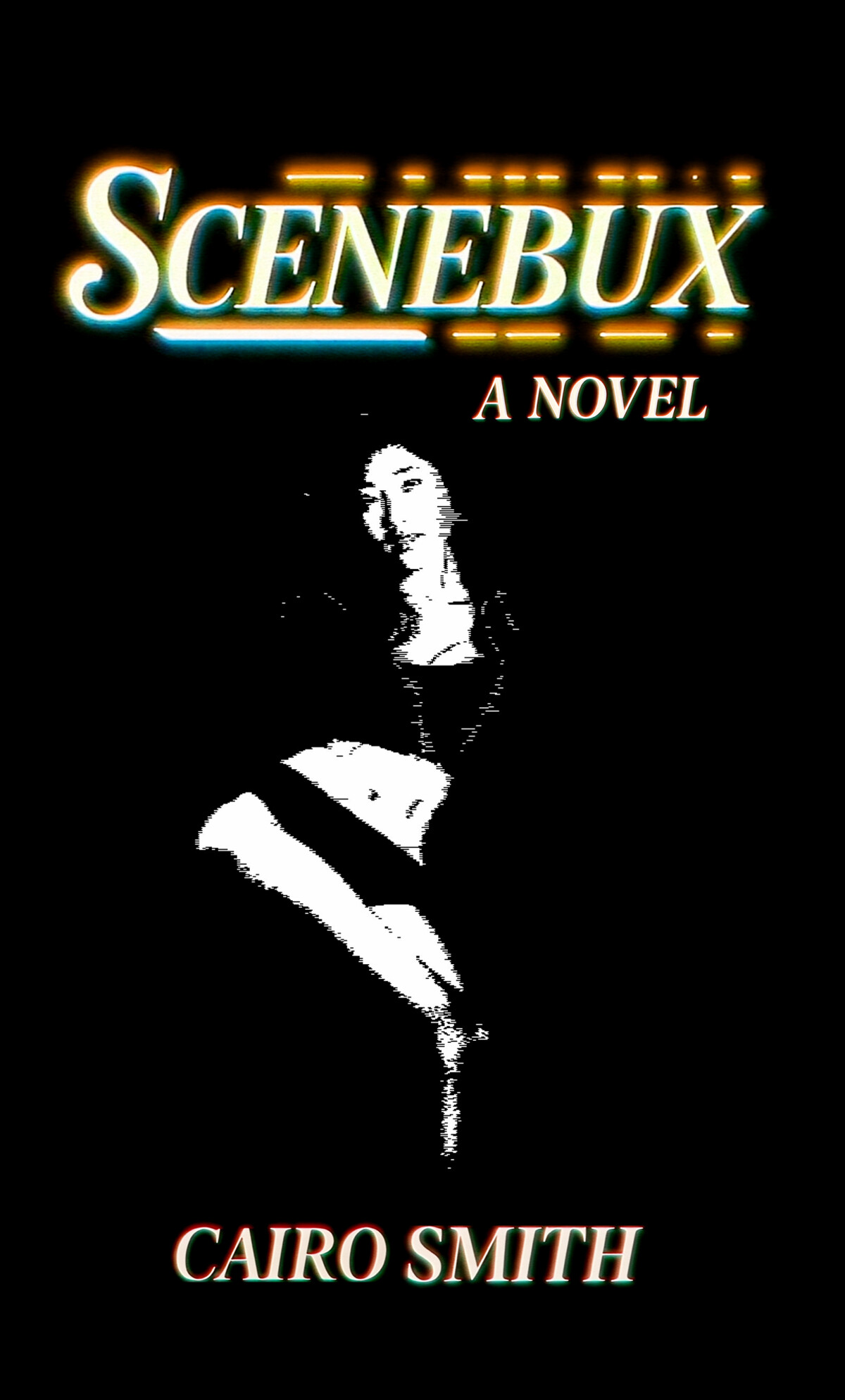
Part One – David’s Questions to Cairo about Scenebux (New Ritual Press, 2025). Part Two will publish tomorrow.
Is Scenebux a Kind of IRL Cyberpunk?
 David Polonoff: Many of your readers (myself included) have noted the parallels between Scenebux and the work of William Gibson in its fluid mixture of hard-boiled detective/thriller narrative and post-human technology.
You’ve quoted ARX-Han on the difficulty of “writing cyberpunk now, because real-life just is cyberpunk.” To what degree is that true? Is it like reading Jules Verne in the 20th century and marveling at the inventions and gadgets he foresaw or more that the cyborgian malaise and dystopian social structure of cyberpunk is what we’re now living in?
Cairo Smith: Yes it is true what ARX said, and I would say both of those options you gave are very similar, just with positive or negative valence. I don’t consider myself a pessimist. I think Ben in Scenebux is ultimately a man who overcomes his aloofness and does the right thing at great personal cost. I believe in zoomer men, and I guess that’s my way of saying so. He also starts the novel believing in this binary between a Luddite life and a life consumed by digital vice. Then, over the course of the story, as he starts to level out, he synthesizes this dialectic into a more healthy and managed digital existence. I guess that’s also me writing optimistically, hoping that we can find a tempered future for ourselves in the world of technology without being bifurcated into extremes.
This is a cyberpunk world, and that’s simply because cyberpunk was right about so many things. For over a hundred years, we’ve asked science fiction authors to try and predict the future. I guess at some point they got good enough at it that now we’re living in a world that actually resembles what they were writing decades ago. It shouldn’t be surprising. They were smart men and women, and they did their jobs well.
Pacing vs. Plotting
David: Scenebux is hypersonically paced but lightly plotted. The machina part of the deus ex machina is working at peak output. My book is relatively fast-paced in its succession of scenes, and essentially has no plot. It’s kind of a picaresque jumble around a loose timeline of disintegration.
Do you think that pace and plot are fundamentally at odds? That as soon as a degree of realism about motivations, finances, feasibility, and other characters’ psychologies is introduced, the propulsiveness of the text suffers? Maybe this is particularly true of first person narrative, where much of the action is in the protagonist’s mind?
 Cairo: No, I don’t think examining believable character psychology and having a propulsive plot are at odds. I think the simplest proof of this would be any incredibly compelling story of action and heroism from real-life history. Obviously, the motivations are all psychologically perfect because it’s nonfiction. At the same time, the excitement of the plot is clear to anyone who reads about certain spy chases or daring raids of history.
I will say, when you’re a fiction writer, it’s probably harder to optimize for both at once than it is to optimize for one at the expense of the other. It’s sort of like designing an engine. You can make a quiet engine, and you can make a fast engine. There are times when you want the engine to be fast and you don’t care if it’s loud as all hell. There are other times when you want the engine to somehow be loud and fast at the same time. In that sense, as writers, we give ourselves a charge and then we do our best to fulfill it. Some charges are harder than others.
The “Internet Novel”
David: Many of your reviewers have been quick to place Scenebux under this rubric – a very amorphous concept that applies to quite different types of works:
In some, the Internet figures prominently because the “extremely online” characters relate to themselves and one another through it, as in their everyday lives. Peter Vack’s Silly Boy revolves around the protagonist’s obsessive girlfriend discovering a reference to his cheating buried in months old texts to his therapist. French farce meets epistolary novel.
Others, like Honor Levy’s, express themselves in the language of memes, texting slang and gaming to manifest an Internet-transformed subjectivity for our delectation.
Your protagonist, on the other hand, has abandoned the internet, feels algorithmically injured, if not anally raped, by it and has thereby gained a vantage point from which he can view the whole society it has warped. It’s not just about attention economy peons trapped inside social media, but about its makers and coders and theorists and the architecture of the future they’re planning.
So, in short, how do you feel about your book being labelled an Internet Novel?
Cairo: I think the internet novel is a completely nonsensical concept. Is Repo Man a ‘television movie’ because he watches TV, or because he doesn’t watch TV, or because his parents are addicted to TV? Is Videodrome? Is Broadcast News? Are Fitzgerald stories telephone novels because people pine for each other over the line using a novel technology in a way that would have been unthinkable a generation before?
The whole idea of an internet novel misses the forest for the trees. Novels have genres and they have styles. Internet is not one. At the very most, internet could refer to a subculture that the book is examining, but the internet is made up of so many hundreds of thousands of subcultures that, again, the phrase loses all salience. A novel about extremely hardcore Polymarket gamblers or Eve Online players would be very different from a novel about TikTok celebrity gossipers.
I think late millennials and mid-millennials are the only people who use this term, and they use it because there was a point in our young lives when only a strange subset of their peers were using the internet. When they say internet novel, they basically mean a novel written by people who were terminally online in their formative years back before it was mainstream. They should probably pick a better word for that, though.
Overall, I don’t think it’s a very useful line of thought.
Irony
David: This stance outside internet culture also provides an answer to the reviewer who proclaimed the internet novel an impossibility because the irony of the medium swallows “any competing irony.”
What could be more ironic than a protagonist of an internet novel without a smart phone and unable to text? It gives him an Archimedean vantage point outside the society he is viewing, which, like Swift’s Gulliver or The Tin Drum’s Oskar, automatically results in irony. Contrasting the phantasmagoria of influencer memes and techno optimism with the social reality of the people whose brains they infect seems not so different than what that most ironic of novels Don Quixote set out to do.
Would you say your novel has ironic intentions? Do you feel that the internet thwarted or enabled them?
Cairo: This is going to sound like a deflection, but I think the term irony is so misused that attempting to bring it into a discourse actually muddies the water more than it clears things up. That said, using a strictly literary analysis lens, the book is obviously full of irony. There’s dramatic irony in terms of things characters know that Ben doesn’t. There’s also dramatic irony in terms of things that Ben keeps from the reader, ways he bends the truth. There’s also irony in the sense that Ben and other characters present things in one way when the obvious authorial intention is very far from what they would admit. There are things about Ben he can’t admit to himself that are very clear from a close reading of the text.
In the sense that the internet has informed the current culture, yes, obviously it affected the irony in the book. That said, I’ve been who I am since long before I started going online. If we were living in a world without telecommunications, I’m sure there would still be rising artistic and political movements, and I would still be satirizing them with a sort of wry smile. It’s just my nature.
Scene Bucks
David: Are these still flowing in the Bay Area?
Perhaps because in NYC the post-covid heterodox neo-reactionary scene consisted mainly of artists with just a small smattering of crypto bros and Urbit enthusiasts, the tech money seems to have evaporated now that state power has been captured and red scare culture has gone mainstream.
From your book it seems like the similar scene in SF was largely composed of people in the tech industry and startups, whose aptitudes and ideology might be more in line with the overlords. (Like Elon’s Doge Boys.) Is their financing still intact? Are they still going strong? I know Yarvin is, but you won’t find him skulking around Dimes Square giving Auden readings any more.
If the Thiel Bucks era is coming to an end, do you think that Scenebux will become a period piece? Or that its thriller element, ironic detachment and jaded eye toward techno culture will preserve its readability for some time to come?
Cairo: I think the book is already a period piece in the best way, and that’s by design, although I guess a more technical word might be a product of its time. Already there are a lot of jokes in the book that have taken an added degree of darkness because the issues they touch on have become so much more deeply embedded in the discourse. For example, there’s a part where Ben hides in a crystal shop and pretends to be getting chased by ICE. Obviously, people hated ICE when the book came out, but now it’s on a whole different level.
I hope this provides additional richness to future readers. They can enjoy it both with the benefit of future sight and by inhabiting the world as it was in June of 2025. I also hope that the structural bones of the thriller are compelling enough that it remains an enjoyable read. Some of these things don’t change very quickly.
Obviously, the political world of The 39 Steps is gone, but it still makes a good mystery. There are also human archetypes that don’t really change that quickly. For those reasons, I’m optimistic that it will have staying power.
As for where the money’s gone, or if it ever existed at all, I don’t really know. I probably know as much as you, just going off what I see online. I and my artist friends sometimes get accused of proximity to this mysterious reactionary money, but we’re not actually involved with it. That was part of the joke of the book. New Ritual is certainly not getting any checks cut from any mysterious billionaires, gay fascist or otherwise.