
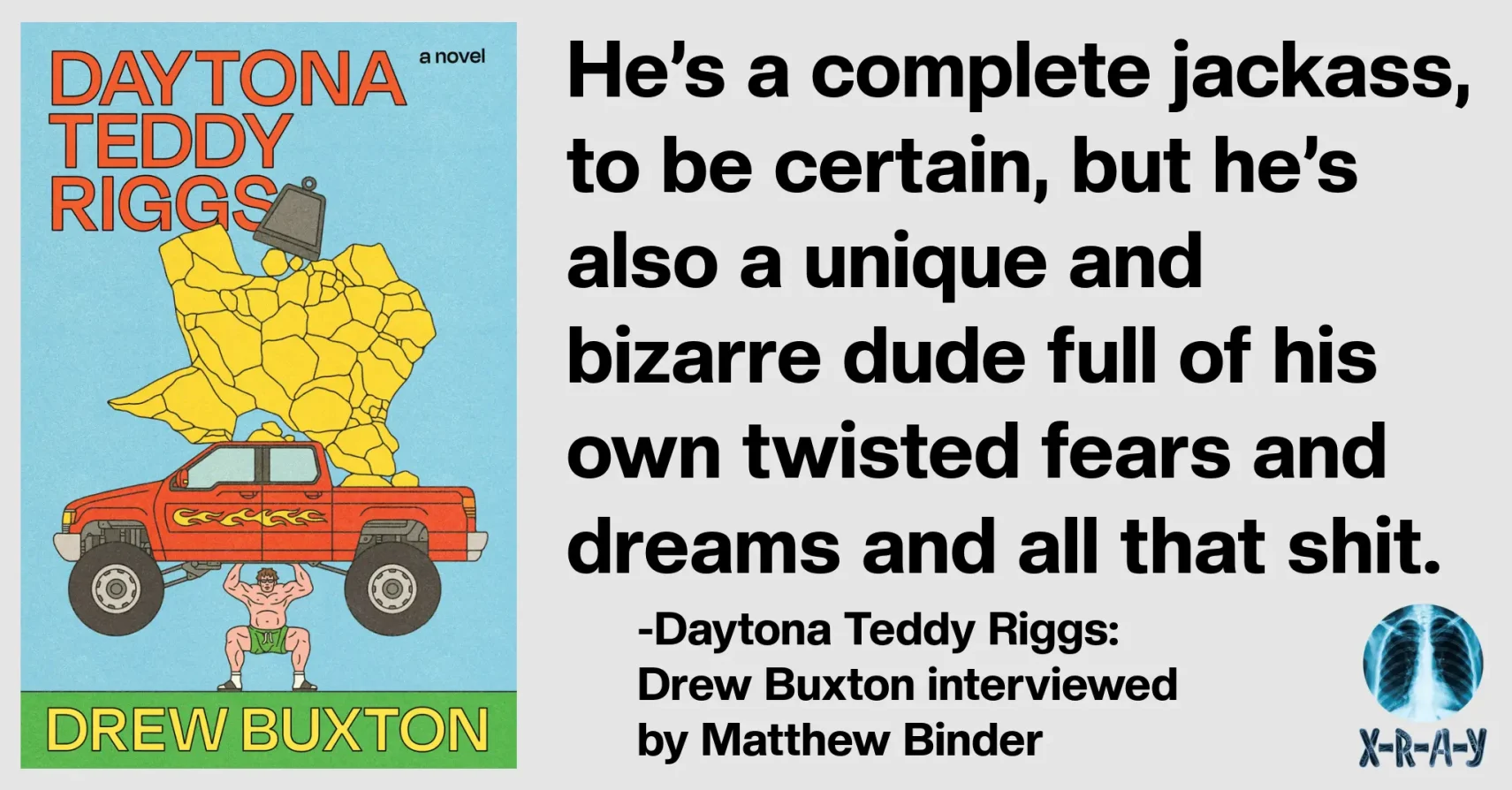
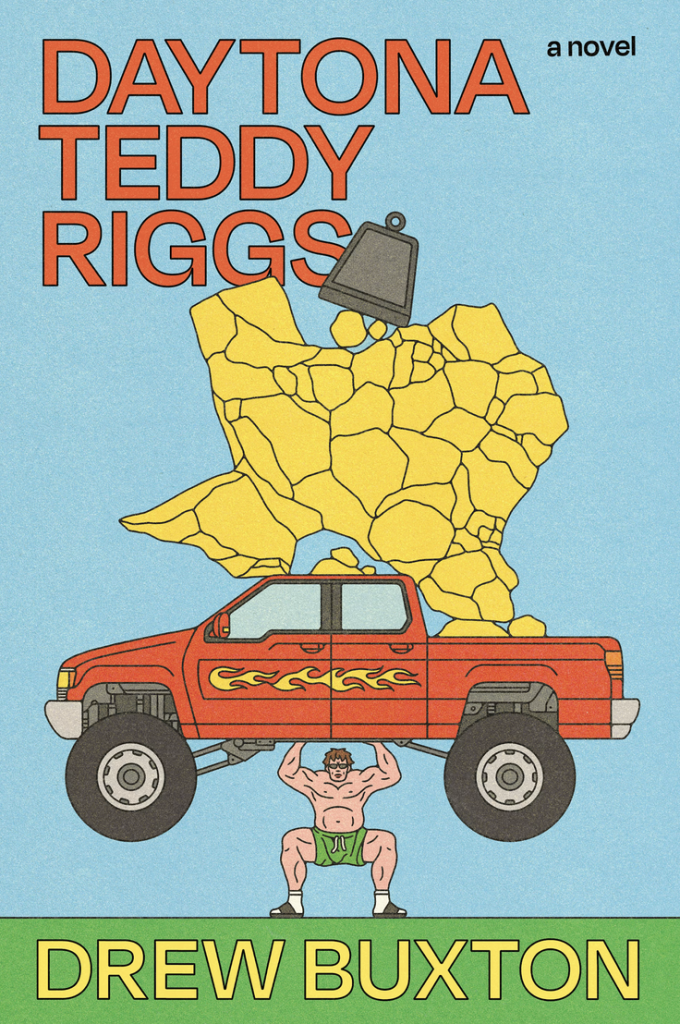
Every spring, the inimitable Sam Berman gathers the finest writers in the land, and me, for the StoryFort Festival in Boise, Idaho. One of the writers who made the strongest impression on me at the 2025 festival was Drew Buxton. After one of his readings, I pinned him in a corner and bombarded him with questions about his work-in-progress, a novel titled Daytona Teddy Riggs (Hub City Press, 2026). It’s about a promising football star who gets himself kicked off his college team and then pursues the World’s Strongest Man title.
To say I was excited about the prospect of such a novel would be an understatement. As a kid, I spent countless hours watching Strongman contests on ESPN. At one point, I even bought a Magnús Ver Magnússon, four-time winner, T-shirt, and it became my uniform for two straight years. I may have even worn it in my eighth-grade yearbook photo, to my mother’s dismay.
Daytona Teddy Riggs is slated for publication on August 25, 2026, but I asked Drew to send me an advance copy. I’m thrilled to report that it’s even better than I had hoped. Daytona Teddy Riggs is one of the most sensitive and thoughtful picaresque novels I’ve read in years. In a literary landscape crowded with novels about Brooklynites living cosmopolitan lives, Daytona Teddy Riggs stands out as a deeply interesting exploration of traditional masculinity set in middle America.
Matthew Binder: Much of contemporary American fiction is set in New York or Los Angeles. Perhaps that’s because so many ambitious writers move there for MFA programs and publishing networks. But you’re from Texas, you’ve stayed in Texas, and you write about Texas. What made you stay close to where you grew up?
Drew Buxton: I’m from Texas, and have spent the majority of my adult life here, but I’ve also bounced around the country quite a bit. I always end up coming back, though. I think spending time away from the state helped highlight the uniqueness of it for me. The novel is set on the coast, which I’ve always found fascinating. When I was growing up, we would visit my grandparents in Corpus Christi fairly often. I later lived there as an adult for about a year, and I’ve always felt there’s a strangeness to the area that is hard to put into words. The great William Boyle said that since he moved away from his native Brooklyn, it has become a mythic place in his mind. That’s how I feel about the Texas coast. Though I’ve spent a lot of time there, it remains in my mind a surreal, uncanny place that I love exploring in my writing.

MB: Your main character, Daytona Teddy Riggs, is a massive, hulking man, an ex-football star who got kicked off his college team and then pursued the World’s Strongest Man title. You’re nowhere near as big as Teddy, but you’re a big guy. Did you play football? Were you ever involved in the world of strongman? What made you decide to set a novel in this milieu?
DB: People always assume I played, but the truth is I only lasted a few days on my middle school team. I was a late bloomer, so I was pretty shrimpy growing up. Practice was after school in the blazing heat, and it was just miserable. I was also terrified, haha. I remember some of the guys were basically fully-grown men at age twelve. I’m glad I didn’t play. I’ve got enough problems with my brain as it is! That being said, I’ve always been a football fan, and watching the Cowboys was a huge part of my childhood. I’m really interested in the former athlete who thinks they should’ve made it big time. I’ve met so many guys who swear they would’ve been in the NFL or NBA had it not been for an injury or a coach who had it out for them. Their identity and self-worth stays tied to their athletic ability long after they stop playing.
I’ve never been involved with strongman. As far as weightlifting goes, I’m weaker than I look. I watched World’s Strongest Man on TV as a kid, but it wasn’t until I watched the documentary Born Strong (2017) that I became fascinated with the sport. It’s the dedication to craft that I admire so much. Out of love for the game, they do things that shorten their life expectancies significantly. Also, let’s be honest, there’s just something awesome on a primal level about seeing massive dudes lift cars and hurl kegs through the air. I try to catch all the major competitions now.
MB: In many ways, Teddy is totally buffoonish and naïve, but when it comes to building physical strength and competing, he’s the real deal, a true contender to be the strongest man in the world. How were you thinking about this juxtaposition as you crafted the character?
DB: The book is really a study of Teddy’s psyche. It was important that his mind be the main factor in his success or failure. He has all the physical capacity, and he’s from a wealthy family, so it just comes down to the decisions he makes, and how he copes with his mental illness. One thing I’ve noticed about successful high school and college athletes is that there’s often a naïvete. Their lives are so busy and structured, and they have this built-in social status, so there’s not a lot of time or need for reflection or questioning.
MB: Teddy’s constant visits to fast-food joints are one of the great motifs of the novel. Every few pages finds him cramming down a couple of bacon-jalapeño burger combos. But Whataburger is not just a place to eat for Teddy, it’s his place of solace, where he does his thinking. That said, Teddy doesn’t like to eat this much food. It’s almost a form of self-imposed torture, and it takes on an almost meditative quality for him. It was very interesting to see fast-food joints—often dismissed as part of “low” culture—become central to Teddy’s training regimen and his pursuit of greatness. How did you arrive at this idea?
DB: I was raised by a single dad, who, to his credit, did cook pretty often, but we also ate a lot of fast food. I have fond memories of our little family sitting in fast-food booths on weekday evenings. I still love fast food, and have that same fuzzy feeling about it, but I’m almost forty now, so I can’t eat as much Whataburger these days as I’d like.
I’ve heard many strongmen describe the eating as the hardest part of the sport. They call it force-feeding. Generally, they try to get a minimum of 10,000 calories in daily. They talk about how much of their lives is just chewing and swallowing, chewing and swallowing. It sounds miserable—turning one of life’s simple pleasures into a grinding chore, but again, that’s dedication and sacrifice. It’s just the opposite of how we generally think of the strict diet of an athlete.
MB: You explore Teddy’s sexuality in interesting ways. Early on in the novel, we learn that he’s a virgin when he suffers a failed sexual experience with a girl who picks him up while he’s working as a bouncer at a bar. Later, one of Teddy’s male clients comes on to him, and Teddy becomes curious. Throughout the novel, Teddy is always questioning his sexuality, constantly checking whether his dick gets hard when he deals with men. Teddy, obviously, inhabits a world intensely focused on the male body. Were you deliberately exploring the tension between obsession with the male physique and gayness?
DB: OCD, actual obsessive-compulsive disorder, is something I’ve dealt with since adolescence. In my short story collection So Much Heart, there’s a story set in a present-day OCD treatment center with a narrator who understands the disorder and all the clinical terminology. That isn’t the experience of most sufferers. Almost no one, including clinicians with Ph.Ds, actually understands OCD. If it weren’t for the internet, I never would’ve figured it out, so I wanted to explore OCD in the pre-internet era. Often, the core fear behind OCD is a fear of ostracization. Teddy is Gen X, but I imagine it was quite similar to the experience of millennial boys where, in the eyes of the world, nothing could be worse than being gay. Teddy’s OCD latches on to that, and he has to constantly check that he’s straight. Abandonment is another common core fear—Teddy needs constant reassurance that his granny is still alive.
MB: My absolute favorite section of the book is when Teddy attends a personal development seminar with Pat Dupree, a famous self-help guru he idolizes. Teddy is convinced that this man holds the key to helping him unlock his potential. I was very impressed by how you handled this section. A lesser writer would’ve written Pat Dupree with cynicism, portraying him as an outright charlatan, but you walked a fine line between hucksterism and genuinely helping people find purpose and meaning in their lives. Can you say something about this?
DB: The reality is that good therapists are few and far-between. Even if your insurance will cover it or you can afford to pay out-of-pocket, you may not be able to find a decent one. An alternative is self-help books and gurus. There is always some amount of bullshit with gurus, but with the best ones like Tony Robbins and Eric Thomas, it’s complicated. I find them genuinely compelling and inspiring at times. A lot of people swear their lives have been changed by a seminar or a book. Who’s to say they’re wrong?
MB: Many readers and critics will probably describe Daytona Teddy Riggs as satire, but I don’t think that’s quite right. You’re not using humor or irony to mock Teddy or his way of life. You’re simply observing him as he moves through the world, and sometimes that observation happens to be funny. Do you think contemporary audiences have become less willing to extend sympathy to traditionally masculine men?
DB: Maybe to an extent, but regardless of era, Teddy isn’t a very sympathetic character in how he presents to most of the other characters in the book. It would be hard to feel for him if the novel were written from a distant third-person point of view. For the most part, his struggles are internal, and go unseen by others. With the access that the first-person allows, we see the difficulty he has navigating the world, and therefore can root for him.
The word satire gets thrown around a lot these days, and is sometimes just used as a synonym for funny. There’s some satire in the book, but satire alone isn’t interesting outside of two-minute comedy sketches. We are taught from a young age to analyse art for themes, and there are plenty that occur naturally in the story, but I’m more interested in Teddy Riggs the individual. He’s a complete jackass, to be certain, but he’s also a unique and bizarre dude full of his own twisted fears and dreams and all that shit.
MB: Now that your debut novel is about to see the light of day, what’s next?
DB: I’m hard at work on a surreal noir set on Galveston Island in the ’80s. It draws some inspiration from Rian Johnson’s first movie Brick (2005), which is a hardboiled noir involving high school kids in the LA suburbs. It’s much more complicated than the plot of Daytona Teddy Riggs, so it’s been an interesting exercise in thinking intensely about structure and character motivation. I’m excited to share it eventually!
Matthew Binder is the author of the novels Pure Cosmos Club, The Absolved, and High in the Streets. His forthcoming novel, My Painted Smile, will be published by Stalking Horse Press in April 2027. He is also one half of the recording project Bang Bang Jet Away.
Drew Buxton is a writer from Texas. His story collection So Much Heart won the Texas Institute of Letters’ Sergio Troncoso Award for Best First Book of Fiction. Daytona Teddy Riggs is his first novel.