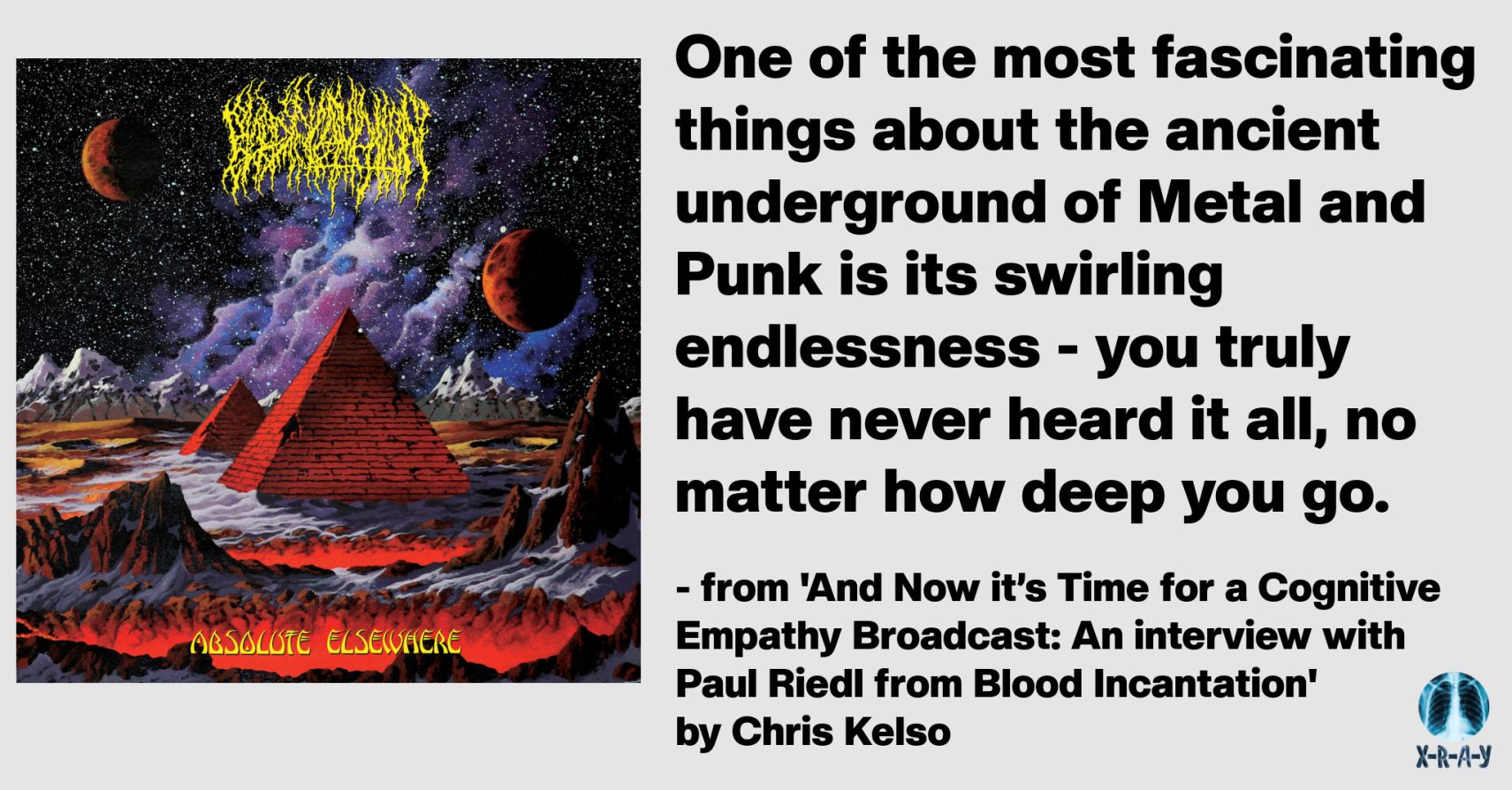
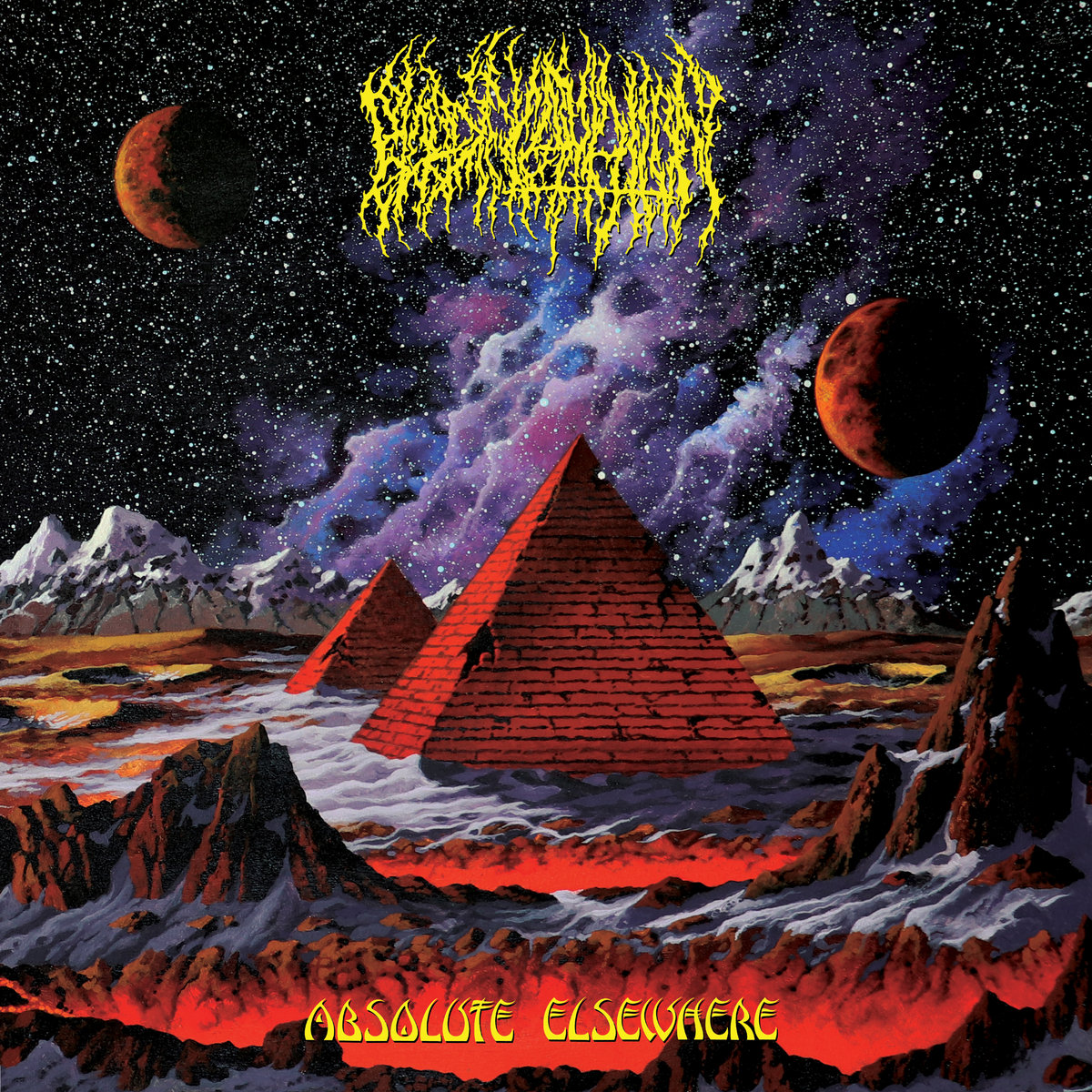
 Music is the shorthand of emotion. There is something intrinsic to the structure of it – with its overtures, rising crescendos, and authentic cadences – which seem to mirror our temporal patterns so effectively. Ethnomusicologists have divided the empathic processes of listening to (and creating) music into two categories – low-level emotional contagion (the unconscious mimicry of nonverbal cues that leads to synchronised emotional states) and high-level affective empathy (the ability to share in the emotions of other). Often the former ‘low-level’ state is achieved through listening to catchy pop music, or music which feeds the brain’s natural desire to locate patterns and familiarity (which is primarily why simple, repetitive, and predictable musical structures are so effective in provoking this reaction). This low-level emotional contagion is considered a primitive response to music. It takes more to elicit the latter ‘high-level’ response. With the recent Blood Incantation album, Absolute Elsewhere, something has certainly resonated with a much wider audience. This is a metal album which has a thesis statement: to actively communicate high-level affective empathy to the listener. It’s difficult to pinpoint exactly how it is achieved, but there does seem to be something indisputably vital in the energy of this record. It’s an objectively brilliant piece of work, seminal, but people who don’t even like death metal are engaging with it, which suggests it has a unique prosocial resonance. Absolute Elsewhere is a new type of cognitive transmission, and the world seems ready and receptive to its frequency. I spoke to frontman, Paul Reidl about the album’s thesis.
Chris Kelso – Was it your intention to extend the frequency of your satellite to reach more people, or has that just been a nice bonus?
Paul Reidl – Greetings, Chris, and thanks for your interest. I believe that Absolute Elsewhere is indeed full of vitality; borne from a genuine love for life and brimming with as much artistic power as we could personally muster. We put everything – and I do mean absolutely everything – we had into its creation and were completely immersed in its production process, spending years of our lives working towards creating the most potent and succinct artifact that we were physically capable of at that time. One of the greatest motivating factors during that whole process was hope; not just hope for a better result or hope for a better music (specifically in Metal), but also all music & art beyond our niche, as well as hope for a better world. A world where the externally-imposed boundaries and limitations thrust upon artists and human emotions are a bit more absolved, and the human mind, our hearts as well as the universal consciousness at large are more free to roam the infinite worlds of both micro- and macro-cosmos, enjoying their myriad intersections, whether they be creative or interpersonal.
CK – And you see Absolute Elsewhere as a tool to achieve this…
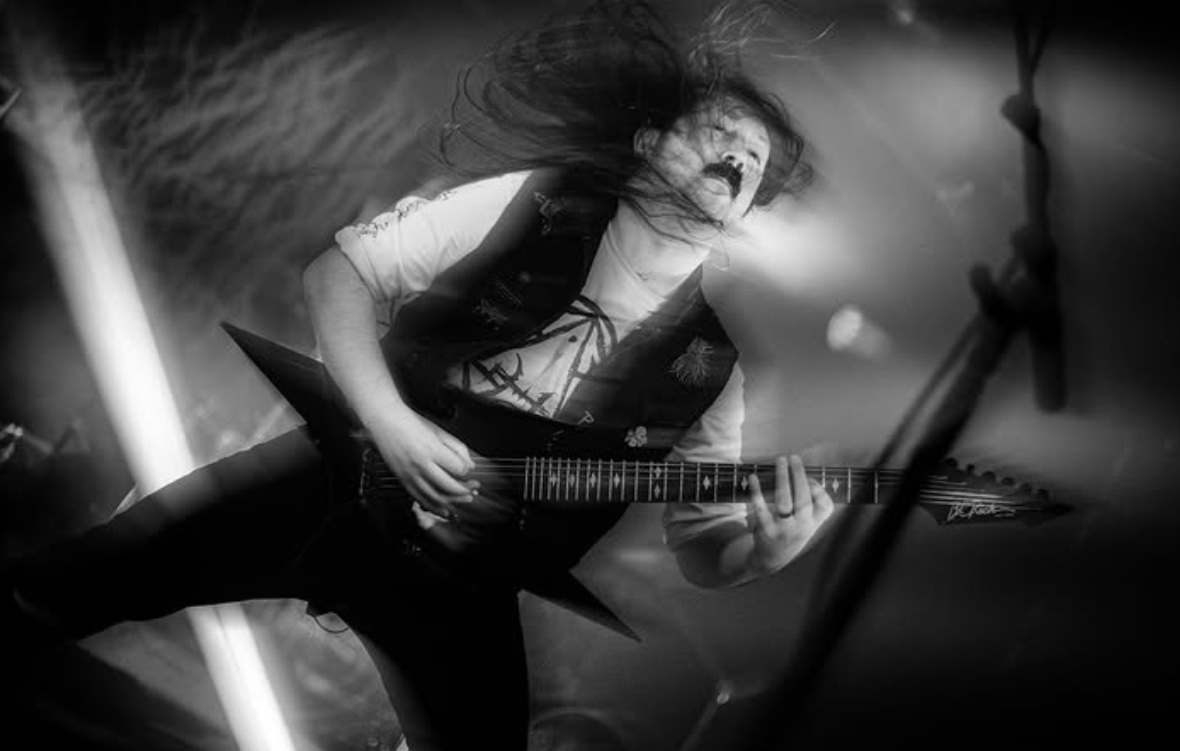 PR – Why not? In my opinion, it is precisely this openness and resolute hopefulness felt throughout the album which resonates with so many people outside of the Death Metal scene, since art, music & hope are ultimately universal. Our intention for the album was to make something which moved the needle. It was not our goal to make a “good album”, which is a fine enough goal, of course – Absolute Elsewhere was always required to document an attempt to genuinely impact the human soul. Which, naturally, is a much wider playing field than the various schisms of Death Metal’s myriad sub-genres, or the clique-based “insider only” mentality of much Underground music. Of course, one cannot create something with such ambitions without incurring the rote accusations of pretension or bombast. But, BLOOD INCANTATION is merely an ongoing collective expression of four individuals’ evolving creative dreams, which does happen to utilize Death Metal as one critical vehicle (or tool) among the many in order to reach our sonic aspirations – but it is not the destination in and of itself.
CK – Do you think it’s this willingness to blur genre and form that gives it a unique resonance? You’re breaking out of the ‘externally-imposed boundaries and limitations’ you mentioned earlier, and as a result you bring your listener to a new state of freedom.
PR – Even at a cursory glance, our music has always been a bit outside of “just” Death Metal – whether this means long-form songs with so many clean guitars and dynamic shifts, our ambient records Timewave Zero and All Gates Open, or even the instrumental songs “Inner Paths (to Outer Space), “Luminescent Bridge” & “Meticulous Soul Devourment.” Add to this our pronounced eschewing of machismo’s stereotypical tough-guy-isms – which perhaps too much of Metal is predicated on – the repeated demystification of our human (and thus, flawed) personalities in the greater social perception, and a genuine willingness to interact with new people/outlets beyond what is considered “cool” or acceptable to many of the Underground’s most insular tropes, I think the average person coming to our music can simply detect this openness towards themselves, feeling unfettered by a need to impress or vet anyone. This is something I think contributes to the general sense of excitement around our band; specifically, the fans’ eagerness to share their appreciation of the music. While our music is first and foremost made for ourselves – meaning we seek the sounds we most want to hear, for our own enjoyment – we are also mirrors of others, and all persons willing to enter the Stargate are likewise welcomed and encouraged to listen as much as we ourselves want to enjoy the music.
CK – Victor Hugo described music as an expression of ‘that which cannot be said and on which it is impossible to be silent.’ I get the sense that you sincerely believe music to be a vital transmission device. In this epoch of ultranationalism, authoritarianism, populism, and xenophobia, how might music be harnessed as armament against the rise of neo-fascism?
PR – Music is art, and art is inherently transgressive to the concepts you mention. Hence the freedom of art is so heavily stifled under authoritarianism, and why corporate art is so dehumanizingly bland and faceless. Meaningful art represents meaningful ideas, which are intangible and cannot be killed by force, trends or even time. Great (or even just new) ideas are dangerous to those in power because their origin in the “nothingness” of thought becoming manifest through the imperfect human vehicle has a natural tendency for grassroots expansion in the collective hearts & minds of the people. This is exactly where a better world will grow from, which the rich and powerful have understood since time immemorial. But truly, it is their arts which moves civilizations throughout history, bringing ages of enlightenment and progress into our reach – it is not political power, religion or nations which accomplishes this. Human consciousness grows and expands in order to reflect/adapt to compelling art, which reaches back through time and stretches far into the future in ways that even the greatest dictators could only dream of. Art – meaningful art – is considered dangerous to the status quo specifically because of its ability to transcend societal limitations of class since there is, ultimately, no war but class war throughout all ages. It has always been a select few against the many, the greedy against the impoverished, the powerful against the defenceless, and so on. That is where the blood which greases the wheels of history is always culled from: the people. I might be misanthropic, but I nonetheless will forever believe in humanity’s innate capacity for spiritual change, and that a better world is indeed possible, if only the common person can awaken to the light of their true nature – which is Oneness. Art can help people open their minds to the universal consciousness, and aide them in recognizing themselves in others, dissolving the alienating tribalism of Otherness: The “us vs. them” mentality (AKA the illusion of separateness) which is the root of all prejudice, paranoia and the majority of various -isms which plague both human consciousness and civilization. I also want to clarify that by my repeated utilization of the word “art” I am not referring to solely its applications through Death Metal, music in general, or even just the Fine Arts at large – I am referring to humanity’s inherent belief in the power of symbolism; to the aesthetic beauty behind mathematic proportions; to the intersections of science and the occult wherein all forms of quantum mechanics, theoretical physics, and millennia of esoteric philosophy are converging over the nexus of Mind itself; and yes, to vibrations’ and frequencies’ musical abilities in regards to healing, warfare & the manipulation or expansion of human consciousness. This greater mysticism, which surrounds and permeates every aspect of earthly life (and beyond), is precisely what I am most interested in when contemplating the purpose and concept of most art. In my experience, that ineffable feeling of witnessing truly powerful, transcendent art is very much present in one’s emotional experience of a truly astounding riff or profoundly remarkable atmosphere. Just one riff, a simple melody (regardless of genre), can change a person’s entire life – even impacting whole generations. This is exactly why the abhorrent and regressive ideologies you mention are so fearful of great art.
CK- Do you believe all art is political?
PR – No. My art is simply the result of the will to create. I do believe human politics are morbidly superficial, and that no political party anywhere actually believes in genuine peace on earth – it’s always “peace for me, but not for thee” in some form or another. Materialism will override spirituality in every political or economic scenario until humanity understands we are all connected and acknowledges the many other worlds around (and within) us. While I regret temporarily bogging your interview down with eco-transcendentalism, it is apparent that so long as humans continue to brutally enslave animals & subjugate the natural world for profit, we will continue to do so to each other. This is because speciesism is one of the first prejudices all infants are taught, regardless of culture: “This animal is OK to kill, this one is not”; In the same way, each culture eventually develops their own versions of “this human is OK to hate, this one is not”, and it spirals from there. Just as individuals are taught to perceive ourselves as utterly separate from other humans, we are likewise taught to believe in humanity as being completely removed from nature itself. Unfortunately, until humanity recognizes the universal consciousness present in all beings to varying degrees, there will never be peace on earth, no matter what political party or religion is in charge, nor how much money is being spent on whatever cause. While this might appear nihilistic, it actually reveals one of the simplest (yet most malignant) axioms underpinning much of earth’s suffering. However, since this thought current initially begs more questions than it provides answers, and we’re short on time, I’ll just say: It is understood that one cannot create peaceful energy in this world until they are able to truly cultivate it within themselves. Thus, I wish it were more understood that mass-industrialized violence against defenseless souls is not exactly benevolent behavior.
CK – You seem to live the ‘art monster’ lifestyle, by which I mean you are totally devoted to your craft. Have you made a lot of sacrifices along the way to preserve this lifestyle? I’m a writer, but also a toddler-dad with a full-time teaching gig in a public school – the art monster way of life is a frequent fantasy, but not one that’s ever likely to materialise for me at this stage. That said, it must be incredibly freeing to set your own parameters.
PR – For better or worse, I’ve always been motivated most by art and had difficulty participating in regular society. Even as a kid, I was more concerned by mysterious artifacts and compelling sonic atmospheres than I was any schoolwork or social obligations. I casually performed music in school in both band & orchestra, but when I was 15 I was finally exposed to the DIY world in the flesh; realizing that contemporary bands were printing their own shirts, dubbing their own tapes, pressing their own records, and booking their own tours, all the stuff like that – from that moment on, it’s the only thing I’ve wanted to do with my life. I’m extremely motivated by the archival continuum of ephemera and how we can both chronicle/collect things but also actively contribute to the context which shaped everything around various music or art scenes. As far as your question, I’ve sacrificed countless things meaningful to me: relationships, friendships, and family life, as well as practical things like reliable income and social safety nets, in order to follow my dreams of living for my music and dedicating my life completely to my art. I can’t recommend it to everyone, but for me, there was never any other option. Some of the best jobs I’ve ever had, I had to quit simply because they couldn’t afford to let me tour; Stable relationships which unintentionally held me back from manifesting another reality had to be let go, despite no fatal issues. I uprooted my entire life 15 years ago to move across the country to join a band I’d only known for a few tours, just to quit after 4 years in order to focus on my own ideas like BLOOD INCANTATION, SPECTRAL VOICE and more. This perpetual building/collapsing of various creative ecosystems has been one of the great, consistent struggles of my life, and at least ten years of it were truly wasted just partying and being a chaotic dickhead. I didn’t start taking things, or even playing guitar, truly seriously until I was at least 25, and it took another decade for things to truly get rolling.
CK – It’s quite a commitment to devote yourself to art and to communicating this message of prosociality. I suppose the ultimate gift you can offer people is a similar experience for the people who engage with your art – a freedom to commit to one’s own calling.
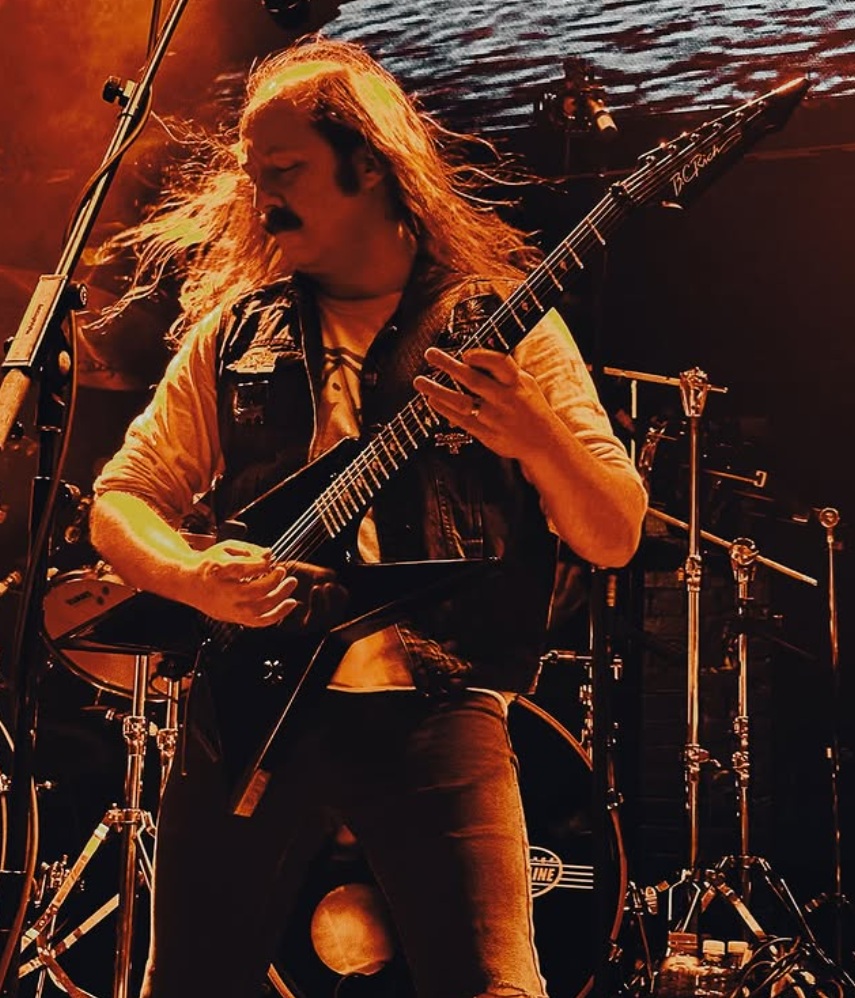 PR – While it’s definitely “freeing” to set my own parameters, I’ve also lived paycheck to paycheck since I was a teenager. In fact, only since the release of Absolute Elsewhere (6 months ago…) has been the first time I’ve ever been able to have any savings set aside, for which I’m incredibly grateful. Considering that my first bands were from 2002, and I’ve been working since 2005, touring since 2007 etc, I’ve more or less always been extremely broke. Even when I was working regular jobs, I was still touring with multiple bands several times per year – I’d work the latenight before the first drive of tour, and slam right back into the schedule the day after we got back, for years and years. I was juggling 2-3 jobs 6 days per week from 2011-2016, still practicing 3-5 nights per week with 2-3 bands in 2-3 different cities. It was honestly just too much, and I eventually did get burnt out, despite my bands’ continued growth. When I finally quit my last regular job (in late 2019, right after Hidden History…), I just figured if I’m going to be living paycheck to paycheck regardless, at least I can be doing so on my own terms, for my own ends. I took a touch of bitter solace from the fact that 60% of the country, however professional they might appear, also lives so precariously. In the meantime, I’ve continued to release experimental solo music, which is something I used to invest nearly all of my spare time in during the late 2000s/early 2010s, but had to step away from roughly 2014-2020, when SV/BI were really building up steam and required a lot of extracurricular focus. Since the bands have become more sustainable, I’ve been able to finally get back into those modes and just enjoy my own private creative process again. I believe the ranges I was able to explore in my solo work 2020-2023 really helped my mind and heart get into the wavelengths necessary to help create Absolute Elsewhere, which is so different and more expansive than our past albums. Coming up next is a double album of what I believe is my best solo material I’ve ever made, along with a split release with one of my most influential inspirations for my solo work, and I really can’t wait to share them with the world. Of course, the Stargate is always open in the rehearsal studio, and BI have much on the horizon, so there’s always more music on the way.
CK – You are connected to so many different genres of music – from Black Metal, Speed Metal, Krautrock/Psychedelic, Technical/Progressive/Death Metal, Funeral Doom, to Ambient, and Experimental/World Music. Does this mirror or reveal an empathetic side of your character? You’re non-judgmental and open to all forms of auditory experience.
PR – I just believe music, like all art, is ultimately infinite in its variable iterations. Speaking as a former record store employee, music genres are most beneficial for marketing/consumerism, ie. I need to know where to stock it, and you need to know where to find it. But they’re not genuinely real, in my opinion. But at the end of the day, I’m simply a guitar player with an affinity for strong atmospheres, so I’ve always prioritized that in whatever band I’m in. As a rather limited player, most of my early bands were much easier to play, guitar-wise; Black Metal, Funeral Doom, Drone/Sludge, Noise etc are less demanding than Technical or Progressive forms of extreme music. However, once I started getting a little better at guitar, these elements were finally able to be incorporated into my music, which happened around 2009 – coincidentally, when my first Death Metal band (TOTAL DARKNESS) sprung forth. One of the most fascinating things about the ancient underground of Metal and Punk is its swirling endlessness – you truly have never heard it all, no matter how deep you go. To that end, your greatest inspiration may be waiting just underneath the next tape you don’t turn over at a Goodwill or random record store in a small town somewhere on tour. As for Krautrock/Prog, this well is exponentially deeper, not least of which is due to the financial state of even the tiniest labels from the 1970s-80s: Vinyl was so much cheaper to produce back then, even a guaranteed “chart failure” of an experimental album could be pressed in 10,000 copies for less than half as many dollars – a small loan in business terms. This actually goes for many early Death and Black Metal releases as well; labels like Earache, Roadrunner, Combat and Metal Blade were pressing literally tens of thousands of copies of classic bands’ debut albums for pennies on the dollar, so, for instance, a first pressing of Altars of Madness is significantly less rare than people might perceive.
But to your question, I’ve never really believed in puritanical genre conformity. Even as a youth, I was always enjoying Metal riffing in my Punk, Psychedelic elements in my Crust, Folk melodies in my Black Metal, Ambient textures in my Doom, and so on. Some of my favorite and most inspirational bands 20 years ago were groups like DYSTOPIA, CORRUPTED, TARANTULA HAWK, ULVER, diSEMBOWELMENT, SUBHUMANS etc, all of whom experimented with textures or soundscapes beyond the realm of their initial subgenre. I always read liner notes on records, which is where I first saw names like BRIAN ENO (thanked by diSEMBOWELMENT), SWANS (thanked by NAPALM DEATH), or DEAD CAN DANCE (thanked by MORBID ANGEL). So, it just seemed very natural to me that Metal and Non-Metal were fine to listen to at the same time. Also, and not for nothing, the average “Metal Only”/“Punk Only”-type personalities I seemed to meet growing up were always some of the least interesting people I knew… so I was very turned off by such attitudes and consequently gravitated more towards individuals who would share a wide range of new sounds with me, rather than chastise me for liking one style or another. In regard to BLOOD INCANTATION, we are of the opinion that there are still worthwhile combinations of new sounds yet to be heard, and we are actively searching.