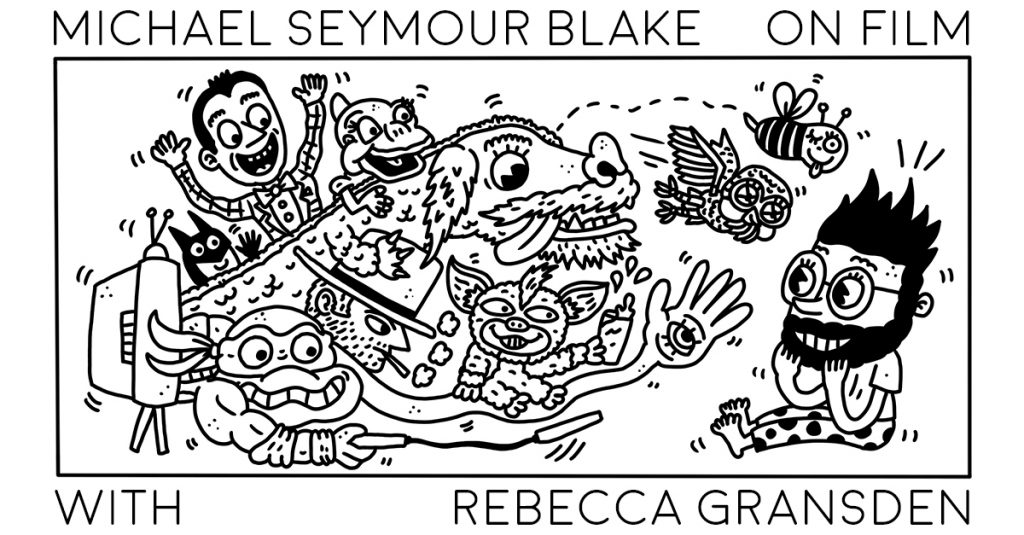
MICHAEL SEYMOUR BLAKE on film with Rebecca Gransden

What film, or films, made the first deep impression on you? Hi. I’m overwhelmed with the amount of responses I have to almost all of these questions. I’m terrible with stuff like dates and technical details etc. and I forget important chunks of information all the time, only to blurt things out weeks later during a conversation with an unrelated person who is probably in the middle of talking about their day. In other words, I will forget to mention movies that live in my heart. I will forget super critical moments. I’m gonna answer this stuff with whatever randomly…

Continue Reading...

I WAS SO READY TO BE ENDURED: A REVIEW OF LAURA THEOBALD’S SALAD DAYS by Evan Williams

Laura Theobald opens her new collection Salad Days with an epigraph from Antony and Cleopatra. Fitting. This book is an acerbic wedding, rejoicing in the union of our worst impulses and their natural consequences. Everyone is dressed to celebrate, except we’re alone. So, so alone.  To be forthright, I had no idea what to make of Salad Days initially. I read the epigraph and thought, “Ah, destructive love, imperial curiosity.” I read the index, where I found the book split into seven spectacularly-titled sections: Waves of Confusion, Art for the Afterlife, Moon Unit, Future Moods, Double Fantasy, Sour Times, and…

Continue Reading...

AUTUMN CHRISTIAN on film with REBECCA GRANSDEN

Quiet like a bomb waiting for its lit fuse, Autumn Christian has steadily accrued a series of intrepid releases. Nominally designed to satisfy certain genre cravings, Christian’s writing transcends any label simply by being uncommonly good. Her work is strange and provocative, endlessly imaginative, full-blown addicted to ideas, and fearless. For any insight into a mind this committed to creative freedom, the natural starting point is to visit the environment Christian grew up in. ‘I was born in Oklahoma City, but my parents moved to Fort Worth when I was a toddler so my dad could pursue a career in…

Continue Reading...

A NONLINEAR PROCESS: ON CHANGE IN TAO LIN’s LEAVE SOCIETY by Alan Rossi

Tao Lin’s new novel, Leave Society, is a book that embodies what it means to mindfully evolve one’s consciousness while also acknowledging that one’s individuality is tied to a sea of consciousness, myriad beings all evolving toward some unknown destination, what the main character in the novel, Li, might term “the mystery” or possibly “the imagination.” Leave Society is challenging in that it doesn’t have the typical propulsion of a novel: drama isn’t the point, but internal and external, by way of other people, i.e., other consciousnesses, revolution of the mind and experience is. It is, in my opinion, less…

Continue Reading...

GARY J. SHIPLEY on film with REBECCA GRANSDEN

Rebecca Gransden: Your work explores extremity. Extremity of violence yes, and also conceptual extremity, extremity in language use, of idea. I instinctually back away from inquiry into direct influence, seeing it as reductive, although I have noticed trends among artists. To some, influence is a question of attraction to work reflective of, or in kinship with, their work, and to others influence exists as an energising feedback loop. With that in mind, how do you view extremity in cinema and, by extension, its relationship with and influence on your writing? Gary J. Shipley: Yes, “conceptual extremity” and “extremity in language”…

Continue Reading...

ZAC SMITH on Normal Life with REBECCA GRANSDEN

What is an ordinary day? With our days increasingly under analysis, it’s a reasonable question. Everything is Totally Fine arrives at an opportune time. Zac Smith’s stories are permeated with seemingly mundane events, actions familiar to the everyday, the stuff that makes up life. And life is strange. What do we feel when we think of ordinary days? Nostalgia? Longing? Resentment? Relief? As Zac Smith sat down to write these stories, maybe he had some of these in mind, or perhaps he wanted to forget about them. His ordinary days gave rise to a collection of stories, something he didn’t…

Continue Reading...

GARIELLE LUTZ on film with REBECCA GRANSDEN

The way we talk about film, how we digest it, is worth a thought. We “capture” images, we “take” pictures. For those oldest reels, where life skitters in shades of black and white, it’s tempting to view the images as a record, as a window or portal to another time. There is a truth in that. Pointing a camera at people unaware their image is being taken, in that between-time when the medium was new and its nature not widely known, has an unnerving quality. When animals are presented in these infant days of moving image the issue is somehow…

Continue Reading...

JANICE LEE in conversation with VI KHI NAO

VI KHI NAO: I read the first half of your Imagine A Death during a flight into San Francisco. I am currently in Boulder—where I think the landscape ofthe high elevation may have altered my relationship with your work in the second half. Many of your sentences are long – like Bela Tarr long – and they require strong lung capacity to fully experience, inhale the depth and intensity of your gaze.  Being near this mountain, I feel I could acclimate to your long, gorgeous, beautiful sentences that open one world into another world into another world.  Has this long…

Continue Reading...

THE LAST INTERVIEW: Blake Middleton vs. The New Guy at XRAY

Blake Middleton is an actual person. A Floridian. An American. The co-worker of your bartender friend who you immediately like better than your bartender friend after just a few conversations. And a poet. The kind of poet who just wants everybody to feel less fucked. Writing concise, concrete lines that once piled together form a sort-of meditation, a smirking mantra of “Fuck You” in the face of an absurd world. What follows is a conversation/battle of wits between he and I, revolving around his new book “An Actual Person in a Concrete Historical Situation”—out now from CLASH Books.   Part…

Continue Reading...

TROY JAMES WEAVER DOES A LITTLE CHATTING WITH GRAHAM IRVIN

Troy James Weaver is the author of Wichita Stories, Visions, Marigold, Temporal, and Selected Stories. His work often centers around young and vulnerable characters from rural areas struggling to fit into the world. He writes with an unparalleled rawness in quick, powerful bursts. A Troy James Weaver novel is quick and slim, but will change the way you think about writing and people both. In a blurb for Temporal, Scott McClanahan wrote, “[Troy] is our Witold Gombrowicz.” For Marigold, Michael Bible wrote, “[he] is the poet-laureate of Midwestern absurdity with a heart a mile wide.” Dennis Cooper wrote, as a blurb for Selected Stories, Troy’s collection out with…

Continue Reading...