Saul Lemerond

Saul Lemerond (he/him) is a dyslexic writer who lives with his family in Madison, Indiana where he teaches at Hanover College. He is originally from Green Bay, Wisconsin. His fiction has appeared in Flash Fiction Online, X-R-A-Y, JMWW, and elsewhere.

COME AND SEE THE VIOLENCE INHERENT IN THE SYSTEM by Saul Lemerond

It’s another hot day, and the tide is rising. The son shoulders his father’s rifle and walks back toward the beach house thinking the reason he’s shot the hole in the tank is because his dad refused to buy him a half million follows.“Please like, comment, and subscribe.” He says, holding his phone at eye level and trying to steady his hand because he is still shaking with generational anger he will probably never understand. Water spills out onto the ground as the cat patiently watches the flapjack octopus scurry to the opposite side of its tank. Time is running out. The big cat hopes to eat soon. There is a large hole in the glass that the son put there, and soon this flapjack octopus will be sucked out with the last of the water onto the beach where the cat is waiting. “I can’t wait until the tank drains,” the really big cat says. “Because I’m going to eat you.”“I don’t know why you want to eat me so bad,’ says the flapjack, who is a gentle creature. “You know, I’ve never ever given you a reason to dislike me. I don’t really have anything against cats. It’s the rich man that bothers me, and I think he should bother you too.” “I imagine you are tasty,” the cat says. “The notion preoccupies me. Anyway, don’t blame me. This isn’t my fault. It’s not anyone’s fault. Blame Capitalism.” Neither of these animals actually say these things. Not strictly speaking. Animals cannot talk. At least not in any way we can understand. What the cat actually says is this:Meow. What it means, and what the flapjack octopus knows it to mean, is this: Blame Capitalism. Because they’re in Miami and because Miami is in Florida and because Florida is in the United States of America, Capitalism is the system on which the cat places most blame. What the cat thinks, and would say if it could, is that their owner, a multi-billionaire, is the reason for a great many conditions directly relevant to their present moment. The flapjack octopus would not deny this, though it does find it a tad ironic. It is a fact that the very big cat, the hole in the tank, and the boy with the rifle have all come to their present circumstances because of this very rich man. This man, a man who heads a notably successful private equity firm, likes guns and cats and rare octopi and has a son. If it were not for him, all of their material circumstances would be very, very different. Incidentally, he is very busy, this rich man, and ignores them all unless it’s convenient for him, which is most of the time.At any rate, there are octopi in large tanks all over the premise of this beachside property. Cats as well. Big. Well fed. Cats. And oh boy, do they want to eat the octopi. Every single one of them, especially this one. Meow. Luckly for this cat, the others haven’t yet come to investigate. That the cats had, up to this point, never been given the opportunity to eat any of the owner’s exotic octopi is a great source of consternation. One that leads them to understand they are living tragic lives, surrounded by what must both be delicious and lovely rubbery meat they can never chew because, among other things, they don’t have the resources. Meow.Capitalism. It was the only reason for all the octopi to be in and around this rich man’s house where the cats could see but not eat them instead of in the ocean where they belonged. This is doubly true for the flapjack octopus, which is exceedingly rare and unattainable to anyone who is not super rich. It’s also the reason for the hole in its pressurized tank, which was put there by the son of the rich man. “How about that, Dad?! How impressive is your big tank now?!” He had shouted while uploading the video of him shooting the tank to his socials. The flap jack octopus, who we might assume is trying to calculate its chances of survival, is running out of time, and the cat has a point as to why this is the case.  “Damn this rich man and his son and his cat! God, I don’t want to die.” the flapjack octopus laments. “This is all very frightening. Beyond all that, this cat refuses to take responsibility for any of its actions, the state of its life, or recognize its own culpability in a much larger, very flawed system!” This last part being a common criticism of those who level systemic critique toward their specific and individually lousy lots in life. The flapjack didn’t say this last part. If you wanted to get overly technical, it didn’t say any of the parts, not precisely.What the flapjack octopus actually says is this: Bubble. Bubble.But it says it emphatically so, and as you might imagine, the cat is unmoved.  To be fair, the octopus is conflicted as, as much as it’d like to, it can’t really see a clear path beyond our current systems of capital. Not that there couldn’t be one, it’s just that it can’t imagine what that would look like. “I am but a simple creature,” admitted the flapjack octopus on many an occasion, “so, it could be that in this case my pessimism is the result of my limited imagination.”Despite the self-deprecation, it is important we do not underestimate the complexity of the octopus, who it could be said, much like America’s Bard, contains multitudes. The flapjack does not want to die. To be eaten. But even more than this, it doesn’t want to be alone anymore. To be possessed by some rich man. It does have hope for freedom. For too long it’s been like a fish out of water, only instead of a fish, it is an octopus, and instead of being out of water, it is in a tank, separated from any kind of good company, or anything familiar to its species. It has not just been lonely, but existentially lonely. What’s worse than this is that the tank is in clear view of the ocean, so that the octopus, for as long as it’s been here, can see its true home. It can see the surf rolling up, over and over again, inviting him back to the place it knows it belongs, with what we as human beings might think of as equivalents of friends and family.What the cat doesn’t understand is the octopus has actually been waiting for this opportunity because it could be a chance to escape. The boy doesn’t understand this either, though this shouldn’t be a surprise to any of us because there are so many things the boy does not understand.Another thing he doesn’t understand is how, due to increased levels of CO₂ in the atmosphere, the sea level has been raising. For the octopus, this is a very important because if the pressure of the water leaving the tank is strong enough, and the tide is high enough, and the sea level has risen enough, then it has a chance at that thing it’s been waiting for. Freedom. But not just freedom. A return to the world it belongs. This would make the flapjack octopus very happy.  Happier than it’s been in a long time, and the flapjack octopus deserves to be happy because it is a gentle creature.    Bubble. Bubble.Is this octopus capable of the complicated calculations it needs to solve concerning its chances of survival or not? Probably it’s capable of some math. Most creatures are, even the son of the rich man.  Speaking of, he is still walking toward the beach house, checking the engagement on his video. People are watching. They are liking, commenting, and subscribing, which is good because that is what he’s asked them to do. If asked, the son would’ve been able unable to say why he got so mad he shot the hole in the tank other that it felt like the right thing to do after his father refused to buy him a half a million bots to increase his subscriber numbers. And that he thought the video would make good content and generate no small number of followers, which in his mind was only fair since his father had denied him so many. The real reason? He is acting out because he idolizes his father more than anything in the world and never gets to see him because his dad is always too busy figuring out ways to increase his wealth, which communicates to his son, either subtly or unsubtly, that his father loves money more than he loves him. The fact that this was true for all major movers of commerce and industry does nothing to make the son feel more loved. The fact the father is just repeating the behaviors of his father before him doesn’t make the son feel more loved either. Ultimately, what the son wants is for his father to smile at him the way he smiles at his exotic flapjack octopus. To care about him the same way he cares about his money. In the absence of this, the son has learned to seek validation through the praise of people he’s never met by making social media content in hopes of becoming a major influencer. In short, the cat is right. Capitalism is to blame.Meow.And what of the flapjack’s chances of survival? Let’s look at the variables. The number of gallons in the tank. The tide. The position of the sun and moon and their gravitational pull on the ocean.The current. The speed at which this octopus must swim to get to a livable depth.  And most of all, the release of CO₂, the warming of the earth, the melting of ice, and the rising sea levels. The conclusion? We cannot know. This story encapsulates only a brief moment in time. But one might imagine the flapjack’s conclusion is this: if the ocean level has come up just enough that when it gets sucked out of the tank, it rockets directly into the choppy surf and out to sea. Then, there is some likelihood that the flapjack octopus can safely get to the bottom of the Atlantic where it can spend its time hanging out with its friends and family waiting and watching the ocean levels rise and rise until everything on the surface, including the rich man, the son, and the cat, eventually drown. It's a very satisfying thought for the octopi.  Mostly because the only rich thing left on the surface then would be the irony.  Bubble. Bubble.

Continue Reading...

SAN ANTONIO by Saul Lemerond

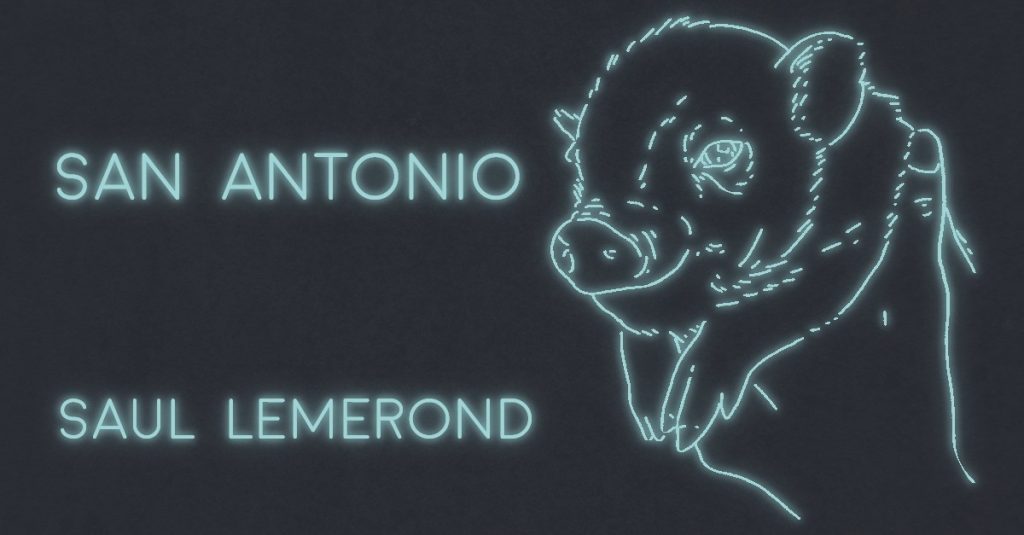
The piglet was pink, but not the regular pink that you expect piglets to be. This was the sort of glowing, warm pink that only exists in Disney movies. God, the little animal was so cute Yancy wanted to squeeze the thing to death. Wanted to squeeze it ‘til its head popped off its precious little body. 

Yancy’s friends Tim and John think this too. He is so lucky, they think as they stand beside him wishing they could also have one. They’d all been on their way to the Riverwalk but now no longer care.  

Yancy reaches out a hand and pets the piglet on its snout, which offers a high-pitched oink. This is right. Rightly right. He names the piglet Normand. Normand smiles. Normand’s smile is a demon’s smile. There is an air of danger about Normand, which only makes Yancy desire him more. 

Yancy picks up Normand, thinking, My mother will like this piglet

He looks over to his friend Tim who is tall and reminds Yancy of the bronze cowboys on the Riverwalk, the Briscoe. Stetson hatted. Rugged and loving life. There is a piglet that has appeared at his feet. 

John, who is dashingly handsome and reminds Yancy of a younger version of himself, also looks down to find one.  

This is strange. Yes, they admit that, but, their libidos are excited. They know a good thing when they see it, and they brace themselves, psychically, for what promises to be a considerable amount of sexual attention. Yancy looks at Tim. Tim looks at Yancy. They smile at one another. The attention, it seems, is already here. 

How beauteous these piglets are. Oh, brave new world, Tim thinks, that has such creatures in it

They take pictures and record videos of the piglets and post this on their many profiles. Tim names his piglet Worthington. Worthington, like Normand, has the grin of a hungry hobgoblin.  

***

Yancy’s mother is a starchy woman who likes index funds, has a drooping heart, an aching soul, and a mood in constant need of cheering. Her name is Mildred. 

“What a cute little piglet!” Mildred shouts when she sees Normand. She tries, very hard, to hide her jealousy which is a very ugly part of her that she rarely acknowledges. 

Oh, and will you look at that. Mildred didn’t notice at first, but she has a piglet standing next to her as well, sniffing at her fern-green flats. 

“Where did this little guy come from?” Mildred asks. “This is the cutest thing I have ever seen in my adult life. I will name him Weatherford. It looks like a Weatherford, don’t you think?” She, like Yancy and his friends, is also excited about the attention this will afford her, sexual and otherwise. 

Mildred sends a picture of Weatherford to her friend, Francene. Francene sends Mildred a picture of her piglet, Hamlet. Hamlet, like Weatherford, is adorable yet also menacing. 

It’s a profoundly joyous time, and they make sure to post this on their many profiles.  

There are many questions about where the piglets came from and why they are here. These questions seem important but not as important as, say, actually having a piglet. The piglets are a mystery to be sure. Everyone agrees. They will investigate, of course. Of course they will. Later. 

Then the message: Arbuckle just ate John

Yancy looks at his phone and wonders if this is a typo. If instead of ate, they meant @. ‘@John!’ makes more sense than ‘ate John’, but no. A photo is shared with a little adorable Arbuckle chewing on John’s foot, still in its classic western boot.

Everyone at John’s funeral who doesn’t have a piglet finds a piglet there. They are dangerous, these piglets, it cannot be denied, if only slightly, which just adds to their titillation. The funeral is like most funerals only more so in that it serves as both a celebration of life and a fracture in their interpersonal happiness along with flowers, drinks, and old friends. 

The occasion is emotionally wrought. Everyone loves their piglet, but at the same time, they do not know if they can trust them. Tim looks at Yancy. Yancy looks at Tim. The death of their good friend has brought them closer than ever.   

During the funeral, Hamlet attacks Yancy’s mother’s friend, Francene.

At first, Hamlet leaps up to Francene’s neck and takes a fleshy chunk out of her neck, right around where the carotid artery probably is. 

The other piglets, seeing this, jump aboard this flesh lunch wagon and take what they can get. Muscle, bone, tendons, and teeth. When they are finished, there is nothing left. Everyone posts this on their many personal profiles.

Mildred takes out her phone and reports this to several organizations who make it their business to keep data on such things. 

It seems to the mourners as if time stops and the whole scene freezes in tableau. 

Yancy looks at Tim. Tim looks back. Suspended between them is an aerosol of terror, disgust, and desire.  

The horror sharpens slowly, like the point of an icicle in early springtime, then everything begins to move again.

Tim pukes in the large clay pot of a Ficus benjamina. Several others join him. Many fear they will be eaten next. They inspect their piglets who oink at them dismissively, so dangerous and yet so cute. 

***

Later, when they are still alive and uneaten, it becomes clear to everyone that their piglets will either eat them or they won’t. 

Yancy could not get rid of Normand even if he wanted to. He puts him in a box outside at night and finds the piglet in his bed moments later. He leaves him hundreds of miles away in the Chihuahuan Desert and returns home to find Normand waiting on his porch. 

Yancy sits down and reflects on these uncertain times. He wonders if he is in love with Tim. Tim does not wonder. Tim knows. 

The two of them sit and drink coffee together.

“I want that piglet!” A voice shouts. It is strange to Yancy and Tim. People do not care that the piglets are dangerous. People, it seems, have complicated relationships with danger. 

Yancy and Tim hold Worthington and Normand close. Across the street, there’s a group of people with no piglets and a single man who has one. 

Yancy and Tim think there might be violence. You never can tell these days. 

A drove of piglets runs up from off of E. César E. Chávez Blvd. Now, there are exactly enough piglets for everyone. Tim kneels down in front of Yancy.  

Yancy calls his mother, Mildred, to see if she is still alive and unchewed.

Her smiling face appears on his phone with Weatherford in the background. 

He is adorable. The threat of him, Yancy thinks, somehow adds to his appeal. He tells his mother that Tim has proposed. Life is too short, he says. He wants a Texas wedding. 

Across the street, one of the new piglet owners is being devoured by his adoptive little pink package of joy. 

Several of the other piglets join in on the meat buffet and blood sprays everywhere. The shock and smell of the wet, naked viscera send several observers to vomit into the gutter lining their side of the street. 

Yancy turns his phone around so that his mother can watch. Mildred sends this information to the appropriate data collection agencies, then she congratulates Yancy and Tim. What a good couple they make.   

The drift of piglets lets out a long whine. High pitched, like a host of porcine cicadas. 

Tim records all of this on his phone, livestreaming to followers with similar interests. 

Oh, how cute, they’re singing, Yancy thinks. Is there no end to their precious benefits? 

These are interesting times. Uncertain, yes—destabilizing and frightening, of course—but interesting to be sure. 

Another piglet begins to eat its new keeper. It starts at the leg. The screams that follow are uncanny. 

“Yancy,” Mildred says, and Yancy turns his phone to face his mother. “I’m so happy,” she says, “for you, and that my Weatherford is a kind and gentle creature.”

“My Normand, too,” Yancy says, lifting the singing piglet up to nuzzle his neck. He is happy to be with Tim and Worthington.

“I cannot believe how many people have joined my livestream.”

“We should take one of those Lollipop carriages downtown.” 

The gutter runs thick with retch and gore. 

Continue Reading...