
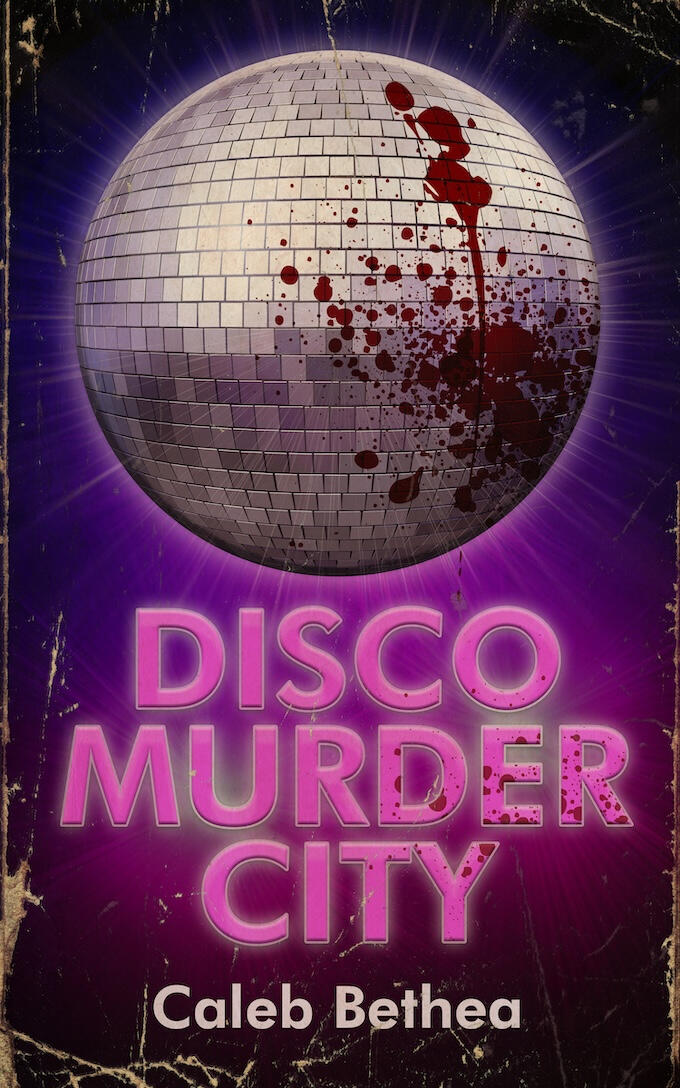
 The city lights up after nightfall, and Caleb Bethea knows the way. With Disco Murder City (Maudlin House, 2025) Bethea takes the lead, chasing fear along emptied alleys, into pulsating nightclubs filled with star-kissed divas. The sweat of violence and the will to get down infect every pore, and demons release their energy with a smile. Bethea decorates the city in cinematic grit and sparkle. The only thing more silver than the screen are the knee high platform boots. I spoke to Caleb about the book.
Rebecca Gransden: Disco Murder City takes place in a world saturated in the vibrancy of disco culture. What drew you to this era?
Caleb Bethea: Who doesn’t love shiny things? At the time, I was doing a lot of work with a maximal style. So when I had this idea of combining A Nightmare on Elm Street with a couple disco-coded scenes from Prom Night, it just clicked. The excess and hedonism of Disco culture gave me so much room to play with loud, godless prose.
RG: They’re uncomfortable, these Feather Demons, in the crowd. Torsos body into theirs and the movement sends a stiffness all through their countenance. Feathers begin to fall from their eye sockets. Just one or two at first. Floating side to side in a swing motion around the shuffling of knees and shoes. More come down, straighter now in their fall. Sticking to the floor. Something dark and wet melding them to the tiles. A molted pile of drenched feathers. The demons try to stop it. They hold their hands over their eyes. But the feathers seep out from between their fingers. It’s getting worse. Feathers that might as well be bodily fluid.
Demons inhabit the city’s streets. When did the demon types occur to you, and how do the variants interact with the city and its citizens?
CB: First thing to note is that they’re all sleep paralysis demons. They enter the city through your sleep, and then are free to roam—though they do tend to return to you for more paralysis experiences. It’s a big draw for tourism!
With differentiating the demons, my first idea was to make a sleep paralysis demon that could be used as drugs, which is where the Feathers came in. They’re these humanoid fucks with feathers for eyes. You can harvest the feathers from their faces and smoke that shit.
Pretty Faces came from my lifelong fixation with masks. They’re also humanoid, but completely faceless. They cover their blankness with handmade masks, using shit like gilded beads, chicken bones, heroin needles, etc.
The Whisper Teeth is a sadistic voice you hear in your head during sleep paralysis, but you can’t see their form. Netti is one of the few clubgoers who’s encountered this voice.
RG: Your protagonist, Netti, is an animator, of a kind referred to as an ‘inbetweener’. What does this mean, and does it tell us anything about Netti’s place in the world of Disco Murder City?
 CB: Back in the day, teams of inbetweeners were given a stack of art for an animation, but these images only hit the key beats. Their job was to draw new images with incremental differences in order to give the illusion of movement and connect the beats. I chose this as Netti’s job for a couple reasons.
Socially and emotionally, he’s decentered. Giving him a job that’s literally in between points A and B was a tangible way to express his liminality.
By the time disco came about in the ’70s, inbetweening had been replaced by more efficient methods. Giving him an obsolete artform to thrive in also allowed me to lean into the absurdity of work during a demon outbreak.
RG: Netti’s position as an animator sees him working on a project about a wolf man detective. The detective genre is a dominant theme of the book. Certain passages remind me of the operatic quality possessed by some giallo films. Is film an influence on the book, and if so are there specific examples you’d recommend to those who appreciate Disco Murder City?
CB: I pitched this novel as Evil Dead 2 meets Suspiria. So, I would recommend those classics to anyone who’s missed them thus far. The bonkers ass chainsaw quality of Raimi’s work combines with the technicolor lyricism of Argento’s in such a fun way. Both are so schlocky and full of life—lowbrow art with the volume turned to eleven. For me, that kinda shit is life-affirming and it brings me joy when people pick up the subgenres I was obsessing over when writing this novel.
RG: The figure of the wolf man recurs throughout the book. What is your own relationship to this icon of horror and how did he come to possess such a significant presence in your narrative?
CB: As for the wolf man, he’s a queer classic. The abject fear and the inevitable empowerment that come with having a body outside societal norms is just too damn fascinating not to allude to in a queer horror novel.
This archetype, though never literally played out, gives Netti a vehicle for his queerness, anxiety, and guilt. And he inhabits this archetype at varying levels of success.
RG: Murder City’s killer is masked, with appearances that possess the quality of a waking nightmare, as if the figure is a manifestation of the city’s darkest impulses. How do you view your killer? Is the slasher film genre an influence on you?
CB: I’m curious if there’s a way to word this without sounding like an overreaching intellectual asshole, but I viewed the Killer less as a literal killer and more of an idea of a Killer. Once I abstracted him in that way, I was able to play with him as a vessel for the city to live out its urges for mass panic and live-or-die nihilism.
So, on one hand, I was distorting the masked killer trope. On the other, I was having a fucking blast with the classic elements of a masked killer. My work, in form and content, is largely about indulgence and I shamelessly indulged in my slasher fandom for this experiment.
RG: The murder scenes themselves stand out as being rendered in a cinematic and poetic manner, and embrace a level of stylised violence. When writing the book, did you consciously approach these scenes with a specific technique in mind, or did the result evolve in a more instinctive way?
CB: When approaching the kills, I always kept two things in mind.
Number one was the reader. Whether they fuck with horror or not, I wanted them to connect with the kills on an aesthetic level. And I was able to do this through a flippant tone and some drippy prose. No one’s going to cry about the deaths in this novel, but they might wince at a pretty murder.
Number two was musicality. In the same way a musical builds a scene as an excuse for a dance number, I wrote scenes for the kills. It all led up to those moments. Then, in later edits, I would layer other elements of the story on top of it. But, it all begins with the kill!
RG: Murder City has its own radio call-in shows, where the public unload their opinions. There is a romantic, nostalgic feel to this type of radio show. Any call-in shows you grew up with that are an influence on the book?
CB: Big Coast to Coast Radio fan! I didn’t find it until I was an adult, but the ambient chill of a paranormal call-in show just fucking stretches my brain out on the couch.
Having citizens of Murder City call in with their demon experiences gave me that same feeling as I wrote. Plus, there’s sea monkey horror in one of those calls, and it makes me wonder if I pioneered a new subgenre?
RG: When did the realisation you possess creative leanings occur? Are there movements or artists you have a particular creative affinity with?
CB: I spent the last few months of 1999 trying to convince my first grade class, and myself, that I was an alien. A lot to unpack there in therapy, but I think creating (bullshitting?) was a mode where my brain was always comfortable. Because this shit is fun!
I’ve always resonated with writers who show evidence of fun in their work. Even shit like Kafka. You’re telling me that man was 100% down all the time when he wrote a man-turns-into-a-beetle story? What the hell is even going on with Gregor Samsa? That shit is fun!
I feel like fun is one of the things that makes indie lit indie. So many cool people doing this shit because it puts endorphins in their brain. And that’s art, dude.
RG: Did you undertake research for the book? If so, what form did that take?
CB: I looked at Studio 54 images until my eyes bled. Bar signs, platforms, DJs, roller skates, pythons, stilts, horses, wigs, chest hair, Warhol groupies—not all of these photographs made it into the book (you’ll have to see which ones did) but I aimed to capture that energy in every disco scene.
RG: Murder City does more than live up to its name, and transcends the idea of the city being a character in its own right. How would you describe the personality of Murder City to any potential tourist? Are there any cities you’ve encountered that share traits with Murder City? What does the city mean to you?
CB: Glitter and grime! That’s the crux of Murder City. You could get laid by humans, or murdered by demons and not particularly care which.
With Studio 54 as the clear influence, I would have to give it to NYC as the closest counterpart. Though I love the Big Apple, it does lack a certain sleep paralysis je ne sais quoi.
To me, Murder City is a celebration. Its existence is a sin itself. Bodies exist to be obliterated. For an anxious ex-Christian with a lot of original sin guilt still wired in my brain, this was a healing creative exercise—and a party to celebrate what I’ve survived in terms of mental health.
RG: OK, the menu you presented to me is a great start. It’s sexy and it’s beautiful and the dishes alone are dripping with decadence. All of those are beautiful things. However, I wanna push you just a step further and get you thinking from the perspective of a tourist. If people are traveling to this city, and they want the full experience of this city every step of the way.
Food mood. What dishes or places to eat would you recommend to visitors to the city, and are those recommendations different for tourists and demons?
CB: I always say don’t eat the escargot. (It’s laced with demon feathers.) But, to the right friend, I would absolutely recommend.
There’s also a sous vide recipe in there I would recommend to no one.
(Also, don’t do an Edward 40 hands at the disco.)
RG: When I think of the book now, it is in a color palette of rich purple and blood red. How conscious of color were you when building the world of Disco Murder City?
CB: Purple quickly became a character in the book. To me, it’s the most haunting and beautiful color (aside from Suspiria pink) so I just had to slam the story full of purple neon.
I’m obsessed with the way night lights highlight the body, how much is obscured and what’s left to be illuminated. Club lights make for disembodied bodies—floating limbs, lone torsos, neckless heads, etc, etc. Give that effect a purple glow and, holy hell, we’re cooking.
RG: A shock of purple illuminates the street outside. Silhouettes pass by the open door—the ones who’ve made him hate being conscious, some of them with swords, others riding demons like pigs. He thinks of a Barry White lyric. The baritone. The beat. The extended seven-minute club cut. All the sweat that had soaked into his fur coat through the years.
The book possesses its own rhythm, being set in disco days. What form does a soundtrack to the book take? Did you listen to music while writing it? What is the ultimate Disco Murder City playlist?
CB: The playlist was a lot of mosh pits and dance floors. Structurally, I’m deeply inspired by metal, especially grindcore bands like Pig Destroyer and Full of Hell. They pack the body of a song with as many rhythm changes as musically possible, and that does a lot of the storytelling. When it comes to DMC, I packed as many stories into the stories as I could to make a similarly grindy mess.
My disco influence could be summed up in the fantastic Weather Girls line, “Hallelujah, it’s raining men!” There’s a sacred profanity to disco. An innocence and purity (Hallelujah) paired with a palpable horniness that hyperfixates on the body (It’s raining men). I applied this juxtaposition to the horror and the result was many lyrical obliterations of the human form. Hallelujah!
RG: What about Disco Murder City has surprised you, either while writing or subsequently?
CB: I was surprised how much of this I could write in a moving car. Hailing ass back home after workshop, I would dictate scenes into my phone like my life depended on it. I’d hit Bucc-ee’s at midnight, smash wasabi peas and cheap coffee. Then hit the road and start writing again.
For those who’ve been to Bucc-ee’s after midnight, I think you can feel it in the text.
RG: What now for you, and will you return to Murder City?
CB: I’ll leave Murder City in Netti’s hands for the foreseeable future. But, I’m currently shopping around an experimental clown collection, finishing a surrealist home invasion novella, and starting an autofic horror novel about Bible College.