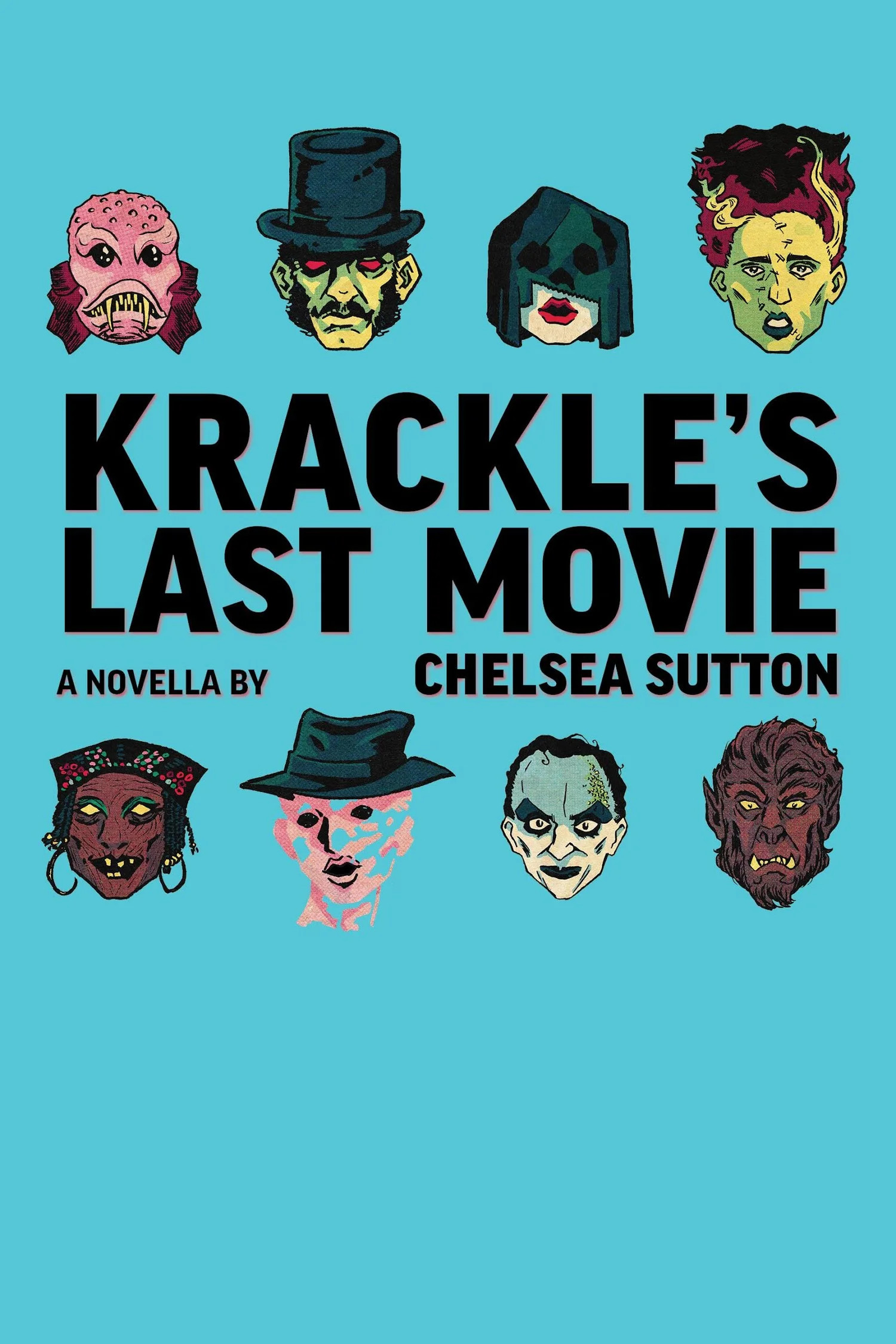
 Chelsea Sutton’s rollicking novella Krackle’s Last Movie (Split/Lip Press, 2026) deals in magic and monsters. The mythology of horror icons meets the world of the film documentarian, in a whimsical ride full of frisky humour and spooky glamour. At its ghoulish heart the tale is a quest—a resolution residing somewhere within old videotapes and archived audio cassettes. I spoke to Chelsea about the book.
Rebecca Gransden: Travelling back in time, what is the first monster you remember? When did monsters enter your life?
Chelsea Sutton: Monsters very clearly entered during The X-Files era of my life — which was around middle school. The variety of monsters and the approach to them as real, physical things in our world that could be investigated and studied really hooked me. But I was a scary stories kid from even earlier than that. Goosebumps, Scary Stories to Tell In The Dark – I couldn’t get enough.
RG: The monsters of Krackle’s Last Movie are the classic types that everyone knows: vampires, werewolves, mummies, straight out of early cinema and the iconic Universal films and Hammer pictures. How did the idea for the book take shape?
CS: When I committed to really figuring out the short story form, I gave myself an assignment to write a collection of monster stories that attempted to reimagine or redefine what a “monster” was; this wasn’t the only kind of story I wrote at the time, and I know this kind of thing isn’t for every writer, but having an umbrella project when I was starting out helped me focus when I was searching for ideas. There’s no way to run out of ideas if all you need to do is go out and find a monster.
Krackle’s Last Movie started as a short story that ran about 6500 words, which I wrote specifically for workshopping in the Tin House Writers Workshop. At the time, it was the longest story I’d ever written. And I wrote it specifically because I felt like I wanted to have a story with an ensemble of monsters in which I could mess with their tropes directly and playfully. I planned it to be the anchoring story of the collection.
Looking back at the feedback I got at Tin House, it was obvious that the form and scope of the story was wanting more space – I was cutting too many corners to fit the word count cap of the workshop; in grad school, I expanded it into a novelette and finished the admittedly bloated collection of monster stories. But as I continued to trim and shape that collection, the world of Krackle continued to open up. I was still holding onto the idea that it needed to be anchored to this collection to mean anything, only because that’s how it was first conceived. But once it reached novella length, it started to become more than that. It kind of broke out of the chains of the collection and became its own thing; the collection is now in tatters, though I got both Krackle and my flash fiction chapbook Only Animals out of it, and most of the other stories are published in literary journals.
In some ways the process of getting Krackle to its final form is the same as Harper’s journey editing the film. It’s the sum of a lot of disparate parts collected over many years that didn’t reveal its final form to me until the eleventh hour.
RG: Krackle had been slowly editing this for ten years, since before I joined the team. And here I am, slapping together the last third as if I know what the ending is supposed to be. What Krackle wanted the ending to be.
Krackle’s Last Movie opens with the titular Krackle having disappeared, leaving her cameraperson and assistant with the task of completing an unfinished documentary in her absence. The book continues as a search through various collected media, in the effort to finish the film in a way close to Krackle’s intentions. How did you approach this struggle? Has the examination of this aspect led you to any thoughts on creative ownership or the handling of an artist’s legacy?
 CS: The only way I felt I could honestly explore this struggle was through pulling the reader along Harper’s active editing process; part of that process is sitting with both the pieces Krackle has already pulled into the edit, and all the new footage she was gathering. Editing (both film and writing) is like putting a puzzle together, except that 90% of the puzzle pieces won’t end up in the final picture, but you do NEED those pieces to find the 10% you will use. Harper has to intuit what Krackle might be thinking, as a human and as an artist. And this process also demands that Harper tap into her own emotional truth, which is not something she’s comfortable with. The active goal of editing a film necessitates Harper to confront her biggest shames and fears — one cannot happen without the other.
In the end, Harper can never truly know what Krackle wanted or was thinking—she can only approximate through her own point of view. We have these moments culturally when artists pass away and never explain their work (David Lynch comes to mind). The urge is to try to explain, to summarize everything the work says — but we are always grazing the surface.
You might have an outline left behind, you might have past work, but to pick up finishing an artist’s legacy would mean to have to let go of all preconceived notions of what they wanted or what you want them to be.
RG: Have you ever made, or wanted to make, a documentary? What drew you to feature the documentary form so prominently in the book?
CS: I have not made a documentary! The closest I’ve done (which is nowhere close) are short interviews and behind-the-scenes bits for theatre shows (I did marketing for the performing arts for years). Documentaries have always been fascinating to me though — the amount of years and patience they take alone! And I’m always drawn to the ones that allow for or accept that the filmmaker themself is part of this story, whether they like it or not. Bias and point of view ultimately bleed into the thing, and the subjects of documentaries have had mixed experiences when it comes to how their story is ultimately framed. And sometimes that framing is shaped by forces outside of the filmmaker’s control – such as in the case of Krackle – which can undermine what they were trying to do in the first place. Documentaries almost always showcase to us as a society what we are ready to examine and what we are willing to ignore.
While I didn’t know her when I first conceived of the book, Margie Ratliff, who I met through the board of directors of my theatre company, is a producer and participant of the recent documentary Subject, where she examines her participation in the 2018 Netflix true-crime documentary, The Staircase. She just started a nonprofit organization Documentary Participants’ Empowerment Alliance, which is working toward ethical standards for documentaries. She’s definitely an inspiration.
RG: Monsters often evoke conflicted emotions. They can be figures of fear and repulsion, but also intrigue and seduction. Did you have a favourite monster growing up? What monster scared you the most as a child?
CS: I think I was always most afraid of ghosts and dolls that come to life! I remember a story from Scary Stories to Tell in the Dark about these guys who abused a scarecrow until it came to life and murdered and skinned them. That stuck with me. I treat every stuffed animal or doll I come across with respect – just in case.
RG: Krackle had heard rumblings of a shift happening weeks before Snaggletooth flagged her down. A change. A transition of sorts. People had all sorts of words for it in the stories they’d tell of humans suddenly growing parts and pieces of monsters. Fangs or hair or fins or, sometimes, something else even more fantastical. Something that seemed to have always been there. Buried deep down.
Metamorphosis and transformation is a key component of classic monster lore. How is this element expressed in Krackle’s Last Movie?
CS: The transformation is tied to emotional truths, shames, and pressures in the world in which these “monsters” live; they are physical manifestations sometimes of their own emotional truths, or the way society sees them. For Krackle, I was forcing an uneven physical change that would spur the kind of panic we’ve seen numerous times in this country: mob-mentality that has caused disappearances, murders, assaults, and basic stripping of human rights and dignity. The “monsters” in the story are not the villains. The villains have TV shows and guns. Those who don’t have a physical change become monstrous in other, more sinister ways.
RG: Do you dress up for Halloween, and if so what is your best costume?
CS: I haven’t dressed up in many years – mostly because I opt to go to haunted houses rather than parties these days. But my favorite costume from childhood is a dead bride (inspired by the character from the Haunted Mansion at Disneyland). In college I did a group costume with two friends; we were the “Mah Na Mah Na” muppets – two pinky monsters with one orange-haired green monster. Sexy versions, of course. It made no sense unless we were standing together, singing the song. And even then…
RG: A spontaneous phenomenon starts to take hold in the book — “beastification” — where people begin to develop physical abnormalities. This soon comes to be categorised under a new medical term Curious Monster Syndrome. Despite this scientific framing, the phenomenon suggests a stranger, perhaps supernatural, origin. Krackle’s work itself suffers from misrepresentation, and faces the question of whether the monsters in her films are ‘real’ or not. What part does belief play in the book?
CS: Misinformation and manipulation of reality through the media is unfortunately getting even more pronounced right now, but framing has always been the best way to undermine a truth. The society at large in Krackle wants to believe this beastification isn’t real, and has worked for decades to literally disappear the monsters through either oppression or actual abduction. One way to make sure people believe it isn’t real is through making Krackle — the one documentarian who wants to see the monsters as people — into a joke. Harper’s journey is also about how you reverse a joke to reveal what people don’t want to see.
RG: I see the influence of classic b movies throughout Krackle’s Last Movie, not only in your choice of monster, but the at times madcap hijinks and comedic imagery you incorporate. Are there particular actors, directors, tv shows or films of a specific era that inspire the book?
CS: I think horror and comedy and politics are forever linked in my mind. I tend to say that The Twilight Zone, The Frighteners (Peter Jackson’s 1996 classic), and It’s a Wonderful Life are my biggest film influences. If you see allegory, horror, comedy, or sentimentality in the book—blame them.
Some of my other favorites are The X-Files, Zombieland, Bryan Fuller TV shows (Pushing Daisies, Wonderfalls, Dead Like Me), The Munsters and The Addams Family OG shows, and the original 1931 Frankenstein, especially because it frames itself as a theatre show in its opening. I’m also a fan of the horror that started to come out of the 1960s when the camera became more mobile and POV became a more active tool: Psycho, Night of the Living Dead, etc.
RG: Krackle always capitalized Time.
The concept of time is central to the book, with the word itself capitalised throughout. Looking back, how do you view your Time writing Krackle’s Last Movie?
CS: I view the time I spent as a lesson in listening: the project was not at all what I thought it would be when I started. Time kept folding back in on the project, forcing me to examine things I’d left out of it. I hope that I can approach the drafting of longer projects with the kind of vulnerability Harper finds in her editing process—if anything so that I can be a little more efficient! But then again, everything is found in the editing anyway.
RG: Where are the modern monsters?
CS: I feel like all the monsters of modernity are derivatives of ancient ones; even Frankenstein’s monster and Dracula, as innovative as they were at their times, were drawing from older monsters, of bloodsuckers and immortals and things rising from the dead. They were reimagined into new forms that reflected the fears of their age. They weren’t made that long ago in the grand scheme of things, so Frankenstein’s monster, in my mind, IS a modern monster. There’s been at least five retellings of his story just in the last couple years — Poor Things, del Toro’s adaptation, The Bride, etc. But there’s also The Rocky Horror Picture Show — an adaptation that also creates its own ensemble of creatures and is still a cultural phenomenon. Monsters evolve like any other creature to reflect the changing fears in the environment around us.
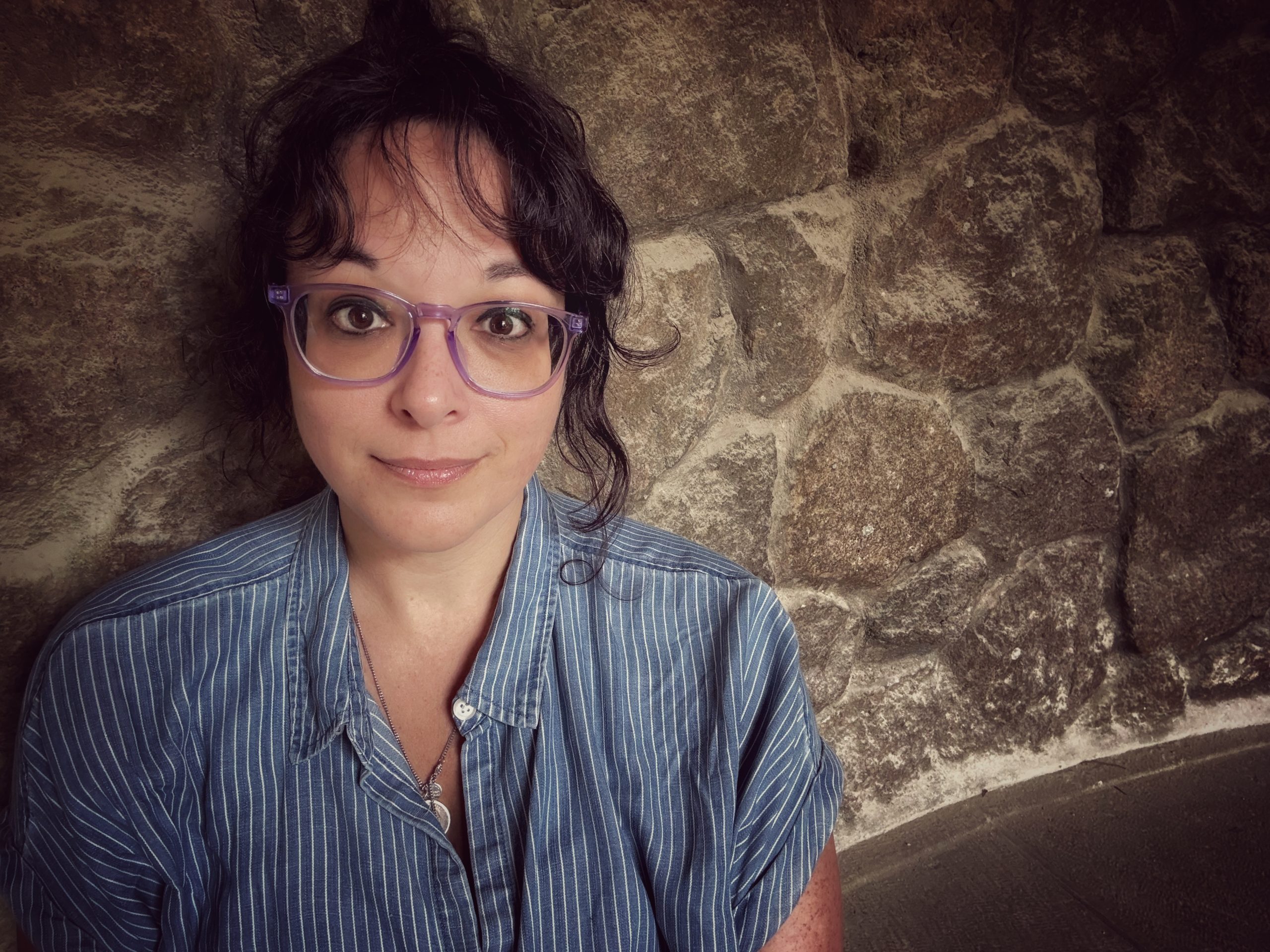
Chelsea Sutton is an LA-based writer and director. She’s a PEN America Emerging Voices Fellow, a Humanitas PlayLA award-winner, a graduate of the 2022 Clarion Science Fiction and Fantasy Workshop, and holds an MFA in Creative Writing from UC Riverside. She co-wrote the Emmy-nominated Welcome to the Blumhouse Live, an interactive film event for Blumhouse/Amazon. Her short fiction has appeared in Uncanny Magazine, Apex Magazine, Bourbon Penn, CRAFT Literary and the anthology Mooncalves: Strange Stories, among others and was featured in the first season of It’s Storytime with Wil Wheaton. She is the author of the flash fiction chapbook Only Animals (Wrong Publishing, 2024) and the novella Krackle’s Last Movie (Split/Lip 2026). Chelseasutton.com