
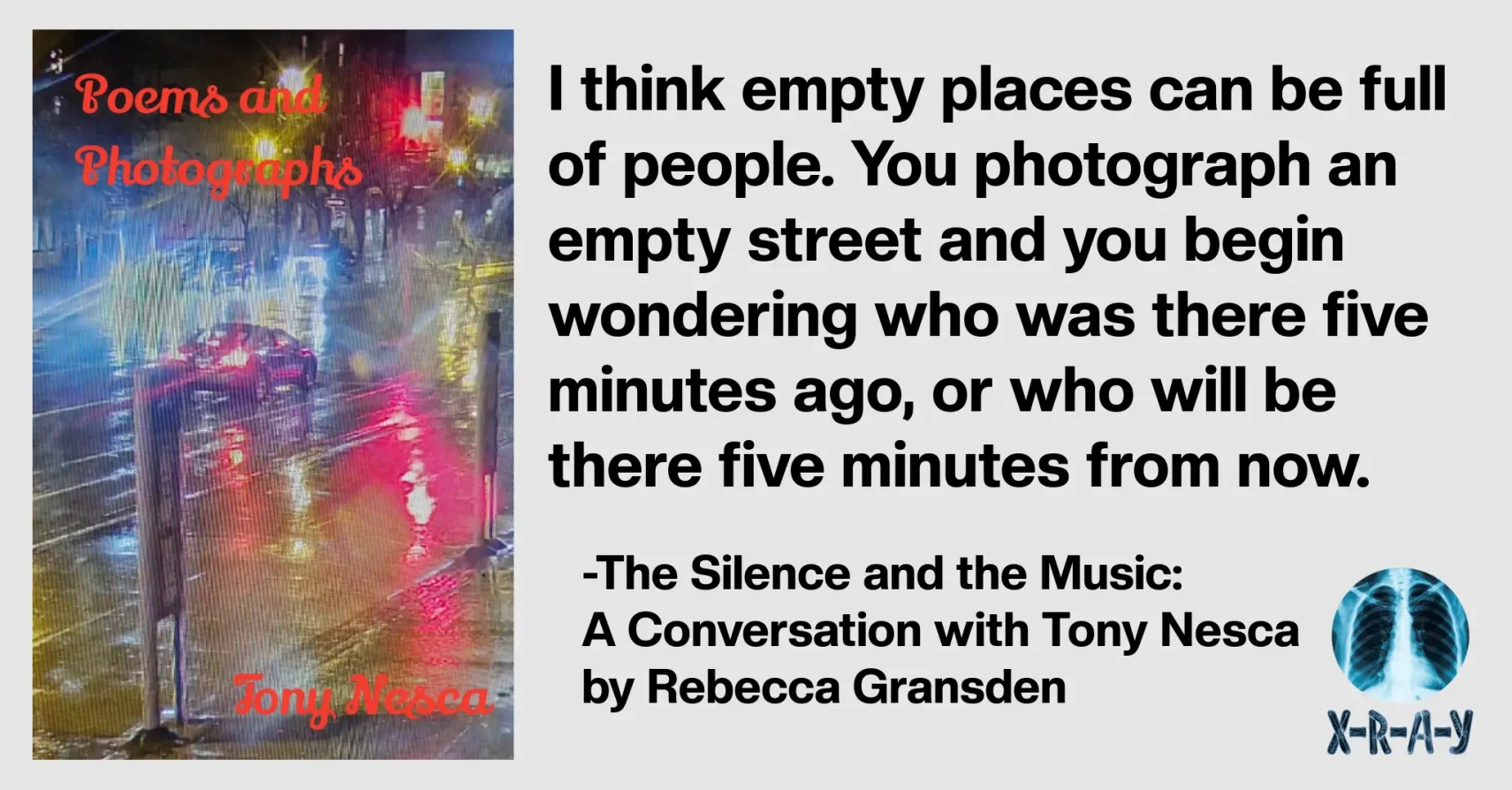
Two cities dominate Tony Nesca’s Poems and Photographs (Screamin’ Skull Press, 2026). A chronicle of Winnipeg and New York City, the collection acts as a psychic flight. Simply stated from the get go, Nesca pairs his poetry with images of the places in his sights. The resulting book presents a vivid, encompassing account of city life, with all the potential excitements and bruisings it has to offer. I spoke to Tony about the collection.
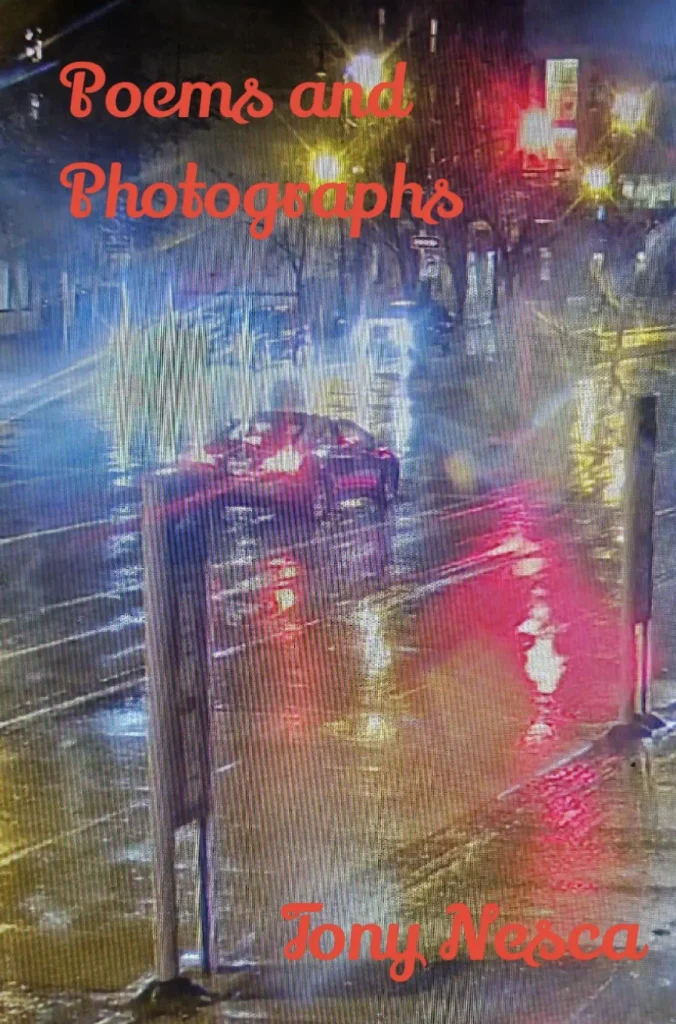
Rebecca Gransden: Your collection, simply titled Poems and Photographs, gathers writing and images focused on Winnipeg and New York City. What significance do these places have to you?
Tony Nesca: Winnipeg is home, obviously, but I think home is a complicated word. I’ve lived here long enough that the city has become part of the way I see things. I know its streets, its neighbourhoods, its uglier corners, its beautiful corners, and all the spaces in between. Winnipeg has a particular character. It’s a working-class city but also has this very strong artistic slant, great music scene, a liberal place with lots of arty types. It also has high crime and a high homeless rate and drug problem. It can be bleak and beautiful at the same time. It has a strange sense of isolation, but it also has a lot of life underneath the surface.
When it comes to New York, I have had a long-distance love affair with it my entire life, from all the movies, books, and comic books I devoured as a kid. I didn’t think it was real for the longest time, it seemed like a science fiction city to me. Then I got older and with it came the music. All those wild musicians that were coming out of New York and writing about it. Lou Reed, Patti Smith, The Ramones, CBGBs and all that great, original punk – not to mention the most respected jazz scene in the world. It is said that if you are one of the greatest musicians in New York City, you are one of the greatest musicians in the world. The city had me from afar, I was hooked before I ever saw it. Then I saw it. It truly exceeded my expectations, everything I imagined was there and more, and I fell in love with it. New York is different from Winnipeg, but there is something about it that I recognize. I’ve always been attracted to cities, particularly cities that feel lived in rather than cleaned up and presented like postcards. New York is overwhelming, noisy, crowded, beautiful, dirty, violent, romantic, ridiculous, all at once. There are millions of people there and somehow you can still feel completely alone.
I think that’s probably one of the connections between Winnipeg and New York for me, not to mention that architecturally there are portions of the two cities that look very similar, that 19th century architecture, Greenwich Village looks like our Exchange district, incredibly similar. They’re completely different cities that overlap similarities in certain areas, and both contain loneliness, beauty, absurdity, poverty, wealth, death, love, music, architecture, decay and ordinary human life. The streets, the urban parts, feel the same – there is lots of addiction, and street-action, mixed in with an artistic sensibility. These are the things I’m interested in. I’m not really photographing buildings. I’m photographing what it feels like to be alive in a particular place.
RG: What are your roots, and how have these roots influenced your creative life?
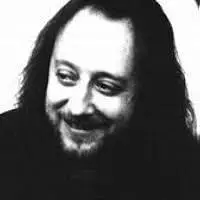
TN: I’m Italian-Canadian. I was born in Italy and came to Canada at the age of three and grew up here, but during my childhood we moved back to Italy several times, the last time being in my early teens for a two-and-a-half-year stint. That has probably influenced me more than I sometimes realize.
There is something about being between cultures that stays with you. You become interested in the idea of belonging, and also in not quite belonging anywhere completely. That outsider perspective has always been important to me.
My roots are also decidedly lower working-class and very much connected to ordinary people and ordinary places. I’ve never been particularly interested in the polished version of life. I’m more interested in the people sitting in the bar at two in the morning, the dishwasher walking home alone after a tough shift, the strange character nobody quite knows what to make of, the woman standing outside a building smoking a cigarette, the family trying to make it on a working class wage, the minimum wage security guard who goes home and works on his unpublished novel, the abandoned lot, the old neighbourhood that is slowly disappearing. All of that finds its way into my writing.
And then there is music. Music was an enormous part of my early life and continues to be. I think I learned a lot about rhythm from music before I ever consciously thought about rhythm in writing. I don’t separate those things very much. Writing, photography, music, they are different ways of looking at the same world.
RG: When did the concept for Poems and Photographs first come to you? What span of time do the poems and pictures included in the collection document?
TN: It came from my first visit to New York when I started seeing, or ‘feeling’ might be more accurate, the similarities between the two cities. I decided on the spot that I was going to produce a poetry/photography combo, and I decided on the title right away, I wanted it simple, no airs, just a statement.
I’ve been writing for a long time, and I’ve also been taking photographs for a long time. Eventually I began seeing a relationship between the two. I’d take a photograph and a poem would come from it, or I’d have a poem and realize that I’d already photographed the world that belonged with it.
Poems and Photographs took four years to complete – three yearly trips to New York to take photographs, then one year in Winnipeg to take pictures and to write the poems.
Some of the photographs are very immediate and some carry memories with them. That’s one of the things I like about photography. A photograph freezes a moment, but it doesn’t necessarily explain it. The same thing can happen with a poem.
I think the book eventually became a conversation between the two forms. The photograph says one thing. The poem says another. Sometimes they agree and sometimes they don’t. I like that tension.
RG: Where on Earth is your favorite place to be?
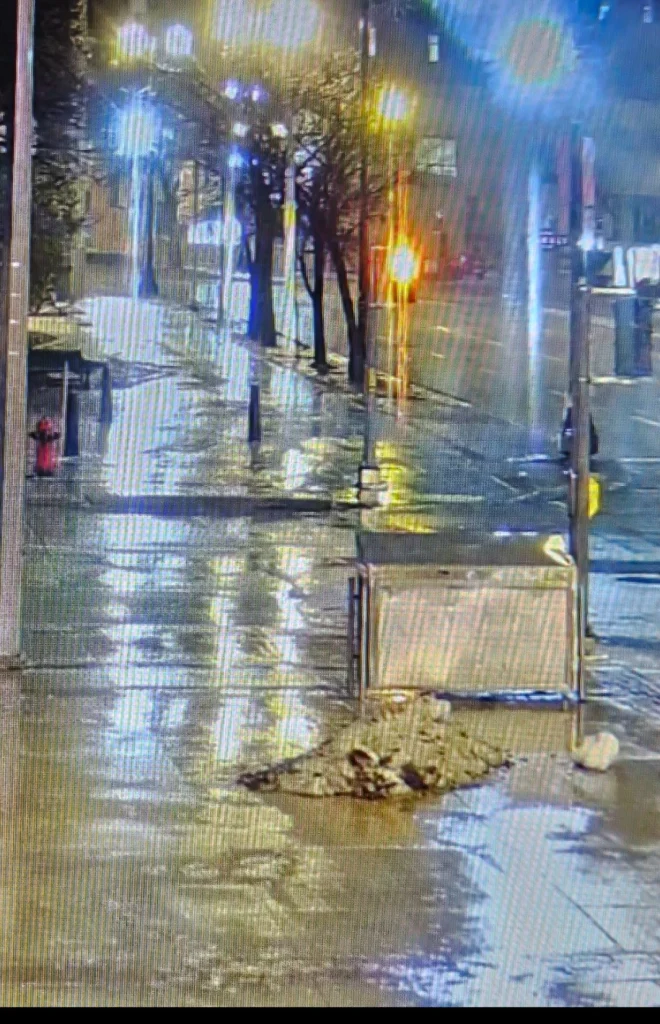
TN: New York is my favorite city, and Winnipeg is a close second, but anywhere I can walk is ok. I prefer cities, but I also like being away from them too. I’m interested in places where something is happening, even if what is happening is almost nothing.
A street late at night. An old neighbourhood. A bar. A train station. A city I’ve never been to before. Somewhere in Italy. Somewhere in New York. Somewhere in Winnipeg.
I like places where you can wander without necessarily knowing where you’re going. That’s probably more important to me than the destination itself. I like the possibility that something will happen when you aren’t looking for it.
RG: When did your interest in both writing and photography arise and how do these practices commingle in your artistic life?
TN: Writing came before photography, although music was there before writing. I’ve been writing for many years, and eventually photography became another way of recording the things I was seeing. For me, photography isn’t separate from writing. I’m interested in the same things in both. People, places, loneliness, humour, decay, beauty, death, movement, silence. The photograph can capture something that language can’t, and language can go somewhere a photograph can’t. A photograph gives you the surface of a moment. A poem can get underneath it; or completely distort it. That’s interesting to me.
I also don’t think art has to stay inside its assigned little boxes. If I want to write a poem, take a photograph, make music, write a story or a play, I don’t see why I should have to choose one. They’re all different tools. I’ve always been interested in the possibility of putting them together rather than keeping them separate.
RG: Emptiness is a theme that recurs in the book. Your photography frequently features places emptied of people. What draws you to this theme?
TN: I think empty places can be full of people. You photograph an empty street and you begin wondering who was there five minutes ago, or who will be there five minutes from now. An empty building has a history. An abandoned lot has a history. Even a completely ordinary street corner has probably witnessed thousands of small human dramas that nobody will ever know about. There is also something honest about emptiness. Cities are usually photographed when they’re full of people and activity because that’s what we’re told a city is supposed to look like. But that’s only one part of it. There are enormous amounts of silence inside a city. And I think loneliness is one of those things that exists whether or not you’re surrounded by people. Sometimes an empty photograph says more about human beings than a photograph packed with human beings.
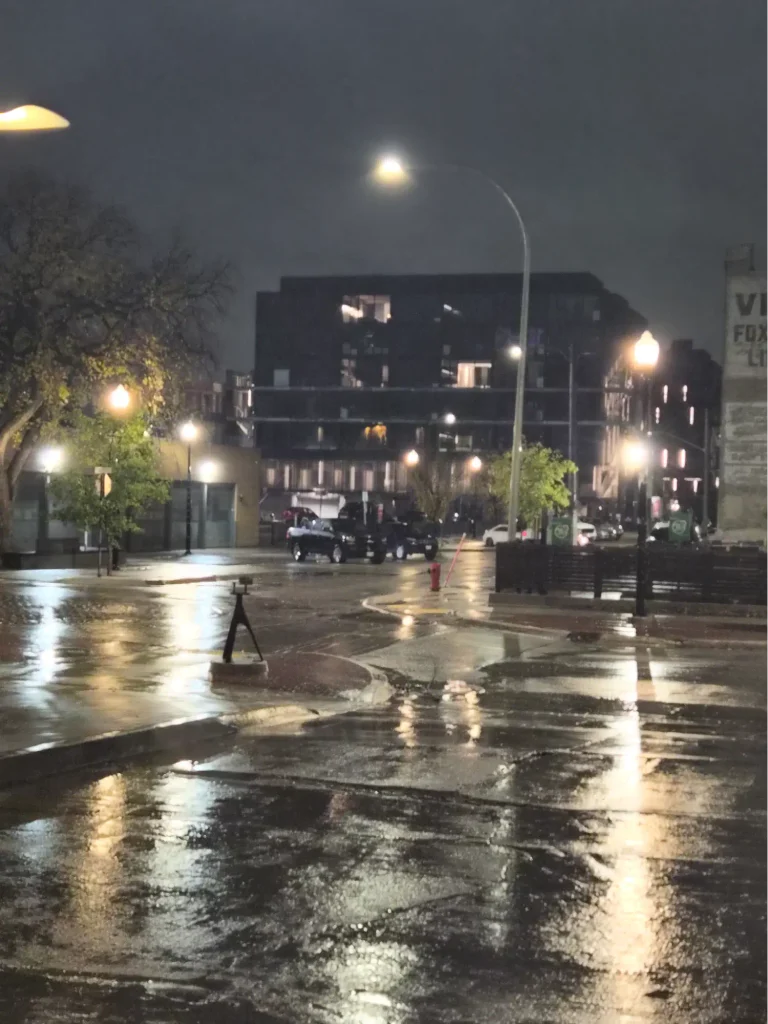
RG: Another theme you touch on is transience. Encounters can be fleeting yet leave a lasting impression, moments that come and go linger with us. How does your work address the transient aspects of life?
TN: I think almost everything is transient. That’s one of the things that makes it meaningful.
You meet somebody for ten minutes and somehow remember them for twenty years. You walk down a street and see something that takes two seconds, but you remember it forever. You hear a song when you’re twenty and suddenly, you’re sixty and you’re right back there. Writing is partly an attempt to hold on to those moments, even though you know you can’t really hold on to them. Photography does the same thing in a more literal way. You press the button and you’ve captured something, but the actual moment is already gone. I don’t think art defeats transience. It can’t. What it can do is acknowledge it. That’s probably why memory, disappearance and death keep appearing in my work. They’re all connected.
RG: “Past the busted streetlamp / and concrete high-rise skeletons / grey as forgotten songs / windows glow like the dead looking out.” What haunts you? Are there spectres that are particular to Winnipeg and New York?
TN: I’m haunted by time, probably more than anything else. I’ve come to the sudden realization that there are certainly fewer years ahead of me than there are behind me. Things disappear. People disappear. Buildings disappear. Neighbourhoods change. You go back somewhere you haven’t been for twenty years and the place is still there but it isn’t really the same place anymore. Winnipeg has plenty of ghosts for me, having lived there most of my life, and for my entire adult life. You can walk through certain parts of the city and feel all the things that used to be there. Buildings that are gone, businesses that closed, people who died, neighbourhoods that changed. New York has them too, although New York seems to bury its ghosts under another layer of concrete every few years.
But I don’t mean ghosts in the supernatural sense. I’m talking about memory. I’m talking about the past continuing to exist inside the present. That’s probably what those lines are getting at. You look at a building at night and the lit windows can look like hundreds of little lives going on behind the glass. You know nothing about those people. But for a second, you imagine them. That’s enough to make a place haunted.
RG: Music is a heavy influence. What is your history with the music scene?
TN: Music has been with me for most of my life. I played professionally in a bar band in Winnipeg for many years and was involved with the music scene, and that experience had a huge influence on how I think about art. Music taught me a lot about immediacy. You don’t have to explain everything. A song can hit you before you understand why.
It also taught me about the underground. Some of the most interesting music I’ve ever heard didn’t come from people sitting around waiting for somebody in the mainstream to give them permission to exist. That attitude has stayed with me. I’ve always liked rock and roll, jazz and blues, more than any other forms, music that has some kind of danger or imperfection in it. I’m not particularly interested in things being technically perfect if there’s nothing underneath them. And music still feeds directly into my writing. Rhythm is important to me. The sound of a sentence is important. Sometimes I know a piece of writing is working because I can almost hear it. I’m also still making music, so the relationship hasn’t ended. It’s just changed shape.
RG: I notice that the trumpet is a motif throughout the collection. What significance does this hold?
TN: That lays squarely at the feet of two people – Miles Davis and Louis Armstrong. Those are the trumpet sounds I hear when I write about a trumpet sound. Davis’ melancholy, and Armstrong’s unbridled joy. There’s something very human about a trumpet. It can sound beautiful and mournful, celebratory and lonely, sometimes within the same few notes. It belongs in a crowded street and it belongs in an empty street. I also like the physical presence of it. You can almost see the sound coming out of the instrument.
For me, the trumpet fits the world of the book because Poems and Photographs isn’t particularly quiet emotionally, even when the photographs themselves are quiet. There is always something underneath them. Music in general is almost like another character in the book. The trumpet becomes one of the ways that character speaks.
RG: Do you have a philosophy of life, and if so has it changed over the years? How does this manifest in your work?
TN: I don’t know if I’d call it a philosophy exactly. I’m suspicious of philosophies that claim to have everything figured out. I’ve become more aware over the years that we’re here for a very short time, that everything changes, that people disappear and that eventually we’re all going to disappear, at least from this plane of experience. That isn’t necessarily a depressing thought. In some ways it’s liberating.
You don’t have to make your life conform to somebody else’s idea of what a successful life is. I’ve always been drawn to outsiders, misfits and people who don’t quite fit into the expected categories. Maybe that’s because I’ve always had some of that feeling myself.
I think art is one way of saying, “This happened. I was here. I saw this.”
That’s about as close as I come to a philosophy.
RG: “somewhere a dog speaks Latin / to a pizza box with eyes.” How important is it to view a city on foot? Do you consider going for a walk crucial to what you do?
TN: Absolutely. Walking is probably one of the most important things I do creatively.
If you drive through a city, you’re moving too quickly. If you’re sitting in a car, you’re separated from everything. When you walk, you see the guy standing outside the convenience store. You hear somebody arguing through an open window. You notice a building you’ve walked past a hundred times. You see a piece of garbage on the sidewalk that somehow looks like an object from another planet. That’s where writing comes from sometimes. I like getting lost. Not literally lost necessarily, although that happens too, but lost in the sense of wandering without a predetermined purpose.
A city reveals itself when you walk through it. And you never really know what you’re going to encounter. That’s important to me because I don’t want everything to be planned before I begin. I want some element of accident.
The dog speaking Latin to a pizza box is probably a good example of that way of looking at things.
RG: The architecture of the city and how that contrasts with empty places is a central focus of the photographs you’ve included in the book. In your time among city structures are there places you’ve found yourself drawn to return? What lives in the spaces between?
TN: I’m always drawn back to older neighbourhoods, streets where you can see the layers of the city. The spaces between things interest me as much as the things themselves. An alley. A vacant lot. The side of a building. The space between two houses. The gap between an old building and a new one. Those places don’t look important, but they contain evidence of everything around them. And I think that’s true of people too. We’re always told to look at the main event, the important person, the important building, the official history. But a lot of life happens in the margins. That’s probably why I’m attracted to the spaces between. They’re where things that don’t quite belong anywhere else end up.
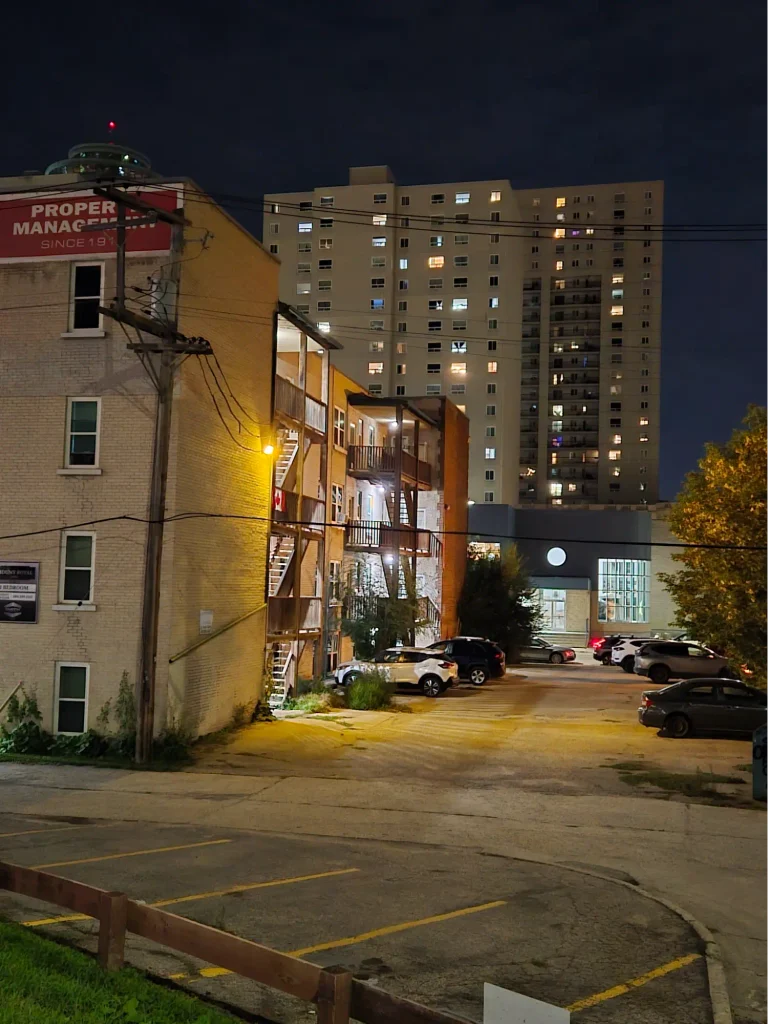
RG: “Death isn’t a scream / it’s the silence after the music stops…” What is your relationship with mortality?
TN: I’ve thought about death for a long time. I don’t think you can write honestly about life without eventually writing about death. They’re not opposites. Death is part of life from the beginning. As you get older, mortality becomes less abstract. People you knew disappear. Places disappear. Parts of your own life disappear. You realize that the past isn’t somewhere behind you that you can simply visit whenever you want. It’s gone.
But I don’t want Poems and Photographs to be understood as a book about death in a purely bleak sense. It’s a book of hope, a celebration of being alive. If anything, thinking about mortality makes life, and the book, more vivid, more alive, more in tune. A photograph matters because the moment is gone. A song matters because it ends. A person matters because they aren’t going to be here forever. The silence after the music stops is part of the music.
RG: Another theme you cover is that of addiction, whether that be drugs like fentanyl or drink, sex, art, music, hope or misery. All can be addictive given the right circumstance. How do you approach addiction in the collection?
TN: I don’t think addiction is limited to drugs. Obviously drugs and alcohol can destroy people, and fentanyl in particular has devastated communities. They can also be liberating and enjoyable, to the right mind, the right person, But I was interested in the broader idea of addiction – the things we use to escape ourselves, or the things we pursue even when we know they’re hurting us. People can become addicted to love. To sex. To misery. To ambition. To nostalgia. To art. To music. Even to hope, which is the best addiction of all. Sometimes misery can become familiar enough that a person doesn’t know what they would be without it. Artists aren’t immune to that. You can become addicted to creating, to the attention, to the chaos around creating, even to failure. I don’t approach addiction from the standpoint of judging people. I’m interested in what it does to people and why we keep returning to things that aren’t necessarily good for us. We’re complicated creatures, and ultimately, whatever gets you through the night, is alright with me.
RG: What is the role of art to you personally?
TN: I have dedicated my entire adult life to making art, publishing it, putting it out into the world. Art is how I make sense of things. That’s probably the simplest answer.
I don’t make art because I think I’m going to explain the world. I make it because I don’t understand the world completely. Writing lets me examine things. Photography lets me look at them. Music lets me feel them. Sometimes one form gets at something that another form can’t. I also think art should be allowed to be strange. It doesn’t always have to have a lesson. Sometimes a poem is just supposed to make you feel something. Sometimes a photograph should make you stop for a second. Sometimes a song should kick you in the head. And art doesn’t have to be respectable, as a matter of fact it shouldn’t be. That has always been important to me.
RG: Your involvement with Screamin’ Skull Press goes back a long way. For the uninitiated, please explain the history and ethos of the press.
TN: Screamin’ Skull Press was born in 1994 when I put out my first book, a 50-page chapbook of stories and poems. The name of the press came out of rebellion or came out of a need to scream out at the mess we have made of things. I ran it by myself writing and self-publishing many books, until Nicole joined in 2008 and became co-owner, co-editor, co-publisher, co-everything, and writer of her own books. Nicole and I shared the idea that we wanted to put our work into the world without waiting for somebody else to tell us that we were allowed to. We’re both writers, and Nicole is also a painter, and I am also a musician, an active one. Over the years we’ve both created a lot of work separately, while publishing together – novels, poetry, short stories, spoken word, art and music. The press became a natural extension of us, who we are, not just what we do. The name probably tells you something about the attitude. We’re not particularly interested in behaving like a conventional publishing house. First of all, we only publish our own work. The ethos is basically: make the work and get it out there.
We’re not trying to imitate the mainstream publishing industry. We don’t have any interest in sanding all the rough edges off our work so it becomes easier to market.
Screamin’ Skull is independent in the real sense of the word. It’s Nicole and it’s me. That’s all. It’s essentially a little underground operation run by two people who continue to make things because we want to, or perhaps because we have to.
RG: What has been your experience as an underground press publisher and writer? Has your view of the indie literature scene changed during your time associated with it?
TN: It’s been a mixed experience. The good thing about being independent is the freedom. You can write what you want, publish what you want, design things the way you want and experiment. The difficult part is that you’re doing almost everything yourself.
You’re the writer, publisher, editor, promoter, publicist and sometimes the person standing in the corner of the room wondering why nobody has bought the book yet.
There is also still a stigma around self-publishing, although I think that’s changing. People sometimes assume that if something is independently published, it must be inferior. That’s nonsense. There is brilliant independent work and terrible traditionally published work, just as there is brilliant traditionally published work and terrible self-published work. I would say the traditionally published work is the worse of the two, broadly speaking.
The internet has made it possible for independent writers to reach readers directly, which is a huge change. But it has also created an enormous amount of noise. Everybody is publishing something, everybody is promoting something, and getting somebody to actually stop and look can be difficult. But I’d rather have the freedom, at whatever price. I’d rather struggle to get our work noticed than have somebody else tell us what our work should be.
RG: Looking back on Poems and Photographs now, how do you feel about the collection? Has anything surprised you about its release?
TN: It’s been going much better than expected. After all, who reads poetry these days?
There are some books, while you are writing them, you think – this is good, maybe not my best, but it is good and I will release it. Then there are other books where you realize about halfway through that you are writing something special. I knew that Poems and Photographs was something on another level, I could see it on the page, I could feel it. I read an enormous amount of literature, and I knew that this was something special.
What surprised me most is how differently people can respond to the same poem or photograph. Something I might have thought was a small piece of the book can mean something very personal to another person. That’s one of the great things about putting art into the world. Once it leaves you, you don’t control what it becomes.
The combination of poetry and photography has also made me think differently about both forms. I don’t see them as simply illustrations of one another. They can contradict one another, add another layer, or create an entirely different feeling when they’re placed together. And I’m happy that the book is rooted in Winnipeg and New York. Those places are part of my history, and they’re part of the way I see the world. I don’t know what the book will ultimately mean to other people. But I know what it means to me. It’s a record of looking. And, in the end, that’s probably what most of my work is about.
Tony Nesca was born in Torino, Italy in 1965 and moved to Canada at the age of three. He was raised in Winnipeg but relocated back to Italy several times until finally settling in Winnipeg in 1980. He taught himself how to play guitar and formed an original rock band playing the local bars for several years. At the age of twenty-seven he traded his guitar for a Commodore 64 and started writing seriously. He has published six chapbooks of stories and poems (which he used to sell straight out of his knapsack at local dives and bookstores), seven novels, seven books of poetry and/or stories, a spoken word album, and has been an active contributor to the underground lit scene for twenty plus years, being published in innumerable magazines both online and in print.
Rebecca Gransden lives on an island. She is published at Burning House Press, Expat Press, Bruiser, Hawkeye, and BULL, among others. Her books include Figures Crossing the Field Towards the Group (Tangerine Press) and The Undead Shepherdess and Further Cavities with Sean Kilpatrick (Pig Roast Publishing).