
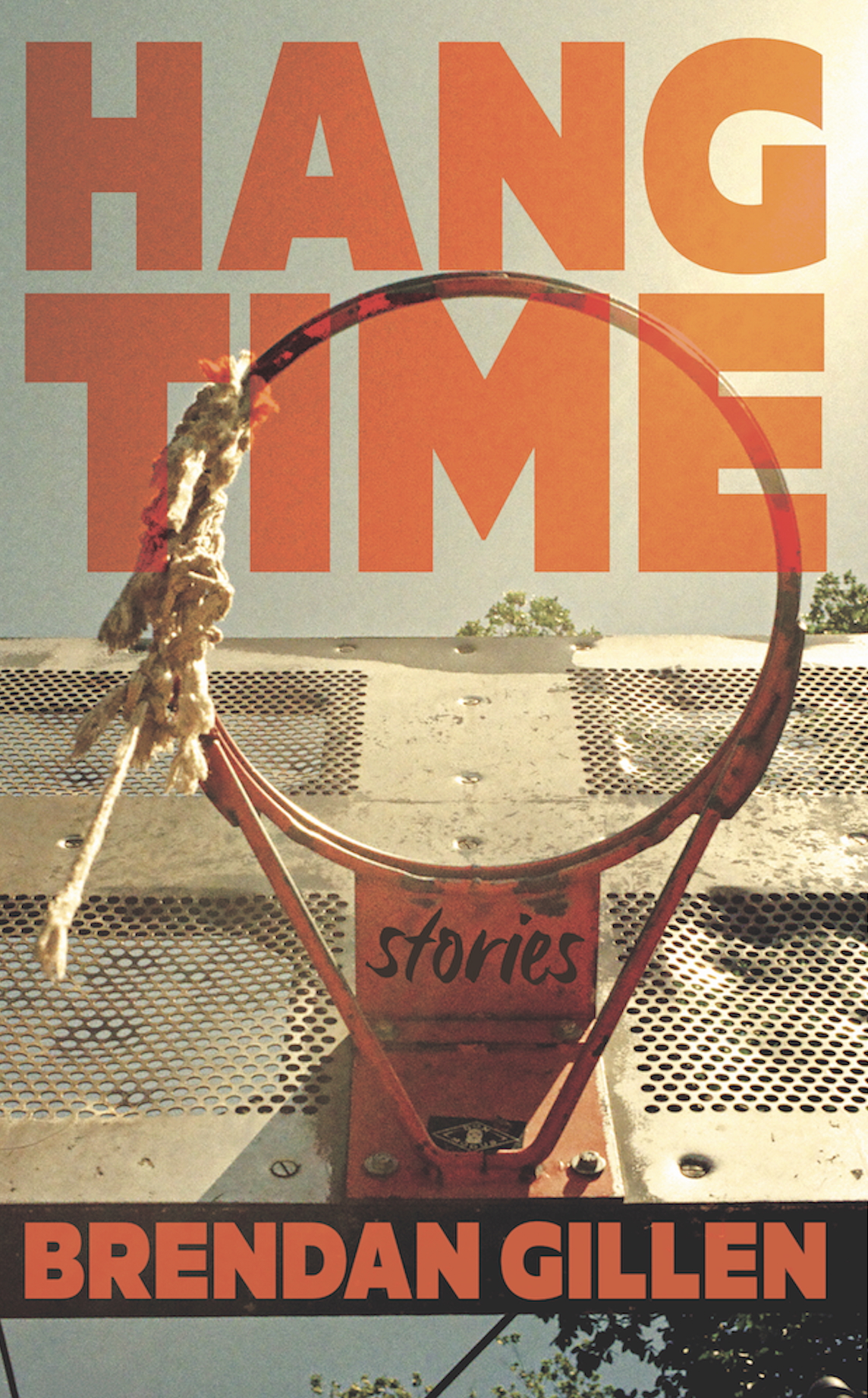
 I can’t listen to music while I write. Even as I sit here writing about the music that either inspired, or is directly referenced in the stories that make up Hang Time, my new collection out now via .406 Press, the only sounds I hear are the gurgle of my own stomach, the scratch of pencil on paper, and the hurl and rush of afternoon traffic on the Brooklyn Queens Expressway outside my window.
I’ve DJ’d and collected records for over twenty-five years. I still read Pitchfork every morning, for better or worse. I’m always on the hunt for sounds—new, old, doesn’t matter—a song that might crack open the day, crack open my life.
And yet, when I write, it’s a distraction, like two competing radio frequencies clashing in a scramble. So maybe that’s why music so often winds its way into my stories. Even in the quiet, it’s never far from reach. A tether and a north star.
The songs below form part of the constellation that holds together the stories in Hang Time, even if some of them are invisible in the text itself. From outsider folk to new age, yearning songs about Jesus to battle raps with the Antichrist, they’re as disparate as it gets, just the way I like it.
Judee Sill – “Jesus Was a Cross Maker”
I’ve struggled with bouts of insomnia throughout my adult life. I wish I could romanticize it. The bleary hours in the dead of night, a pocket of stillness and quiet, time that I have all to myself. Time for creative germination. But nah. It’s almost never like that. Instead, it looks like hours of tossing and turning, vicious rumination and self-recrimination and obsessive thought patterns and Please, for fuck’s sake would my brain just SHUT UP so I can get some goddamn sleep.
“A bandit and a heartbreaker,” that’s what insomnia is. And it’s a phrase I’d never heard before listening to Judee Sill’s “Jesus Was a Cross Maker.” The opening piece of Hang Time, “Headhunter,” infuses my battles with insomnia into a baseball player’s at-bat as he stares down a flamethrower on the mound—and Judee’s song provides the walk-up music, the soundtrack to the lonely journey from dugout to batter’s box.
There’s a mellifluous drone to Judee’s voice, an idiosyncratic sweetness. A strangeness that probably kept her off the charts and cemented her legacy as a beloved cult artist. But knowing what I know of her short, tragic life—if you haven’t seen Lost Angel: The Genius of Judee Sill, a fantastic documentary about her life and career, I highly recommend it—the hard-won hopefulness is what makes her music so intoxicating. That even when we haven’t slept in a week, when shadows corner our vision and sleeplessness becomes an impossible quicksand, dawn is never far away.
Ricky Nelson – “Lonesome Town”
Rickey Nelson Henley Henderson. Born on Christmas Day in the back of an Oldsmobile. The best leadoff hitter who ever lived. A brash, slick-talking speedster, the likes of which Major League Baseball will never see again. When Rickey Henderson passed away last year, five days shy of his 66th birthday, it hit me much harder than I expected. Maybe because he was my favorite player when I was a boy. Maybe because he was asthmatic—cruelly ironic for a man known for his legendary speed—and died of complications from pneumonia, an illness that seems like it should not be lethal in the 21st century. Maybe because all of this meant I was getting older too.
I only recently learned that Rickey was named after singer/actor/heartthrob Ricky Nelson. A fact I found oddly charming. Rickey: a badass baseball player. Ricky: a square, straightlaced crooner.
In “Rickey Henderson Sits by a Lake,” I imagine the evening he might have had after he famously broke Lou Brock’s record for most stolen bases in the history of the game. In an on-field ceremony that day, Rickey declared, “Today, I am the greatest of all time,” words that would come to haunt him, words (mostly white) critics and journalists would use against him. Worlds that, even if he’d earned them, he later claimed to regret.
I could imagine Rickey listening to “Lonesome Town,” a somber, haunting tune by his namesake, all alone on what should have been the greatest night of his life. Not because he wanted to be alone, but because when you’re the fastest man alive, no one can ever catch up.
Townes Van Zandt – “I’ll Be Here in the Morning”
In many ways, Townes Van Zandt is a patron saint for lonely men. Hard-drinking, hard-drugging, capable of emotional truth and vulnerability only when it came in the form of a song. The characters in his songs are fragile, on the verge of breaking, much like the father and son we encounter in “An Empty Ballfield is a Pocket of Peace.” This story centers an eleven-year-old boy named Dustin, who arrives early at his Little League field to get away from home, where his mother numbs herself with drink in the wake of the drowning death of Dustin’s infant brother. Dustin’s father shows up unannounced after baseball practice, damaged and with dubious plans to reunite the family. This is all Dustin wants in the world. Or so he thinks.
Of course, Dustin’s dad doesn’t really have much of a plan beyond driving around in his old Blazer, listening to the Townes, John Prine and Lee Hazlewood tapes that rattle around in the center console. Deep down, Dustin knows there is no plan, that his family will never be whole again. As Townes sings, “There is nothin’ that’s as real / As a love that’s in my mind.” But Dustin lets himself hope, at least for a little while.
Soon he’ll learn to identify the space between hope and the truth, and that this is what it means to grow up.
Dirge-like and slow. Haunting. Sounds like it was recorded inside of a mammoth Richard Serra sculpture. Or in the belly of a cavernous, groaning barge. Or in the tunnel of a concrete arena. Right before, say, a monster truck rally.
Frankly, I don’t know what led me down the path of “They Played Enya at the Monster Truck Rally,” one of my favorite stories in Hang Time, other than the fact that “Boadicea” is the perfect soundtrack for slow-motion catastrophe. Whether it’s the twisted metal climax of one of our culture’s strangest and most absurd sporting traditions, or the slow dissolution of a romantic relationship, as in the case of the young couple at the center of the story.
I discovered this tune in the mid-90s by way of “Ready or Not” by the Fugees, one of the many hip hop songs that has brilliantly re-interpolated Enya’s music. But these days I find myself more frequently listening to the source material.
Close the blinds, dim the lights, crank this tune, and prepare for the worst.
“Get At Me Dog” arrived like a bomb in 1997. I can still picture the music video as though seeing it for the first time: monochrome, blown out black and white footage of a raucous bandbox concert, the assault of blinding strobe-lights daring you to look away, and DMX commanding the stage shirtless, as though the championship belt of New York hip hop had always, and would always, belong to him.
In 1998, DMX put out two #1, platinum-selling albums in the span of seven months. “Get At Me Dog” was the first single and the bellwether for what was to come. But “Damien,” from It’s Dark and Hell Is Hot, was the song that really grabbed my attention. In it, DMX asks for a guardian angel to help guide him through right and wrong. Instead? He gets Damien. The Antichrist. Son of Satan. Super chill!
DMX’s music rides the razor thin duality between spirituality and violence. At times the struggle seemed to tear him apart, in both life and in the recording studio. Prayer—beseeching and desperate—finds its way into his records and his live shows. Clips of 100,000 festival goers struck dumb by the force and conviction of DMX praying onstage are worth tracking down.
And so “Damien” struck me as the perfect tune to soundtrack a scene in “Man Up”, the longest and last story in the collection, which focuses on a star college basketball player navigating trauma and tragedy and insomnia as he careens toward a future as either a millionaire NBA player, or a broken man. The specific scene in which the song is mentioned takes place after a game in the protagonist’s teammate’s Tahoe as they hotbox the shit out of it. They’ve just witnessed their beloved coach suffer a heart attack and die on the court. What they don’t know is that they’ll be subject to a piss test in the morning, and it’s how they try to evade suspension that sets in motion a cascade of violence and chaos. I won’t spoil it any further, but the scene is indicative of what interests me as a writer…moments of in-between, the “hang time” as it were, right before transformation happens: the collapse of a relationship, a game-winning jumpshot, or the unexpected placement of a potential lover’s hand on your own, a gesture of love and companionship and promise. It’s in these moments that our lives exist if we’re willing to slow down and notice them.
You can check out the full book playlist HERE. And I’d be grateful if you check out Hang Time on .406 Press! Even if you’re not a sports fan, there’s plenty to dig into: belly flop contests, surfing, monster truck rallies, Scottish Fold cats, that one time Randy Johnson exploded a bird mid-flight with a fastball, rollercoaster vomiting, dystopian Miami gun range bachelorette parties, plus: anxiety.
Thanks to X-R-A-Y for the support!