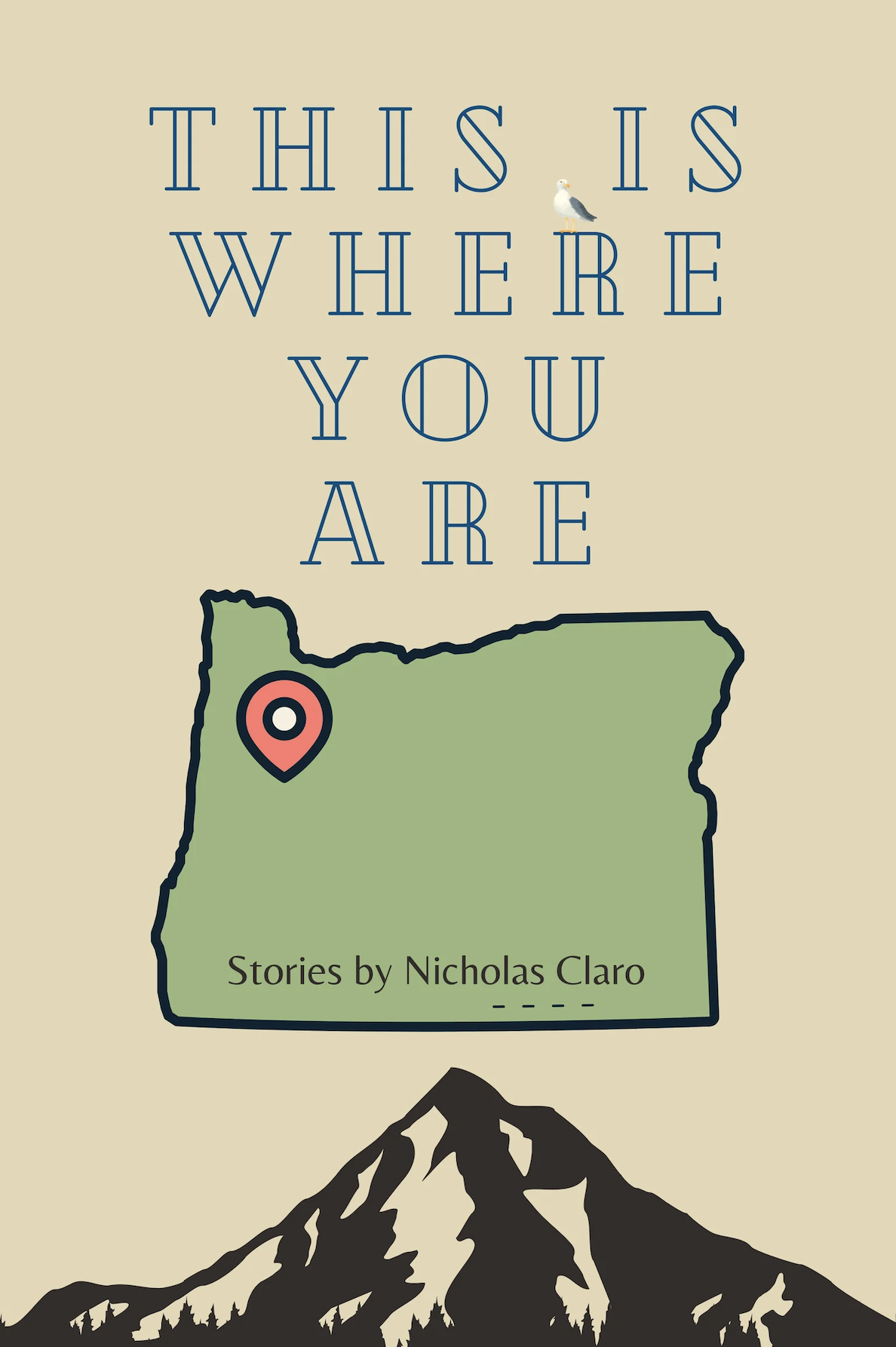
 Catastrophe—often in the form of an accident, illness, or injury—is either witnessed or implied throughout the stories of Nicholas Claro’s debut collection, This Is Where You Are (Roadside Press, 2025). His characters tend to sound even keel, despite it all.
Claro’s dialogue, in its spare and restrained expressions, strikes a delicate balance that reveals how traumatic events ripple through our daily conversations and actions. Instead of slipping into melodrama, his characters seem to wonder what they are supposed to say to each other in the wake of grief or violence, what they are supposed to eat. I found myself lingering on such moments, like when the narrator of “The Blow,” while visiting his comatose father in the hospital, describes the sensation of eating a burger as “chewing on a mouthguard,” or when Sam, a woman steeped in years of grief in the opening story “The Current,” walks silently on the coast with her husband, finding solace in the cold, smooth surface of a rock inside her jacket.
Of the fifteen stories of This Is Where You Are, which was published by Roadside Press this past August, nine originally appeared in literary magazines. Nic and I met back in 2017, in Fayetteville, Arkansas, where I’d often run into him reading or drafting at Puritan, a local coffee shop. He has remained one of the most diligent, committed, and generous writers I know. It was a pleasure to read some of these stories again, in their final form, and especially to encounter them so thoughtfully linked by linguistic bridges as well as the spirit of W.H. Auden’s ploughman, both things we discuss in the interview below.
Anna Vilner: How did you arrive at the mood or theme of catastrophe? And what were the challenges, whether in narration or dialogue, of writing characters who are witnesses to it?
Nicholas Claro: Honestly, in small ways, I am constantly thinking about catastrophe, so I guess it’s only natural that it comes out in terms of mood and theme in many, if not all, of my stories. I think that’s because in real life, tragedy is all around us—every moment of every day—but usually it isn’t as dramatic as we see on television or in movies or video games. And when it’s our own, it’s personal. It’s internally dramatic. Usually what is seen from the outside a lot of the time appears to be nothing out of the ordinary. It’s business as usual, even mundane. The world keeps spinning. It’s like that Auden poem,”Musée des Beaux Arts.” For Icarus, it’s the worst and last day of his life. But for the ploughman, it’s no biggie. And that big, delicate ship? It continues on with its course. I’m always keeping this in mind when I write this stuff—the ploughman, the ship. So, for me, one of the interesting challenges when writing stories with characters who are suffering a great deal is figuring out a way to have them acknowledge their grief, but to do so with a controlled restraint regarding the way they process and navigate it, rather than allow them to break down and become hysterical, which is a natural response to tragedy, but I think is a far less interesting one, in fiction, anyway.
AV: That Auden poem is such a fitting reference. The last stanza, or a few lines of it, would have made for an excellent epigraph to your collection. I thought a lot about Raymond Carver’s stories as well while reading your work. It inspired me to return to “A Small, Good Thing,” because Carver pulls off this balancing act we’re talking about so effortlessly, tragedy and loss told through restraint. What were you reading or watching while writing and revising portions of this book? Which authors do you feel inform it?
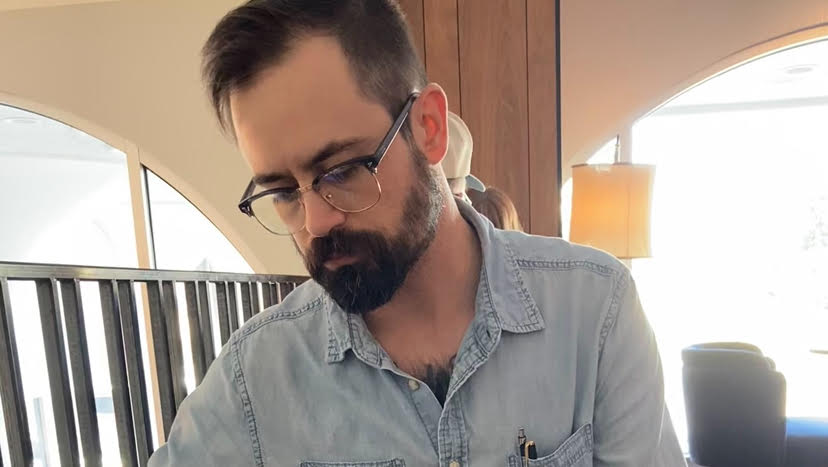 NC: You’re so right about the lines from the Auden poem making for a good epigraph. I’ll have to keep that in mind. As for what I was reading while writing and revising this book—I almost always have my nose in something by Ann Beattie. Once, sometimes twice, a month, I revisit two of her stories in particular: “Where You’ll Find Me” and “The Big-Breasted Pilgrim. I was certainly reading a lot of her other work while crafting the stories in the book, as well. Along with Beattie, I read American Estrangement and Brief Encounters with the Enemy by Saïd Sayrafiezadeh, who, in my opinion, is right up there with the best of them. And during final revisions, I was totally absorbed in Tehrangeles by Porochista Khakpour and Who is Rich? by Matthew Klam. Speaking of Matthew Klam, his short fiction is always a constant source of inspiration. I don’t know anyone who can so seamlessly balance humor and severity like he can.
AV: Another preoccupation of the contemporary fiction writer, I imagine, is how to represent technology. The world of these stories feels like ours in its presence of phones and social media, which is constantly alerting us to tragedy, political violence, natural disaster. On the one hand, this is desensitizing. One of your narrators, for example, wonders if his partner’s face is contorted because she’s absorbed in a video on her phone, “ASMR, maybe.” And then on the other hand—and we see this at the end of the same story—this leads to a binding, shared language among us, a sort of shorthand. Can you speak a little bit to this technological aspect of your stories and how you went about representing it, as well as any problems you encountered during the process?
NC: I make the conscious decision to include some sort of technological aspect in my stories simply because cellphones and social media are—for better and worse—a huge part of our everyday lives. So, why wouldn’t they be for my characters? I think of it this way: it’s rare to meet someone who doesn’t own a cellphone, unless they are a small child, so I think, on some level, if I don’t mention Instagram, a text message, a missed FaceTime call, or whatever, there’s a sliver of authenticity with regard to setting missing from my stories. I suppose one thing I’ve struggled with, and still do, is how much of this should go into a story, and how to recognize when it’s become more of a distraction (like in real life) than a necessary element regarding era and how we as contemporary citizens deliver and receive news, information, and correspondence.
AV: The story I mentioned in my previous question, “So Far,” felt powerful not only because of its brevity and shift from first to second person, but also because of its placement. The final line, which suddenly implicates the reader, really lands for me because you have already established the tone of your collection by this point in the book. How did you go about ordering the stories?
NC: When I first started to think about ordering the stories, I didn’t really have much of an idea of what I was doing. All I knew for sure is I wanted to start with “The Current,” since I thought it would set the tone for the entire book. After that, I got to thinking: Well, what piece fits best next to this one? and mimicked this process. I realized about halfway through that I’d clumped together some shorter pieces in the beginning of the book. Namely “Trajectory,” which is 256 words and “What Would You Say?” which is just shy of 500 words, but I liked them where they were. “So Far” is the shortest piece, at 205 words, and I thought placing it after the longest story in the collection would balance out the structure of the entire book and serve as a small bridge to yet another, longer story, which is written in the second person. And they are connected by the second-person pronoun, too. The last word in “So Far” is “you” and the first word in the following story “Boil the Ocean” is also “you.”
AV: As a reader, I really appreciate things like this, linguistic bridges and other moves toward transition or cohesion. The repeated “you,” is something I might notice after the first read, when I begin to pay closer attention to the shapes and details of things. Since we’ve both now touched on the shorter stories of the book, I’m curious about your past and current relationship to flash fiction. Is this a form you are continuing to explore in your writing?
NC: I used to write a lot of flash fiction when I was in grad school, where I met my friend Robert Warf, who is an absolute wizard when it comes to the form. But I don’t dabble too much in it any longer. I love reading flash and respect it so much, and admire that a successful flash story functions in the same way as a great poem—how it is this compact machine with many moving parts that all work harmoniously together. I think they’re beautiful. But, if I’m going to be honest, I struggle a lot whenever I sit down and try to write flash stories of my own. I think “Trajectory” took me two months of fine-tuning before I finally stepped away from it, and that was with a lot of advice and edits from Rob. I’m working on some longer-form pieces at the moment, but maybe after I finish a few, I’ll sit down and try my hand at something brief, just to switch things up.