
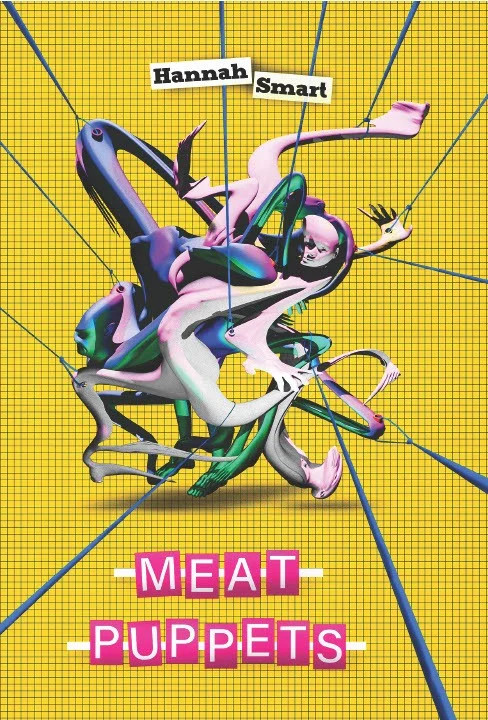
 Hannah Smart’s debut novel Meat Puppets (Apocalypse Confidential, 2026) is a metafictional romp through the lives of people who know they want more without being entirely sure of what they want more of. Weaving her way through drug-use, acting seminars, and a celebrity-based stock exchange where people can put up real money in the hopes of cashing in on the soon-to-be-famous (or-not), Smart crafts characters whose lack of self-transparency makes them as relatable as they are complicated, as charming as they are repulsive, and as touching as they are fantastic—then she puts them through the wringer.
Like all great works of experimental fiction, Meat Puppets’ formal fireworks are neither unnecessary varnish nor the sole raison d’etre of the work. Instead, her innovations elevate the literary whole. By touching on a vast array of cultural vices, Smart weaves a tale that’s topical without forcing itself to stay “on topic.” Intimate dialogues between lovers stand juxtaposed next to fighting clowns and guns named after literary figures. The result is a book that earns its right to take you for a ride.
I sat down with Smart over the phone to ask her about the book, her process, and what she thinks fiction can do for us today.
Ben Gross: I want to start with something Adorno said about philosophy and poetry: “All attempts to comprehend the writings of philosophers as poetry have missed their truth content.” What he meant, I take it, is that philosophy is concerned with the truth, in getting at what he called “the real as a binding nexus of concepts.” Like a lot of great novels, your book sits somewhere in between philosophy and poetry. It’s also interested in a similar problem: the collision between telling a good story and telling the truth. Where does that come from in your writing, and why is examining the relationship between fiction and truth important to you as a novelist?
Hannah Smart: Well, first of all, I think if you write any kind of metafiction that’s always going to be a question that comes up, because traditionally the role of fiction was to suspend the reader’s disbelief—to get them to buy it, essentially. And metafiction is sort of saying, “No, I don’t want to suspend your disbelief, I want you to be aware that this is a story.” One of the criticisms people have had of that is that it ruins the capacity for emotion toward the characters, or the capacity to really immerse yourself in the story. When I was developing Meat Puppets, I was watching a lot of this show called Nathan for You, which—for those who are unfamiliar—is about this guy who goes to business owners and offers them insane ideas for improving their business. Like, the very first one is this ice cream shop that’s struggling, and he proposes that they offer poop ice cream as a flavor, and they do it, and people buy it. It’s just a hysterical show. But the more I watched, the more I started to wonder how much of it was actually real. There seemed to be clues that maybe some of it was fake or embellished. And eventually I got so paranoid that I started watching with this eye toward: “okay, this is all fake, everyone’s actors.” And I realized it became less funny and less enjoyable. And I wondered why that was. I kind of wanted to play with that question in Meat Puppets: to what extent does a good story rely on people assuming that it’s true?
BG: I’m interested in your relationship to acting—a lot of Meat Puppets deals with acting, with the truth in acting, with whether there’s something more truthful in being an actor. Do you have any experience with acting, or with public performance more generally, that you brought to the book?
 HS: Yeah. I was in drama as a kid—in eighth grade I was in Annie, as one of the orphans with no lines. And I did debate and stuff in high school, which isn’t really acting, but it is a kind of public performance. But I feel like my main experience with acting is just the day-to-day stuff—pretending to enjoy conversations that aren’t interesting to me, pretending to like people I don’t like, pretending to be happy at work or in class when there are a million other things I’d rather be doing. That’s kind of what inspired the book: this feeling of, “oh, I’m acting all the time—and I wonder how many other people feel that way.” That’s why in Meat Puppets, the people who are acting aren’t just the actors. It’s also Mitch and Hayley and—well, I won’t say more, I don’t want to spoil it. But there is this perpetual feeling that everyone is acting.
BG: On the subject of acting as yourself, there is a version of yourself in the book. The use of your own persona as a character in a novel isn’t new—writers like Karl Ove Knausgård or David Foster Wallace, who I know has been a huge influence on you, are classic examples of it. What made you want to use that in this book? What about that technique spoke to you in this story?
HS: I don’t consider Meat Puppets to be autofiction, because I think fundamentally it’s not a book about myself. But the insertion of myself happened kind of naturally, because I was thinking about fiction and the parallels between fiction and acting—the suspension of disbelief that’s required in both. And I thought, “you know, the writer is sort of a puppeteer: the writer of fiction is controlling everything, manipulating everyone.” And it’s very much a story about manipulation—the characters are manipulating each other in all sorts of ways. And I thought, “well, I’m actually manipulating all of them, so what if I consciously inserted myself into the book and made myself a part of this whole puppet show?” Bringing myself into the story wasn’t something I initially intended, but I’m ultimately glad I went that direction, because I think it does add another layer to what’s going on.
BG: That’s great, and I think that distinction between autofiction and what you’re doing is really useful. It’s so fascinating that it wasn’t originally part of the plan. How did that work in terms of your writing process? What was writing those parts like compared to writing about the other characters in the book?
HS: I realized I wanted to put myself into the book after writing Part 1. So I added the preface, and I went through and rewrote Part 1 so that it reads through a kind of secret first person, as opposed to a basic limited third person. The parts that were explicitly about me—where I’m in the first person as the main character—were way, way harder to write. I wrote them dead last, once I’d finished everything else. When I’d hit one of those sections I’d think, “okay, I’m going to skip this for now.” Which I think was the right move, because it allowed me to put in some meta elements that described the book as a whole.
But there was a real difference in writing someone who was me—or supposed to be me—versus writing someone else, particularly someone like Mitch or Syd, who are a bit evil. There’s a lot less concern about how they come off. I know readers aren’t going to like them as people. Whereas I kind of did want readers to like me as a person—but I also didn’t want to come off as a suck-up, or a saint, or a Mary Sue. And there’s always this consciousness in my head that people might read Meat Puppets and project my narratorial self onto me, the author.
BG: What about that voice in your head changed the way you write?
HS: I think a big part of it is that the process of creating fiction is very difficult for people who don’t do it to understand. I’ll often write something and my mom will read it and say, “Is this character me?” And I’ll say, well, no—no character is you. I’m not going to just put you into the book. But it might have this element I got from you, and this other element I got from someone else, and this other element I got from somewhere else. There is just this impulse in people to want to guess who a character was in real life. And it’s like: if it’s fiction, it’s not real life. And I am implicated a little bit in the shenanigans of the book, so that’s maybe part of my fear as well.
BG: The plot of the book is driven by these characters’ urges to financialize things, to speculate, to predict—in a word, to gamble. In the past few years, online gambling has exploded in the United States. When you set out to write this work, did you know that you wanted to write about gambling? How did that come about?
HS: I knew I wanted to write about finance, because my dad’s a big finance guy, so it’s something I’ve always had a cursory understanding of—stock markets and such. But I suppose when you dramatize finance in any way where things go wrong, it kind of ends up being about gambling, because it’s people risking money they shouldn’t be risking. When I started writing this book in early 2023, the Polymarket stuff was still in its infancy—I definitely hadn’t heard of it. So it was a happy accident that it’s blown up so much since. I mean, I don’t know about happy, since people’s lives are being ruined, but in terms of the book and how I hope it’ll be seen, it was nice to be ahead of the curve on that.
BG: Meat Puppets is an extremely funny book. There are a lot of great gags, and they really are gags—clowns, one-liners, that kind of thing. But other parts of the book are extremely sad, and the topics—addiction, dislocated love and lust, familial loss—are extremely serious. In a book that’s trying to cover both of those poles, what made you want to land so hard on the comedy? What did you think the comedy was doing?
HS: Maybe this is the Wallace influence you mentioned earlier, but I’ve always been of the opinion that humor can be found in everything, even in extremely grave matters—and that humor can improve everything. Even if you’re writing about something extremely dark, if it’s done in the right way, making it funny can just add another layer of emotion. I also really like being able to manipulate readers’ emotions, which is one of the best parts of writing fiction. I think one of the easiest ways to do that is by making them laugh at something that’s kind of grave or serious. And then making them feel bad for laughing because of the content. I tried to put in moments where people will laugh at things they don’t typically feel comfortable laughing about, because it’s literature, and I think the goal of literature should be to make people feel emotions, or combinations of emotions, that they’ve never felt before.
BG: Okay, one more philosophical question. Meat Puppets deals extensively with an antinomy or a paradox in the structure of conversation—that is, conversations are both essentially many-sided and essentially one-sided. They can’t be had alone, but they’re also necessarily had alone, insofar as our partner in a conversation isn’t exactly the other person we’re talking to, but the version of that person we have in our heads. Why did conversation and its difficulties, maybe its impossibilities, become such an important focus for you in writing Meat Puppets?
HS: I think it mostly came from my own difficulties maintaining conversations in real life. Oftentimes I feel like I lapse into monologuing when I’m supposed to be dialoguing. And other times I struggle to come off the right way—sometimes I’ll come off as rude when I’m not supposed to. I mean, when are you ever supposed to come off as rude? But you know what I mean.
I really tried to put some of these struggles into Meat Puppets, and I think they fit naturally with the themes of acting, because when you’re being fake in a conversation, you are in a sense acting. And fiction allows you access to everyone’s mind, if you want it. So I used that power to characterize a world in which everyone is dealing with these sorts of struggles—and it’s not just that you are acting while everyone else is being their authentic self; it’s that everyone is acting, and nobody’s really engaging in good faith, and conversation is maybe a bit meaningless. But I hope the book also makes clear that love is still real—if that’s not too cheesy to say. People still have feelings and inner lives and emotions; it’s just that for some reason we find it hard to share those authentically with others.
BG: Say more about what the experience of hoping to get something across and failing is like, and how it relates to your work.
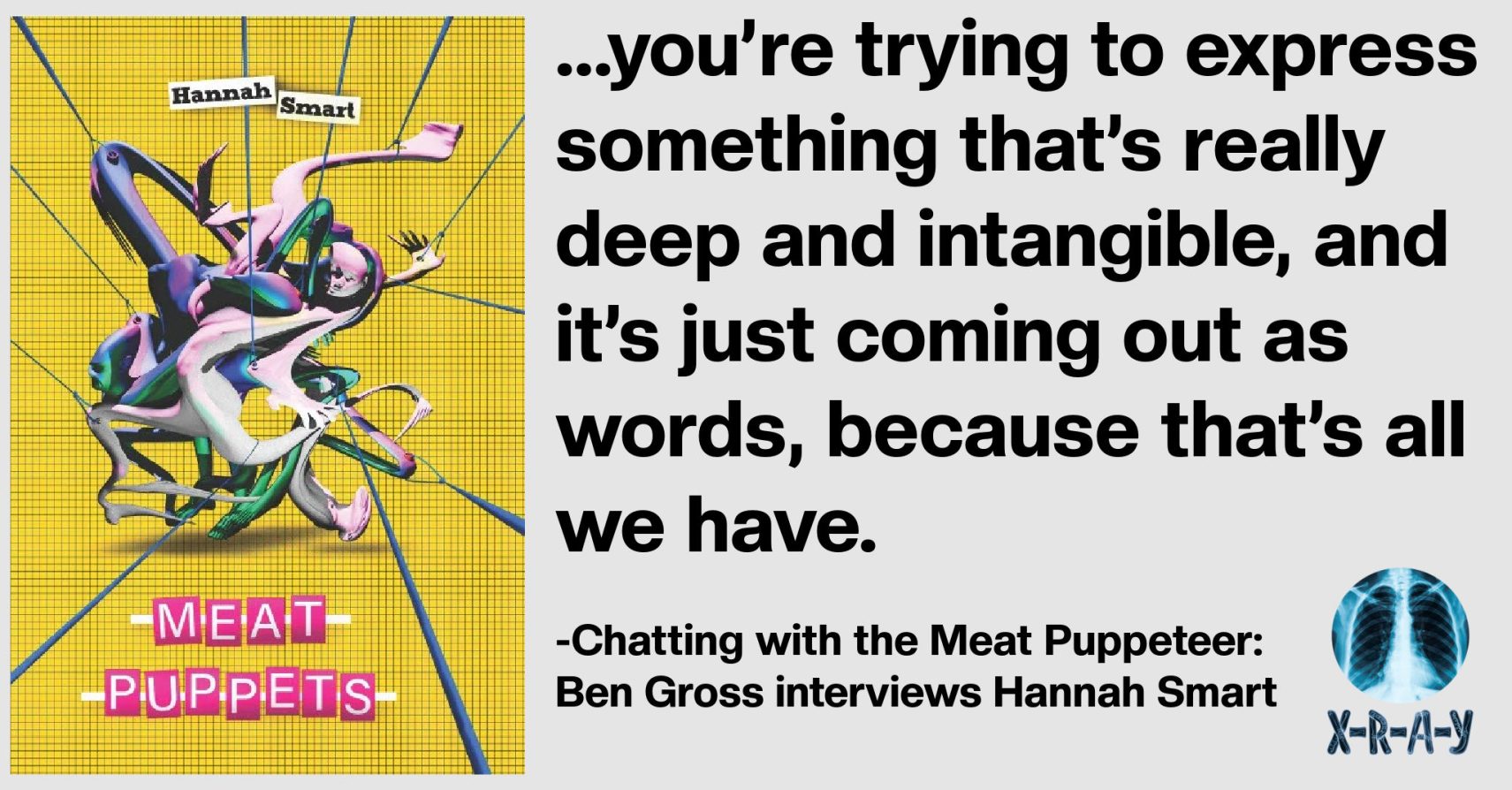
HS: Language is a very crude and limiting means of communication. It can communicate so much, but at the same time it doesn’t communicate everything, ever. There’s this David Foster Wallace quote—“How odd that I can have all this inside me, but to you it’s just words”—and I think that’s kind of what it feels like: you’re trying to express something that’s really deep and intangible, and it’s just coming out as words, because that’s all we have. Obviously that relates to the book, because a book is composed solely of words. But I think one of the magical things about literature is that if you have enough words in the right orders, eventually it does seem to transcend the “just words” feeling and become something more. And so I hope my book does that.
BG: Given that complicated, paradoxical nature of conversation, I thought I would give you an opportunity to ask yourself a question you wish you had been asked.
HS: Hm. I think I’d ask “How does Meat Puppets factor into the current socio-political moment?” And I think that—beyond the Polymarket stuff, the gambling—there is just a desperation in the culture right now, where people are looking for anything to blame their financial ills on. I think it’s easy to see how something like Mitch’s plan for getting rich in Meat Puppets—which is utterly ridiculous—might seem appealing in a time of desperation. But I think it’s important that we band together as a community and a culture and not cave in to this pressure to do something extreme—like start an underground gambling ring.
BG: Last question: what’s next for you?
HS: I’ve got another novel that I’m querying right now. And I’m also in the early stages of developing a critical book on David Foster Wallace that attempts to read his work through the lens of his biography. I’m also editing this zine called Emergency, which features fiction, essays, poetry, and art, and sort of attempts to speak to the emergency we all find ourselves in right now—and that will be out June 4th.