Samuel Peters Brown—a stereotypically thin dude with disheveled hair and that beard-with-no-mustache combination of the late-1800’s—was a descendant of the Mayflower and what you might call “uber successful.”
But it wasn’t his severe look that got him places. It was a history in ship-building and time in the House of Representatives for the state of Maine that led to his appointment from President Lincoln as Navy Agent in Washington D.C. And it was through Mr. Brown, millions of dollars’ worth of ships, guns, and naval war materials were purchased during the Civil War.
He founded a town in his lifetime. Started a boatload of businesses. Probably caught gonorrhea. Basically, boss shit.
Also typical of his time was his choice to sire nearly a million kids. Only about fifty-percent lived back then, so why not? Those who made it, upon seeing their father’s wildly successful life and imagining the trajectory of their own, thought: Don’t screw this up.
One of those kids was Frank.
Frank Mason Brown had big ideas. Building a railroad connecting the coalfields of Colorado to the Pacific Ocean by way of the Grand Canyon—to be named, ingeniously, the Denver, Colorado Canyon and Pacific Railroad Company—was one of them.
But he didn’t stop with ideas. He raised money. Big money. Fifty-million dollars, to be exact. That sort of cash back then is equivalent to $1.7 billion in 2026.
Wow.
Go Frank.
Probably a railroad can go through the Grand Canyon, he thought, but we better check. So, he hired a team of surveyors.
Being a posh kid from Maine, Brown had never paddled a river, but his dad was in the fucking Navy. So, of course he would lead the expedition. Robert Brewster Stanton, a prominent railroad and mining engineer from Mississippi, was Brown’s choice as right-hand-man. Stanton also hadn’t navigated anything remotely like the Colorado in a boat. But his home state shared a name with a big river, so whatever.
On May 25, 1889, the sixteen-man and six-boat crew departed. And by early-July, they had reached Marble Canyon from the Green River where they’d begun. (Marble Canyon is where all river trips, post-construction of the Glen Canyon Dam, now start.)
Shortly after 9am on the morning of July 10, the boat carrying Brown flipped just below the mouth of Salt Water Wash at the head of Soap Creek Rapids. Unfortunately, and against the advice of some idiot named John Wesley Powell, Frank hadn’t bought life-preservers when he ordered supplies, so members of the expedition looked on helplessly as he bobbed up and down. He looked like a ragdoll caught in one of the river’s hydraulics.
Peter Hansbrough, leading the boat behind Brown’s, feverishly paddled toward the hole where he was struggling. Once there, he discovered Frank had dropped below the river’s surface for the last time.
Nothing aside from his diary was ever found.
Disembarking at a nearby eddy, Hansbrough clawed his way to the canyon wall. And grabbing a rock, began inscribing upon the black, varnished stone what he’d witnessed.
The most demanding impulse he had, having witnessed his friend die, was to write it all down.
***
Everyone in Alaska from the early-aughts to the two-thousand-teens knew, or knew of, Brian Ashman. They might not recognize the name, because almost everybody called him “Sleepy.” He was the type of living legend who rarely gets publicity. But in an economy utterly crashed, Sleepy chose a lane that not only dodged an era’s pitfalls, it floated above them.
He lived nowhere. So, he pretty much lived everywhere. On somebody’s floor. In a rock “house” constructed on a gravel bar in the middle of a river. Or, inside his car, a 1986 Volvo Station Wagon literally and figuratively held together by duct tape.
He didn’t get his nickname ironically. You’d find he’d nodded off sometime while you were talking and only realize picking your hat off the ground after a F-16 from Eielson Airforce Base knocked it off doing a low flyover.
Sleepy didn’t own a lot of clothes, because he didn’t have a closet. So, he often sported a blue onesie with an American flag he’d stitched on the back. On his head, covering his long blond hair, sat a badger pelt smushed to roughly resemble a hat. And around his neck was a necklace woven from sinew, at the bottom of which hung a leather pouch specifically sized to house a Bic lighter.
I know what you’re thinking. Sleepy wasn’t a bum, though. And not only was he self-sufficient, he was thriving. Unlike everybody nowadays that lives in their car, he didn’t bankroll homelessness from his parents’ checking account. He coined a lifestyle that resulted in his Volvo racking up almost a million miles, most of which were passing through National Parks, or alongside hot springs, or briefly pausing at festivals where twenty-something girls waited in various stages of undress.
As a result, more and more people started to look, act, and dress like Sleepy. The Cult of Sleepy, we called it. Everyone wanted to know how they could have everything, simply doing nothing.
But Sleepy took his fame in stride. In fact, he didn’t seem to notice. Walking around with the enlightened smile of a guru, even saying things like, “Life is long, if you give it away,” and “Well, here we are,” and after someone said something particularly negative, “They don’t believe in Santa Claus.”
He could out-hike anybody despite the beers he drank minutes before. I saw him catch and process twenty salmon in two hours off Kalifornsky Beach before saying, “I gotta get outta here, this place is depressing me.” And once, witnessed him play the mandolin while shitting outside in a snowstorm.
The only things Sleepy couldn’t stand were sadness and depression. I had the sense he was keenly aware what they could do to him, if he let them. Back then, I used to smile a lot, so I was someone whose company he enjoyed. And my most lasting memory came after we’d known each other for years.
At the time, I was a writer. But hadn’t had anything published. And just like today, thought of myself as a failure. In a moment of camaraderie, I told Sleepy I liked to write. And that one day, I hoped people would read something I’d woven from the fabric connecting my mind to my life.
“Oh, yea?” he said. “I used to think I wanted to be a writer. But then I realized I didn’t actually like writers that much. So, I decided I’d be a character instead.”
***
Until the 1940’s, when penicillin was finally developed into usable medicine, Staphylococcus aureus, a Staph infection, was more or less a death sentence. It killed eighty-percent of people who got it, which is pretty good.
Today, one-third of the population is asymptomatically colonized by S. aureus. And for these people, risk of infection is greatly increased. I learned, losing tug-of-war in the 8th grade, where the floor of my Physical Ed class was coarse, dirty carpet, that I was one of the lucky thirty-percent.
Over the next forty-eight hours, the rugburn on my elbow changed character. It spewed a thick mucus that resembled a mixture of sugar and water. It throbbed. I thought perhaps a gremlin would birth directly from it.
I was scared. I wanted to get better. But I also despised the cleaning regimen my mom enforced, because I was a kid who had barely graduated to brushing my teeth instead of simply saying that I had.
A part of me marveled at it, though. How the thing, so unlike all of the other injuries I sustained as a boy in the ‘90’s, didn’t miraculously and instantaneously heal. That is, until I started antibiotics. Where, after three days of refusing to do anything but ooze, the wound not only closed, it didn’t even leave a scar.
Go Science.
Born fifty years earlier, I probably would’ve died in the 8th grade. It wouldn’t be the only time I should have been killed by the bacterium known as Staphylococcus aureus.
Not even close.
It’s a long story. But I’ll start by saying, “Don’t be a banana farmer in Hawaii.”
***
LaVan Martineau was born in Kanab, Utah on January 3, 1932. And because his parents had a lifelong habit of alcoholism, he became orphaned while a teenager.
Life got so bad, when Edrick Bushhead, a one-armed Paiute man who had no steady job and lived in a wheelless sheep wagon, told LaVan he could share the eight-by-twelve-foot space with him, if he wanted, it was too good an offer to pass up.
Martineau soon got adopted into the Paiute Tribe. And, luckily, unlike “civilized” peoples, Paiutes don’t abandon orphans. So, he became a cousin and son and nephew to dozens of wonderful folks.
He learned their songs and traditional dances. Married a woman from the Tribe. And, showing a real knack for language, became fluent in their tongue.
Go LaVan.
In 1951, he became an Air Traffic Controller in the Airforce. And was eventually sent to Korea and made a supervisor.
If you’re unfamiliar with government work, the higher in the ranks you ascend, the less work you do. So, LaVan found himself with loads of free time. Because of his interest in language, he’d often wander to his neighbors’ corner of the wall tent, where the Airforce’s Cryptanalysis Department was stationed. These people spoke in, and broke, all kinds of codes for the Intelligence Branch of the military.
His time with cryptographers in Korea was just the beginning of what would become a forty-year obsession with codebreaking. So, in November of 1959, when LaVan returned to life amongst the Paiutes, he naturally became interested in learning their sign language.
It was a babble fest in North America before Europeans began killing everyone. And amongst many Europeans’ written accounts, are instances where two or more tribes, learning they couldn’t understand a word of what the others were saying, began communicating in a sign language which—despite some regional nuance—seemed universally understood.
In an a-ha moment, Martineau realized the petroglyphs and pictographs he’d loved so much as a kid might not be “art,” like many people assumed, but a written language based off the movements of the sign language he’d become fluent in.
And, if true, Native rock writing would be the first example of written language in the world. Almost three-times as old as Sumerian cuneiform, still considered the oldest by some stuffy Caucasian archaeologists today.
***
Imagining what it must have been like to move through a landscape before maps is a love of mine. So, I often travel without one. Using intuition. A hunch on the wind. And it’s almost always this sort of motion that affords me run-ins with archaeology.
Where options are limited—because of cliffs, canyons, or whatever—two-legged travel, no matter how far back in history you go, ends up circling the same paths.
Often, while pausing to catch my breath after finding a particularly sexy break through the cliff bands, I’ll be smacked in the face by a symphony of movements carved into a cliff. I don’t understand the meaning behind the images—ladder-like figures, faces with an “O” for a mouth, geometric humanoids resembling a DMT trip—but the implications are simple and profound.
Someone, using the same combination of muscle, mind, and determination, discovered this place before me.
And they wrote it down.
***
Semantics is a philosophical subfield of linguistics. Studying the meaning embedded in language. Metasemantics, on the other hand, studies the foundation of that meaning. Or, to put it simply, it uncovers the meaning of meaning.
As often as people try capturing their every whim in a photo, it’s easy to assume meaning is as common as taxes. But, if you stop to measure how often these people look at photos after they’ve taken them, the criteria for meaningfulness gets complicated.
It seems for an event or object to hold meaning, it needs longevity. But, if that was all it took, plastic would damn near be the most meaningful thing on earth.
As I get older, I find myself replaying the same mental tapes on repeat. Interestingly, of the approximately twenty-one-million minutes I’ve lived as a forty-year-old person, only a handful seem to have mattered.
And it’s rarely the ones you’d think.
Of the small number of these on-loop tapes in my head, one captures a short hike I did in Alaska. One where, I was thinking through something. Trying to make a big decision. Trying not to screw up. And, having fasted for twenty-four hours, I knew I shouldn’t go on a real milage spree. So, I took a bus to the Toklat River. And I walked back over the bridge we’d just crossed and into the foothills opposite the bus stop.
I was going where intuition was taking me.
Coming off a hill and into a drainage, I paused. Holding perfectly still, I squinted, then relaxed my eyes. I did this over and over.
On the other side of the wash was a lynx-like log. Or a log-like lynx. I couldn’t tell.
By this time, I’d been staring at it for close to a minute, unwilling to allow myself to believe a log was in fact a living animal, yet unable to accept this object, which hadn’t moved, was undoubtedly a log.
Giving up, I took a step. And it turned its head.
My initial inclination was to grab my camera. After all, I was ten feet from one of the most elusive animals in Alaska. Reaching toward my pocket, I moved in slow motion.
Or tried to. I was also attempting my first silent meltdown. Because none of my pictures were coming out as anything but a smear of light. How was I going to prove to anyone, myself included, this happened, if I wasn’t able to cause jealousy in all my friends by showing them pictures later?
I finally sat down. And placed my camera on a rock. And looked at this beautiful work of sinew and fur and muscle. And it looked at me. Each of us like that for five minutes or more. I would glance away occasionally. To a cloud drifting past. Or busses arriving in the distance and their passengers shuffling on an off, kicking rocks alongside the river and wishing they could see something, anything of meaning, on this vacation they’d spent so much on.
Then it stood. And stretched like all cats do. And vanished over a hillock.
I was glued there. Feeling like something had left me. But that something else, in its shape, yet somehow different, had crawled not permanently into my memory, but directly into my DNA.
***
If a person offers you a job farming bananas, and you have a blinding hangover, think long and hard before answering.
I didn’t. And see where it got me.
I hadn’t come to Hawaii thinking of carrying a machete, battling spiders and snakes, all to carry a sixty-pound bundle of fruit through knee-high mud. I hadn’t even brought boots. Standing there in my board shorts, sandals, and a “Don’t hassle me, I’m local,” t-shirt, all I thought when I said yes was probably banana farmers were the type of people interesting things happened to.
And this is how a man with no socks becomes a farmer.
Amazingly, nothing near-fatal happened the first couple months. I lost almost forty pounds working sun-up-to-sun-down, six-days-a-week, eating a mostly vegan diet. Developed blonde-tipped hair and a six-pack for the first (and only) time in my life. And accepted a shady ride through the jungle with a stranger that allowed me to buy the worst weed I’ve ever smoked, through a beer can, no less.
Yep, life was good.
Until one day, when the fabled over-three-hundred-inches-of-annual-rain everybody warned me about arrived in full force.
When two inches of rain falls per hour, it’s hard to see your own hand, let alone fell trees with an eighteen-inch knife. But that’s what I was doing. Then attempting to transport those hard-earned fruits through mud as thick as concrete and slick as sex lube. My wheelbarrow was not what I would call “working.”
After ten hours of this shit, I got home and kicked off the boots I’d been borrowing since employment and noticed a quarter-sized portion of red skin on my ankle. A hotspot. An “injury” fellow banana farmers would call a “boo-boo” if I showed any of them.
So, instead of heading directly to the shower and scrubbing the spot furiously with soap and a rag, instead, I figured, I’ve basically been taking a shower for the last ten hours. Why would I want to go back in the water?
I ate my unsatisfying dinner and went to bed. After all, more of the same labor would be blessing us in just a few hours.
And, as soon as I woke up, I knew something was wrong.
***
In 2022, I’d just moved to southern-Utah, a place called Kanab. And I signed up to attend a lecture series on the Paiutes native to the region. Each lecturer focused on a specific topic. But a lot ended up talking about petroglyphs and pictographs.
Which was fine by me. I was extremely fascinated by the topic. And, being a newbie, was anxious to learn what I could.
Autumn Gillard was the final speaker. And the first whose skin wasn’t white, white, white. She’s a Southern Paiute. And, at the time, was young. But her persona filled the room. It felt timeless.
Stepping behind the mic, the first thing she said was, “No offense, but you people have no idea what you’re talking about.”
Wow.
Go Autumn.
I smiled. And picked up my pen for the first time all night.
“I kept silent as you came up here and called the writings of my people “rock art.” How would you feel, if I walked into your home, pointed at the Bible on your shelf and said, “That’s interesting art?” Petroglyphs and pictographs are knowledge. They’re stories. And not just the writings, the places themselves, are sacred.”
Having just spent an hour scrounging up my notebook, the only note I took that night was this: “What makes writing sacred?”
***
In his magnificent essay collection, “Happiness Ruined Everything,” Michael Klein writes, “If the poetic line is a kind of fragment, poems at their most essential happen with an understanding of how these fragments lean into what consciousness sounds like.”
I had a conversation with Michael, recently. I was interested in what he had to say about this line. And another, where he talks about how, when writing, the subject emerges as if by accident. The writer becomes a slave being drug around wherever the writing wants to go.
I asked, “If writing is mostly revision, and if revision is exactly as the word suggests, seeing differently, and if our job as writers is the get out of the way, to disappear, what is the thing we are getting out of the way of?”
Like so many writers I’ve spoken with, Michael said he feels like he’s channeling something. Others liken it to translation. I myself described it once as tuning in, as if there is a radio station out there with all the answers.
But Michael said something else. He said, “What’s important, is one thing leads to another.” And I realized in that moment his description was perfect. It is channeling. It’s just our vision of that word is fucked up.
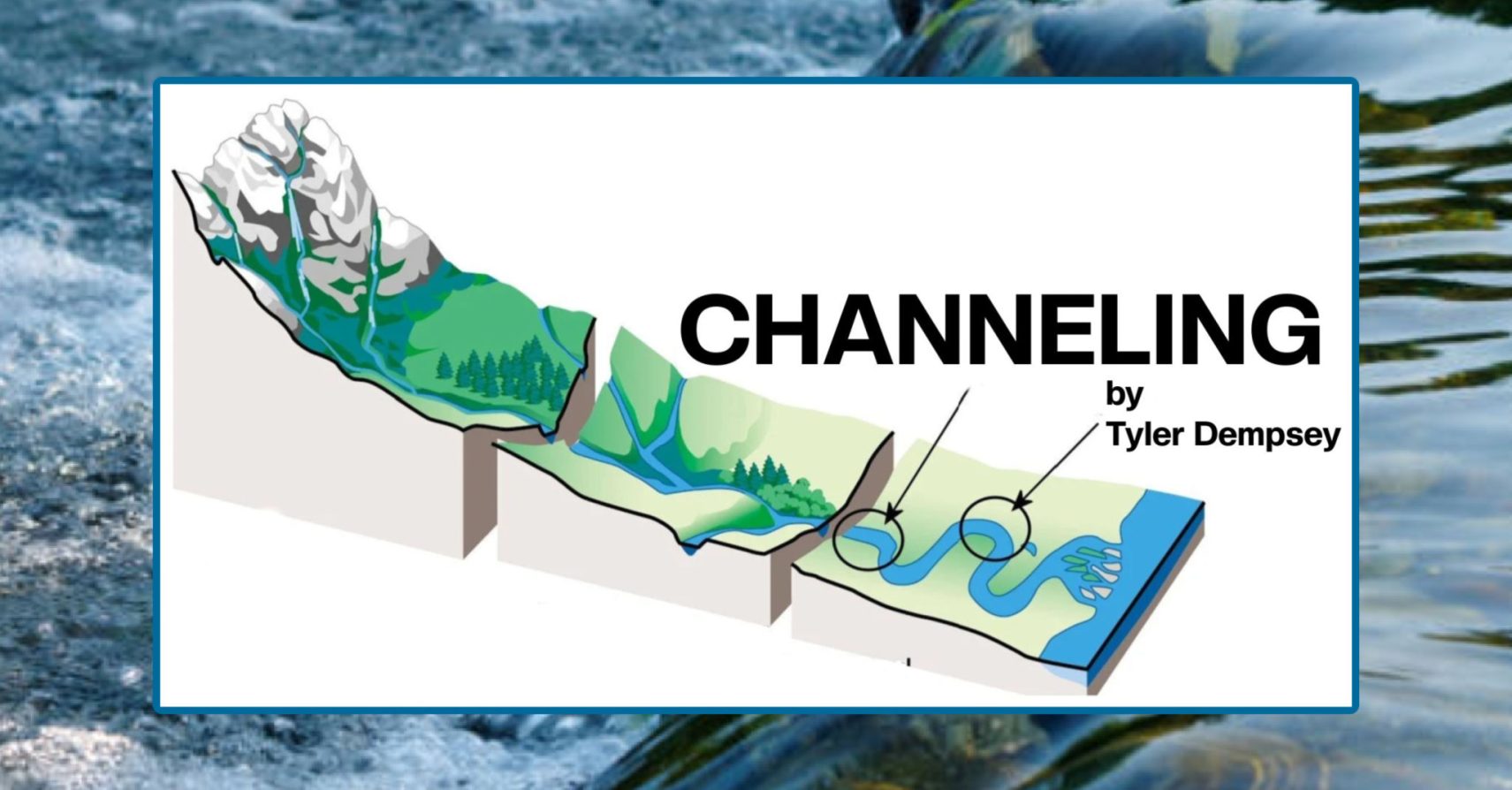
When you hear “channeling,” you picture something passing through. There’s a message, and we, the Artist, are conduits. But I suggest to think about it like water. Like a river.
When a river is cutting through a canyon, finding its channel, it isn’t gentle, like the path of least resistance would lead us to believe. It’s banging into one thing after another. Only after it reaches its conclusion does the path make sense.
Like life. Like consciousness. Like an essay.
***
What surprises me when I stumble on a panel of rock writing is there will often be various stages of weathering apparent. Meaning, someone perhaps three-hundred years ago, of whose life we can’t even imagine, found this wall, and on it, discovered writing by someone whose people had died or moved away four-hundred years prior. Of whose life they couldn’t even imagine.
There are sometimes three or four stages like this. And somewhere, undoubtedly, there will be an inscription. Something like, “Bubba wuz here.” And what’s amazing, is the carving from sixty or seventy years ago, Bubba’s grand message to the world, will be almost completely faded. And some of the ancient writings will look brand new.
LaVan Martineau visited tens of thousands of rock writing sites before he died. He wrote a book. It’s called, “The Rocks Begin to Speak.” And, in it, he deciphers their meaning.
Some talk about wars. What was fought for. What was lost. While others talk about rituals. The actions and ceremonies that gave lives relief or meaning. And some are guideposts. Go here. Don’t go there.
The same shit we write about. They are stories of people banging into one thing after another. Going into the wilderness without a map.
But not alone.
When you approach the unknown and concede control, allow one thing to lead to another, you’re letting consciousness be your guide.
It feels good. Like hearing someone say, “Shhh, I’ve been here before.”
And if you manifest what’s been shown to you, and if it remains true to what consciousness sounds like, it will hold meaning. It will create a whole new way of seeing.
It’ll be sacred.
***
My foot looked like a superhero’s. But one whose power was making their foot giant and grotesque while the other remained normal.
It pulsed. It radiated heat. It hurt.
The other banana farmers didn’t say, “Aww, wook at his wittle boo-boo!” Instead, they said, “Oh, shit.”
I hadn’t imagined coming to Hawaii that my ankle would start spewing mucus that looked like a mixture of sugar and water. I’d only imagined what waves would sound like crashing against beaches made from the ancient lava of volcanoes.
And I hadn’t gotten rich harvesting bananas that were sold at tiny organic markets on the Big Island. So, I used what little money I had left to do the only thing that made sense. I bought a plane ticket home.
Travel is stressful. And, as it turns out, the best thing for a group of bacteria called Staphylococcus aureus, is stress.
They love the stuff. The wound on my ankle loved it so much, it created boils all up and down my leg. And each, in their turn, burst, and began to look like their own mixture of sugar and water.
And after my mom rescued me from the airport and I revealed what my leg had become, she broke down crying. We both did. We cried, because there was pretty much nothing we could do.
Methicillin-resistant Staphylococcus aureus (MRSA) is a type of Staphylococcus aureus that has developed resistance to antibiotics. MRSA spreads through direct skin-to-skin contact or contact with contaminated items. Like a gross boot.
Thirty-to-sixty-percent of staph strains are within this type. And I learned, after going to the hospital and being prescribed and taking antibiotics, I was of the lucky thirty-to-sixty-percent.
I spent many nights wondering, while my leg ached and shooting pain indicated the wound had infiltrated my nervous system and was one step closer to entering my bloodstream, whether I would wake up in the morning.
I wondered if the approximately twelve-million minutes I’d lived, would be all I’d ever get. And which, of all those minutes, had any meaning.
And do you know what turned out, was not only universal to the things I realized had meaning, but also ended up being the response that unlocked my slow healing from Staphylococcus aureus?
It was when I stopped trying to control things. It was those times when events unfolded naturally, when one thing led to another. When I relaxed, and went where the river led me.
It’s been almost two decades since the wounds on my leg healed. And the worst of them still bears a scar. It isn’t fading. It looks like it just happened.
The lesson written onto my leg, an image that to some might appear meaningless, or perhaps like art, is this: let go.