
My cinematic education started pretty early. My mom introduced me to Humphrey Bogart films and my dad to the Marx Brothers and Elvira’s Movie Macabre all before I was a teenager. Later, I would attend Steve Byrd’s Basement School of Cinematic History (that consisted of a solid wall of VHS tapes from floor to ceiling and even laser discs) and John Schloman’s Arthouse Academy (that mostly involved traveling to the Cedar Lee Theatre in Cleveland). During this same time, a number of my friends and I regularly went to The Rocky Horror Picture Show and then started a New Year’s Eve tradition that continues to this day: Bad Movie Night (where each one of us, Steve, John, Scott, Jim, and Jenny, all pick one entertainingly bad film to share and, sure, mock).

Since I was already used to movies being a major part of my life (both for lauding and making fun of), when I found Roger Ebert’s Bigger Little Movie Glossary (1999), which, as the subtitle tells us, is a “Compendium of Movie Clichés, Stereotypes, Obligatory Scenes, Hackneyed Formulas, Shopworn Conventions, and Outdated Archetypes,” it seemed to be written directly for my gang. Like a version of Ambrose Bierce’s The Devil’s Dictionary (1911) or Gustave Flaubert’s Dictionary of Received Ideas (1913) for film, here Ebert lampoons everything from the fact that killers talk too much, that action movies will often end in factories that apparently produce smoke and nothing else, that ghosts never appear until the house is sold, that science fiction laboratories are full of colorful chemicals and steaming beakers (to say nothing about Tesla coils and Jacob’s ladders), that rope and plank bridges only exist to fall apart, and so on. It’s probably not a surprise that I used the Bigger Little Movie Glossary as if it were a collection of writing prompts for my Movies Are Fine for a Bright Boy Like You: Fictions (Whisk(e)y Tit, 2026) because, along with my friends, along with my film professors (Bob West at Kent State and Chuck Maland at Tennessee), Roger Ebert was definitely a big influence on my education in cinema.
I am therefore interested in works of fiction that use cinema, in some way, as part of their style or subject matter…

Gabriel Blackwell’s Madeleine E. (Outpost 19, 2016)
Alfred Hitchcock said that it’s easier to make a good movie from a bad or mediocre book (a paraphrase from his interview with François Truffaut, obviously) than from an excellent book, the idea being the excellent book has already found its true form. I therefore believe that Gabriel Blackwell’s Madeleine E. will never be made into a good movie because this novel is absolutely stellar. Honestly, and I know I’m risking alienating not only my readers, but Gabe himself, I think Blackwell outdoes Hitchcock (cue the throwing of tomatoes). My reasoning is this: there is a split in Hitchcock criticism, some folks saying that Hitchcock is the Master of Suspense, but that is all; while others claim there is a great deal more than just suspense. I tend to agree with the former group, though I’d bet Blackwell agrees with the latter. Since Madeleine E. focuses on Vertigo (1958), a movie about a character (Judy) who pretends to be another character (Madeleine) only later to be asked for very different reasons to play the same role again, you can bet that Blackwell is going to present us with a mind-bending take on identity and performance in his book. But instead of this novel being a kind of murder mystery, it’s a look at how we approach reality, how we access reality. One way to do this is through art. Except art is, of course, highly fictional much of the time. We could then stick with memoir because that’s reality. Except memoir can never contain everything, so how much is lost through the editing process? Okay, then use observations from other people in order to ground your work. Blackwell does that too, employing at times the David Markson style from This Is Not a Novel and The Last Novel, but the dizzying quotes make us wonder who we can trust. Art by itself doesn’t work; memoir (although grounded in reality) doesn’t work; plurality, which can lead to confusion, doesn’t work; and all three Voltroned together doesn’t exactly work either. Yeah, only to me this is Blackwell’s genius: I walk away from Vertigo thinking, “That was a masterful murder mystery imbued with the sadness inherent in romantic relationships,” while I walk away from Madeleine E. wondering why I think I know what I think I know about the world, about other people, about myself.
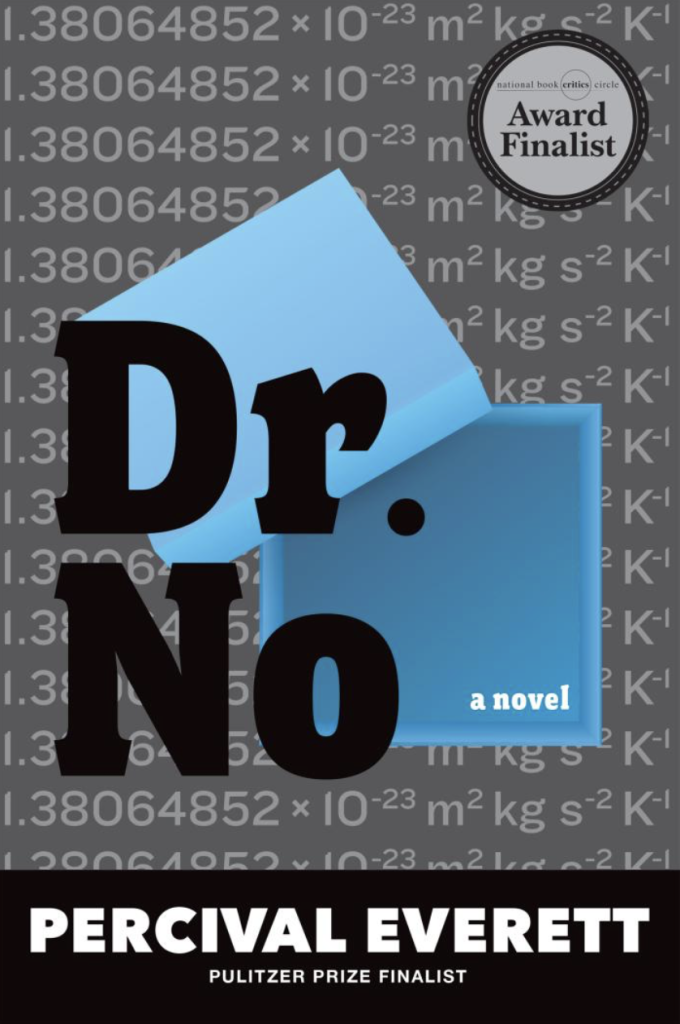
Percival Everett’s Dr. No (Graywolf Press, 2022)
If the title of Percival Everett’s novel seems familiar that’s because it’s also the title of Ian Fleming’s sixth James Bond book and the first Bond film starring Sean Connery. In Everett’s hands, though, the protagonist of Dr. No is the anti-James Bond. He isn’t an action hero. He isn’t a superspy. He isn’t sexy (in fact, when we meet him, our main character has never really dated or had sex at all). He owns an adorable one-legged dog. His name is Wala Kitu, a mathematics professor who specializes in, well, nothing. That doesn’t mean he’s become a slacker. Instead, Professor Kitu knows more than anyone else alive about the concept of nothing. Having an extreme amount of knowledge about a particular topic might sound like a trait an Ian Fleming/Albert R. Broccoli character would have, but Kitu himself explains that it’s pretty much impossible to truly know anything about nothing. Other than being nothing like Bond, James Bond, how does Dr. No end up getting stuck in with the general milieu it’s playing with?
Enter John Sill, a character who understands that he does not live in the world of James Bond, but all the same wants to use his billions of dollars to become an honest to goodness Bond villain. Well, uh, how does he plan on doing that? According to Sill’s research, Fort Knox, contrary to what Auric Goldfinger believes, is not full of gold; it’s full of nothing. Again, as is common in Everett’s Dr. No, that doesn’t mean what you think it means. Instead, Fort Knox contains the I’m going to go with purest physical manifestation of nothing in the world. What does that mean? What could that possibly be? Sill isn’t sure, but he figures Kitu does.
If you find yourself wondering who the Bond girl is in this book, if you find yourself wondering if it could possibly have one, the answer is Eigen Vector, an astrophysicist colleague of Kitu’s who gets, shall we say, caught up in the action (seeing as how she becomes Sill’s henchwoman). What I love about this book, along with its fascinating exploration of the concept of nothing (Everett has taken the Donald Barthelme writing exercise and transformed it into an awe-inspiring work of fiction), is the way it dismantles and reassembles common character types in order to show us that the reason we’re so willing to embrace types and even clichés is because underneath those is, you guessed it, nothing.
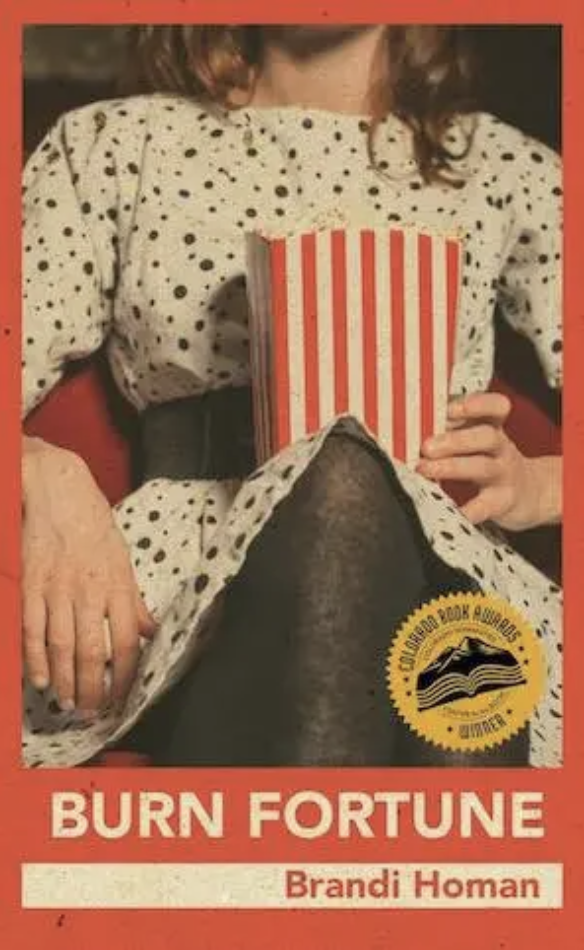
Brandi Homan’s Burn Fortune (CLASH Books, 2019)
I suppose, if you live in a more dramatic landscape, your dreams might be influenced specifically by your environment. If you live in the flyover country, though, the void gives you a vast expanse to dream in, a seemingly limitless horizon to populate. Of course, part of that invented population is inhabited by the cinematic world. But June, the protagonist of Brandi Homan’s Burn Fortune, doesn’t only look west to Hollywood, she also looks east to the French New Wave and specifically to Jean Seberg, the Iowa girl who grew up and starred in Saint Joan and Breathless, amongst other films. And much as Seberg lived a tumultuous life, June does too. Sure, at first, it seems like everything’s normal, the kind of normal that makes us think our main character will go through the time-honored tradition of hating where she’s from and fantasizing about living a different life, either culminating in the acceptance of, in this case, Iowa, or the rejection of it and the expected lighting out for the territories. After all, at the beginning of Burn Fortune, June is a teenager with a boyfriend she plans on running away with. But after her high school hangs Jean Seberg movie posters in the auditorium celebrating the native daughter, June begins to change. She no longer sees herself in the smooth roles society expects of her, but instead in the thorny ones Seberg took on. This artistic awakening does not protect her from the hazards of life, since much as Seberg had the horrors descend upon her, so does June. After her horrific experience, she dismisses her old self and leans into her interest in Seberg. What I love about this coming of age novel, then, is the way film (like all art) can transform us, can help break us out of the tired formulae if we are willing to let it.
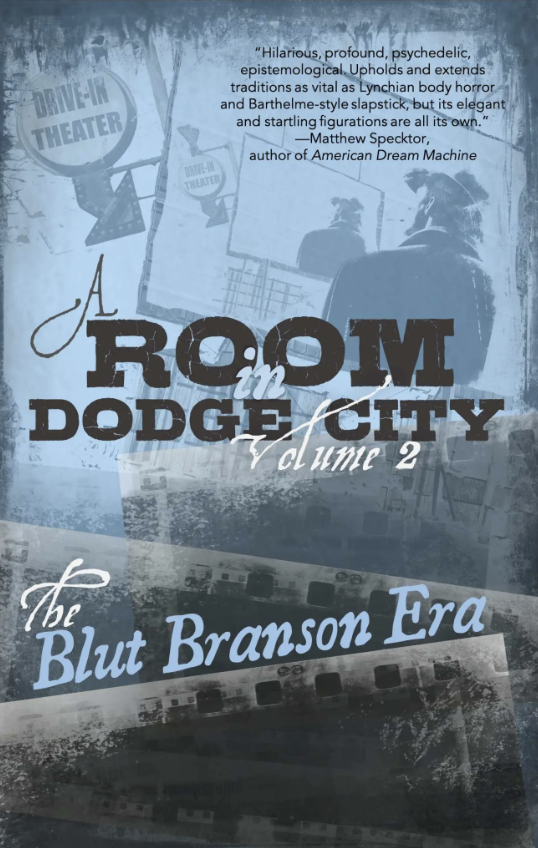
David Leo Rice’s A Room In Dodge City 2: The Blut Branson Era (Alternating Current Press, 2021)
In a manner of speaking, I grew up in the shadow of Jim Jarmusch. He was a freshman in high school in Cuyahoga Falls, Ohio, when my mom was a senior; he was a senior when my aunt and uncle were freshmen. This proximity always made me feel as if I were almost touched by one of the great ones, as if I were almost one of the great ones myself (or perhaps soon to take up the mantle of Jim Jarmusch). And after I learned who he was during my first year at Kent State University, I made sure to include him in with my list of famous people from Northeast Ohio, but always with a tinge of worriment that I might never become as good as him.
I mention my inner experience with Jarmusch because, in a far more colossal way, Blut Branson hovers over David Leo Rice’s fictional Dodge City (meaning, you know, not the one in Kansas), obliterating the hopes and dreams of anyone else because no matter what someone in Dodge City might invent, it was likely already created by Branson, or would immediately be denigrated by the Branson Industrial Complex (which operates an entire tourism industry based on the filmmaker, including a host of Original Birthplace of Blut Branson house museums). After all, it was Blut Branson who committed suicide and, immediately after his demise, directed his next film! Now, in Dodge City, all anyone can hope for is the chance to be inhabited by Branson for a while.
Here, David Leo Rice once again shows he’s the rightful heir to the tradition set by two other Davids: Cronenberg (who is so important to DC2, he seems to be the avatar of some underworld god) and Lynch (pay special attention to what may be the most terrifying art installation ever). But along with the exploration of hero worship and artistic originality, much to my absolute joy, Rice makes this satire of the filmic world absolutely hilarious. Darkly hilarious? Well, sure. For Rice, there’s no other kind.
Andrew Farkas is the author of seven books: The Great Indoorsman: Essays (University of Nebraska Press), The Big Red Herring (KERNPUNKT Press), Sunsphere: Stories (BlazeVOX Books), Self-Titled Debut: Stories (Subito Press), Are You Now or Have You Ever Been: Stories (Alternating Current Press), Movies Are Fine for a Bright Boy Like You: Fictions (Whiskey Tit Books), and The Ancient Mysteries of Las Vegas: a Play (KERNPUNKT Press). He is also an Associate Professor of Creative Writing at Washburn University and an editor for Always Crashing. He can be found at https://thegreatindoorsman.org/